


Turkish President Recep Tayyip Erdogan on Friday ordered another ancient Orthodox church that became a mosque and then a popular Istanbul museum to be turned back into a place of Muslim worship.
The decision to transform the Kariye Museum into a mosque came just a month after a similarly controversial conversion for the Unesco World Heritage-recognised Hagia Sophia.
Both changes reflect Mr Erdogan's efforts to galvanise his more conservative and nationalist supporters at a time when Turkey is suffering a new spell of inflation and economic uncertainty caused by the coronavirus.
But they have added to Turkey's tensions with Greece and its Orthodox Church.
The Greek foreign ministry called the decision "yet another provocation against religious persons everywhere" by the Turkish government.
The 1,000-year-old building's history closely mirrors that of the Hagia Sophia – its bigger neighbour on the historic western bank of the Golden Horn estuary on the European side of Istanbul.
-
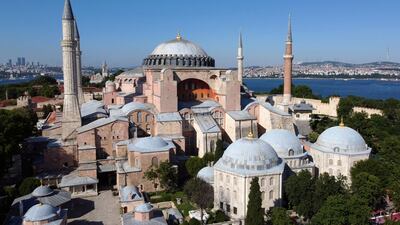
Hagia Sophia, a Unesco World Heritage Site in Istanbul. Turkey’s top administrative court revoked the 1,500-year-old former cathedral’s status as a museum. Reuters -
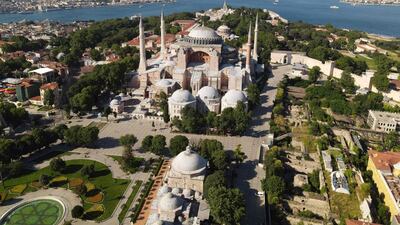
Hagia Sophia museum in Istanbul. Turkey’s top administrative court announced its decision to revoke the 1,500-year-old former cathedral’s status as a museum. AFP -
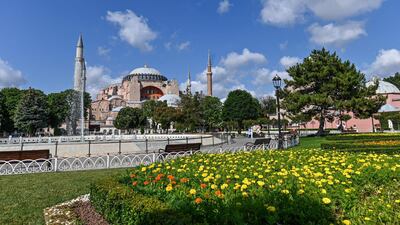
Hagia Sophia museum in Istanbul. Turkey’s top administrative court announced its decision to revoke the 1,500-year-old former cathedral’s status as a museum. AFP -
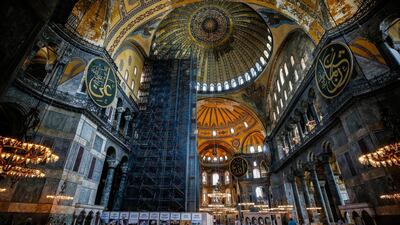
People visit the Byzantine-era Hagia Sophia, one of Istanbul's main tourist attractions. Turkey’s top administrative courtannounced its decision to revoke the 1,500-year-old former cathedral’s status as a museum. AP Photo -
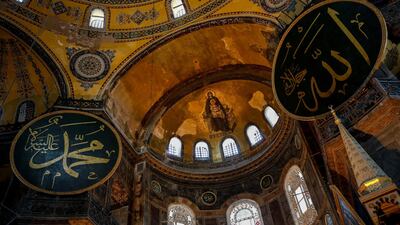
A view of the Byzantine-era Hagia Sophia, one of Istanbul's main tourist attractions. Turkey’s top administrative court announced its decision to revoke the 1,500-year-old former cathedral’s status as a museum. AP Photo -
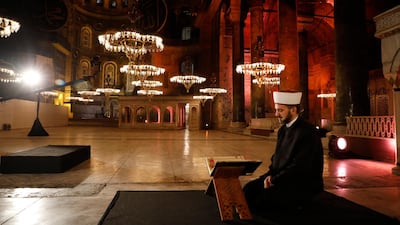
An imam recites the Quran inside Istanbul's 6th-century Hagia Sophia museum. Turkey’s top administrative court announced its decision to revoke the 1,500-year-old former cathedral’s status as a museum. AP Photo -
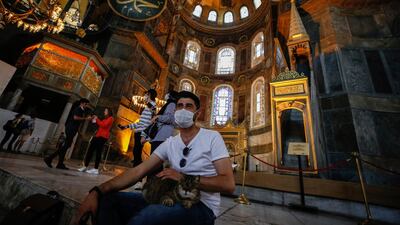
People visit the Byzantine-era Hagia Sophia, one of Istanbul's main tourist attractions. Turkey’s top administrative court announced its decision to revoke the 1,500-year-old former cathedral’s status as a museum. AP Photo -
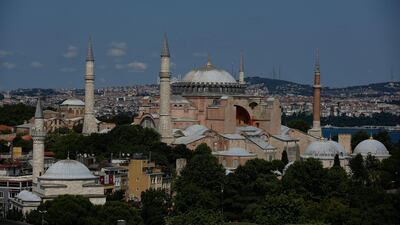
An aerial view of the Byzantine-era Hagia Sophia, one of Istanbul's main tourist attractions. Turkey’s top administrative court announced its decision to revoke the 1,500-year-old former cathedral’s status as a museum. AP Photo -

People walk by the Byzantine-era Hagia Sophia, one of Istanbul's main tourist attractions, in March 2017. Turkey’s top administrative court announced its decision to revoke the 1,500-year-old former cathedral’s status as a museum. AP Photo -
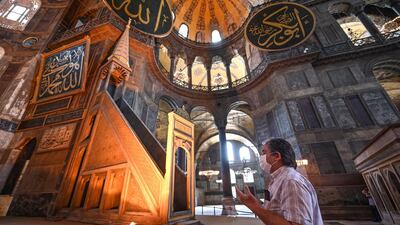
A Turkish visitor prays in Hagia Sophia museum in Istanbul. Turkey’s top administrative court announced its decision to revoke the 1,500-year-old former cathedral’s status as a museum. AFP -

A Turkish visitor prays in front of the Apsis, facing the eastern direction of Hagia Sophia, in Istanbul. Turkey’s top administrative court on Friday announced its decision to revoke the 1,500-year-old former cathedral’s status as a museum. AFP -
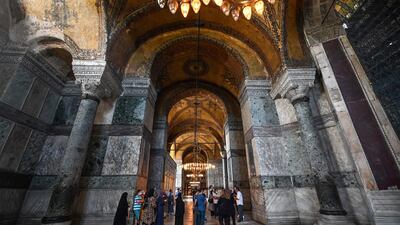
People visit Hagia Sophia museum in Istanbul. Turkey’s top administrative court announced its decision to revoke the 1,500-year-old former cathedral’s status as a museum. AFP -
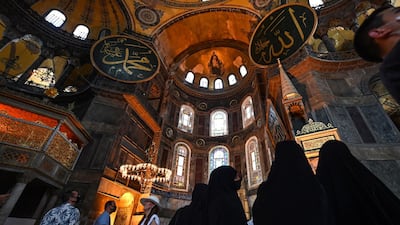
People visit Hagia Sophia museum in Istanbul. Turkey’s top administrative court announced its decision to revoke the 1,500-year-old former cathedral’s status as a museum. AFP -
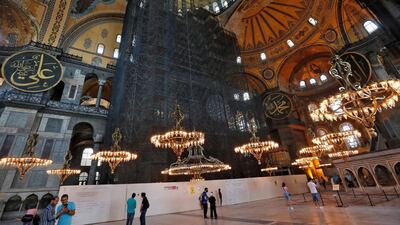
People visit Hagia Sophia, a Unesco World Heritage Site, in Istanbul. Turkey’s top administrative court announced its decision to revoke the 1,500-year-old former cathedral’s status as a museum. Reuters


The Holy Saviour in Chora was a medieval Byzantine church decorated with 14th-century frescoes of the Last Judgement that remain treasured in the Christian world.
It was converted into the Kariye Mosque half a century after the 1453 conquest of Constantinople by the Ottoman Turks.
It became the Kariye Museum after the Second World War as Turkey pushed ahead with the creation of a more secular new republic out of the ashes of the Ottoman Empire.
A group of American art historians then helped restore the original church's mosaics and opened them up for public display in 1958.
But Mr Erdogan is placing an ever greater political emphasis on the battles that resulted in the defeat of Byzantium by the Ottomans.
Turkey's top administrative court approved the museum's conversion into a mosque in November.
"It's a place steeped in history which holds a lot of symbolism for a lot of different people," said 48-year-old French tourist Frederic Sicard outside the building.
"For me, [these conversions] are a little difficult to understand and to follow. But we would visit if it were a mosque. We might just have to arrange visits around prayer times."
The sandy-coloured structure visible today replaced one created as a part of a monastery in the fourth century when Constantinople was the new capital of the Roman Empire.
It features a minaret in one corner and small cascading domes similar to those of other grand mosques whose calls to prayer echo over Istanbul.
But inside it is filled with magnificent frescoes and mosaics that represent some of the finest examples of Byzantine art in the Christian world.
Turkey's tumultuous efforts to reconcile these two histories form the underpinnings of the country's contemporary politics and social life.
Opposition HDP party lawmaker Garo Paylan called the transformation "a shame for our country".
"One of the symbols of our country's deep, multicultural identity and multi-religious history has been sacrified," he said in a tweet.
Yet some locals fully supported the change.
"There are dozens, hundreds of churches, synagogues in Istanbul and only a few of them have been opened to prayer as mosques," said Yucel Sahin as he strolled by the building after the morning rain.
"There is a lot of tolerance in our culture."

