Royal funeral finds time for brothers William and Harry to talk


Simon Rushton
  • English
  • Arabic

Royal brothers Prince William and Prince Harry were seen at the funeral of Prince Philip talking publicly together for the first time since the Oprah Winfrey interview that rocked the family with accusations of racism.
Prince William, second in line to the throne, and Harry, who has stepped down from royal duties, talked as they walked the short distance to Windsor Castle from St George's Chapel.
It was the first time Harry, Duke of Sussex, has been seen publicly with royal relatives since he left the UK for the US with his wife, Meghan.
Last month, a bombshell interview with Winfrey portrayed the royal family as indifferent to Meghan's mental health struggles, and Harry described his relationship with William as "space at the moment".
Harry was first seen speaking to his sister-in-law Kate Middleton, as they left the chapel. William, Duke of Cambridge, then chatted with Harry as the family walked back to Windsor Castle.

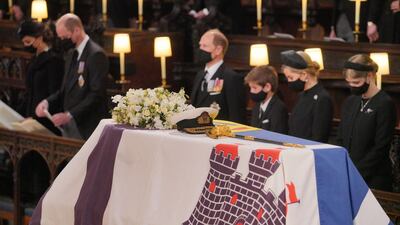
At the funeral, William and Kate sat in a Covid bubble while Harry, who has been self-isolating at his former family home – Frogmore Cottage – sat alone. The Duchess of Sussex is pregnant and was unable to make the trip from California.
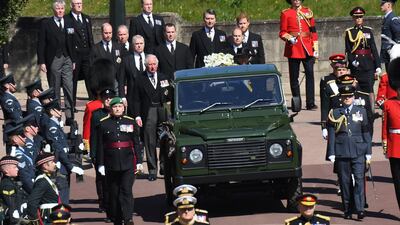
The brothers were sombre and silent as they walked together in a procession behind Prince Philip's coffin before the service, along with their father, Prince Charles, and other close relatives.
As William and Harry walked in silence on either side of their cousin, Peter Phillips, he stepped back slightly to allow the brothers to walk together.

  • Members of the British royal family and military officials follow Prince Philip, the Duke of Edinburgh's coffin during his funeral at Windsor Castle, England. Getty
    Members of the British royal family and military officials follow Prince Philip, the Duke of Edinburgh's coffin during his funeral at Windsor Castle, England. Getty
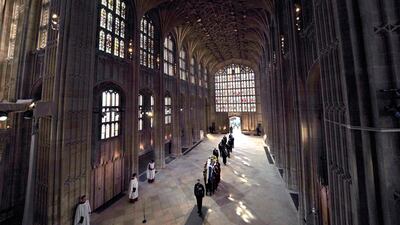
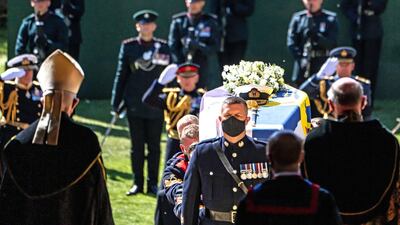
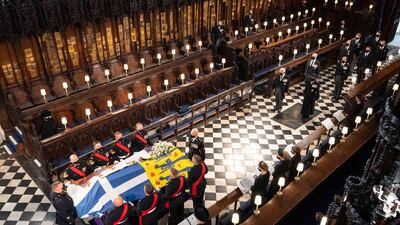
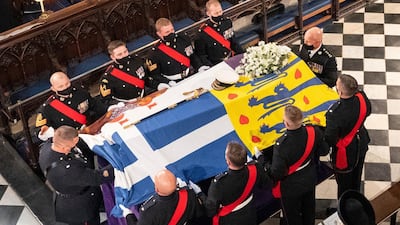
  • Pallbearers carry Prince Philip's coffin into the chapel with only 30 guests in attendance because of coronavirus pandemic restrictions. AFP
    Pallbearers carry Prince Philip's coffin into the chapel with only 30 guests in attendance because of coronavirus pandemic restrictions. AFP
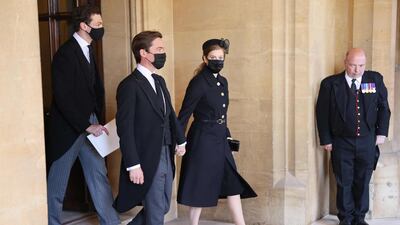
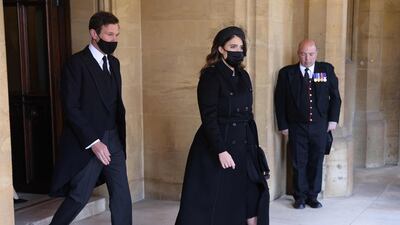
  • People walking at Windsor Castle after Prince Philip's funeral on Saturday. AP
    People walking at Windsor Castle after Prince Philip's funeral on Saturday. AP
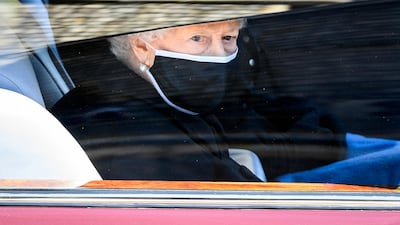
  • Queen Elizabeth II during the funeral of her husband. They married on 20 November 1947 and he served as Prince Consort until his death on April 9, months short of his 100th birthday. Getty
    Queen Elizabeth II during the funeral of her husband. They married on 20 November 1947 and he served as Prince Consort until his death on April 9, months short of his 100th birthday. Getty
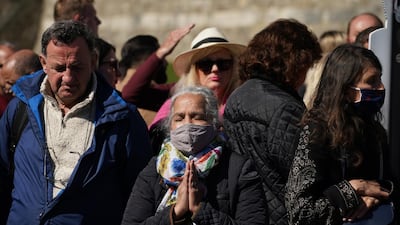
  • Members of the public take part in a two-minute silence outside Windsor Castle during the funeral of Prince Philip. Getty
    Members of the public take part in a two-minute silence outside Windsor Castle during the funeral of Prince Philip. Getty
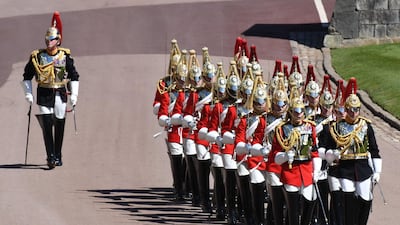
  • Members of the Household Cavalry march ahead of the funeral service of Prince Philip in Windsor Castle. Getty
    Members of the Household Cavalry march ahead of the funeral service of Prince Philip in Windsor Castle. Getty
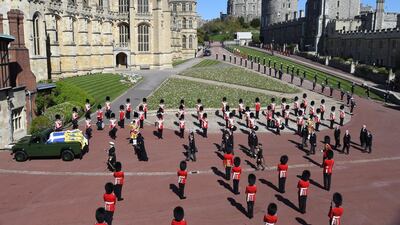
  • Coronavirus restrictions meant social distancing. Getty.
    Coronavirus restrictions meant social distancing. Getty.
  • Prince Philip's coffin is carried into his funeral service at St George's Chapel at Windsor Castle. Getty
    Prince Philip's coffin is carried into his funeral service at St George's Chapel at Windsor Castle. Getty
  • Queen Elizabeth watches as pallbearers carry the coffin of the Duke of Edinburgh during his funeral at St George's Chapel in Windsor Castle. AP
    Queen Elizabeth watches as pallbearers carry the coffin of the Duke of Edinburgh during his funeral at St George's Chapel in Windsor Castle. AP
  • Left to right: Catherine, Duchess of Cambridge; Prince William, Duke of Cambridge; Prince Edward, Earl of Wessex; Viscount Severn; and Sophie, Countess of Wessex attend the funeral service of Prince Philip, the Duke of Edinburgh inside St George's Chapel in Windsor Castle. AFP
    Left to right: Catherine, Duchess of Cambridge; Prince William, Duke of Cambridge; Prince Edward, Earl of Wessex; Viscount Severn; and Sophie, Countess of Wessex attend the funeral service of Prince Philip, the Duke of Edinburgh inside St George's Chapel in Windsor Castle. AFP
  • Pallbearers carry the coffin of the Duke of Edinburgh during his funeral, at St George's Chapel in Windsor Castle. Prince Philip died April 9 at the age of 99. AP
    Pallbearers carry the coffin of the Duke of Edinburgh during his funeral, at St George's Chapel in Windsor Castle. Prince Philip died April 9 at the age of 99. AP
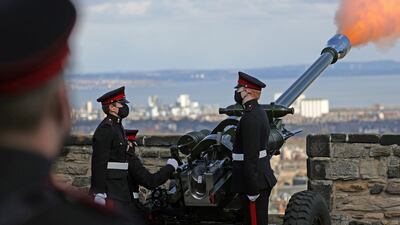
  • A gun salute at Edinburgh Castle. A single round was fired followed by a single round a minute later to begin and end a national minute's silence immediately before the funeral service of Britain's Prince Philip. Reuters
    A gun salute at Edinburgh Castle. A single round was fired followed by a single round a minute later to begin and end a national minute's silence immediately before the funeral service of Britain's Prince Philip. Reuters
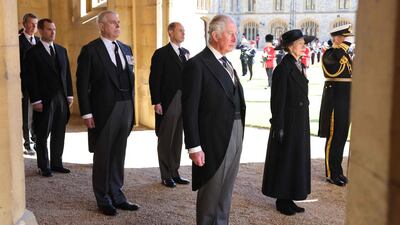
  • From second left: Peter Phillips; Prince Andrew, Duke of York; Prince Edward, Earl of Wessex; Prince Charles, Prince of Wales and Princess Anne, Princess Royal, attend the ceremonial funeral procession of Prince Philip, Duke of Edinburgh. AFP
    From second left: Peter Phillips; Prince Andrew, Duke of York; Prince Edward, Earl of Wessex; Prince Charles, Prince of Wales and Princess Anne, Princess Royal, attend the ceremonial funeral procession of Prince Philip, Duke of Edinburgh. AFP
  • Princess Beatrice of York and her husband Edoardo Mapelli Mozzi attend the funeral ceremony of Prince Philip, Duke of Edinburgh at Windsor Castle. AFP
    Princess Beatrice of York and her husband Edoardo Mapelli Mozzi attend the funeral ceremony of Prince Philip, Duke of Edinburgh at Windsor Castle. AFP
  • Princess Eugenie of York and her husband Jack Brooksbank attend the funeral of Prince Philip, Duke of Edinburgh. AFP
    Princess Eugenie of York and her husband Jack Brooksbank attend the funeral of Prince Philip, Duke of Edinburgh. AFP

Queen Elizabeth led the family in paying their last respects to Prince Philip at a funeral that celebrated his naval past, his international heritage and seven decades of service in which he helped guide the queen through repeated crises.

The queen led the royal procession for his funeral at Windsor Castle, followed by their children and grandchildren.

Prince Philip died at Windsor Castle aged 99 after a month of hospital treatment for a heart condition and an infection.

His coffin, covered with a wreath, his sword, naval cap and his personal standard, was moved by a bearer party from the Queen's Company, 1st Battalion Grenadier Guards, to the royal residence's inner hall and later placed on the Land Rover as God Save the Queen was played.
His death, after 73 years of marriage, has left a "huge void" in her life, the couple's son, Prince Andrew said, and the family has described him as "the grandfather of the nation".
But it's not yet known if the death of their grandfather will help the brothers heal their rift.

The specs

Engine: 3-litre twin-turbo V6

Power: 400hp

Torque: 475Nm

Transmission: 9-speed automatic

Price: From Dh215,900

On sale: Now

JAPANESE GRAND PRIX INFO

Schedule (All times UAE)
First practice: Friday, 5-6.30am
Second practice: Friday, 9-10.30am
Third practice: Saturday, 7-8am
Qualifying: Saturday, 10-11am
Race: Sunday, 9am-midday 

Race venue: Suzuka International Racing Course
Circuit Length: 5.807km
Number of Laps: 53
Watch live: beIN Sports HD

Ten tax points to be aware of in 2026

1. Domestic VAT refund amendments: request your refund within five years

If a business does not apply for the refund on time, they lose their credit.

2. E-invoicing in the UAE

Businesses should continue preparing for the implementation of e-invoicing in the UAE, with 2026 a preparation and transition period ahead of phased mandatory adoption. 

3. More tax audits

Tax authorities are increasingly using data already available across multiple filings to identify audit risks. 

4. More beneficial VAT and excise tax penalty regime

Tax disputes are expected to become more frequent and more structured, with clearer administrative objection and appeal processes. The UAE has adopted a new penalty regime for VAT and excise disputes, which now mirrors the penalty regime for corporate tax.

5. Greater emphasis on statutory audit

There is a greater need for the accuracy of financial statements. The International Financial Reporting Standards standards need to be strictly adhered to and, as a result, the quality of the audits will need to increase.

6. Further transfer pricing enforcement

Transfer pricing enforcement, which refers to the practice of establishing prices for internal transactions between related entities, is expected to broaden in scope. The UAE will shortly open the possibility to negotiate advance pricing agreements, or essentially rulings for transfer pricing purposes. 

7. Limited time periods for audits

Recent amendments also introduce a default five-year limitation period for tax audits and assessments, subject to specific statutory exceptions. While the standard audit and assessment period is five years, this may be extended to up to 15 years in cases involving fraud or tax evasion. 

8. Pillar 2 implementation 

Many multinational groups will begin to feel the practical effect of the Domestic Minimum Top-Up Tax (DMTT), the UAE's implementation of the OECD’s global minimum tax under Pillar 2. While the rules apply for financial years starting on or after January 1, 2025, it is 2026 that marks the transition to an operational phase.

9. Reduced compliance obligations for imported goods and services

Businesses that apply the reverse-charge mechanism for VAT purposes in the UAE may benefit from reduced compliance obligations. 

10. Substance and CbC reporting focus

Tax authorities are expected to continue strengthening the enforcement of economic substance and Country-by-Country (CbC) reporting frameworks. In the UAE, these regimes are increasingly being used as risk-assessment tools, providing tax authorities with a comprehensive view of multinational groups’ global footprints and enabling them to assess whether profits are aligned with real economic activity. 

Contributed by Thomas Vanhee and Hend Rashwan, Aurifer

Mercer, the investment consulting arm of US services company Marsh & McLennan, expects its wealth division to at least double its assets under management (AUM) in the Middle East as wealth in the region continues to grow despite economic headwinds, a company official said.

Mercer Wealth, which globally has $160 billion in AUM, plans to boost its AUM in the region to $2-$3bn in the next 2-3 years from the present $1bn, said Yasir AbuShaban, a Dubai-based principal with Mercer Wealth.

Within the next two to three years, we are looking at reaching $2 to $3 billion as a conservative estimate and we do see an opportunity to do so,” said Mr AbuShaban.

Mercer does not directly make investments, but allocates clients’ money they have discretion to, to professional asset managers. They also provide advice to clients.

“We have buying power. We can negotiate on their (client’s) behalf with asset managers to provide them lower fees than they otherwise would have to get on their own,” he added.

Mercer Wealth’s clients include sovereign wealth funds, family offices, and insurance companies among others.

From its office in Dubai, Mercer also looks after Africa, India and Turkey, where they also see opportunity for growth.

Wealth creation in Middle East and Africa (MEA) grew 8.5 per cent to $8.1 trillion last year from $7.5tn in 2015, higher than last year’s global average of 6 per cent and the second-highest growth in a region after Asia-Pacific which grew 9.9 per cent, according to consultancy Boston Consulting Group (BCG). In the region, where wealth grew just 1.9 per cent in 2015 compared with 2014, a pickup in oil prices has helped in wealth generation.

BCG is forecasting MEA wealth will rise to $12tn by 2021, growing at an annual average of 8 per cent.

Drivers of wealth generation in the region will be split evenly between new wealth creation and growth of performance of existing assets, according to BCG.

Another general trend in the region is clients’ looking for a comprehensive approach to investing, according to Mr AbuShaban.

“Institutional investors or some of the families are seeing a slowdown in the available capital they have to invest and in that sense they are looking at optimizing the way they manage their portfolios and making sure they are not investing haphazardly and different parts of their investment are working together,” said Mr AbuShaban.

Some clients also have a higher appetite for risk, given the low interest-rate environment that does not provide enough yield for some institutional investors. These clients are keen to invest in illiquid assets, such as private equity and infrastructure.

“What we have seen is a desire for higher returns in what has been a low-return environment specifically in various fixed income or bonds,” he said.

“In this environment, we have seen a de facto increase in the risk that clients are taking in things like illiquid investments, private equity investments, infrastructure and private debt, those kind of investments were higher illiquidity results in incrementally higher returns.”

The Abu Dhabi Investment Authority, one of the largest sovereign wealth funds, said in its 2016 report that has gradually increased its exposure in direct private equity and private credit transactions, mainly in Asian markets and especially in China and India. The authority’s private equity department focused on structured equities owing to “their defensive characteristics.”

What vitamins do we know are beneficial for living in the UAE

Vitamin D: Highly relevant in the UAE due to limited sun exposure; supports bone health, immunity and mood.Vitamin B12: Important for nerve health and energy production, especially for vegetarians, vegans and individuals with absorption issues.Iron: Useful only when deficiency or anaemia is confirmed; helps reduce fatigue and support immunity.Omega-3 (EPA/DHA): Supports heart health and reduces inflammation, especially for those who consume little fish.

The%20pillars%20of%20the%20Dubai%20Metaverse%20Strategy
%3Cp%3EEncourage%20innovation%20in%20the%20metaverse%20field%20and%20boost%20economic%20contribution%3C%2Fp%3E%0A%3Cp%3EDevelop%20outstanding%20talents%20through%20education%20and%20training%3C%2Fp%3E%0A%3Cp%3EDevelop%20applications%20and%20the%20way%20they%20are%20used%20in%20Dubai's%20government%20institutions%3C%2Fp%3E%0A%3Cp%3EAdopt%2C%20expand%20and%20promote%20secure%20platforms%20globally%3C%2Fp%3E%0A%3Cp%3EDevelop%20the%20infrastructure%20and%20regulations%3C%2Fp%3E%0A