


British hospitals are cancelling non-urgent procedures and struggling to find space for Covid-19 patients as cases surge despite tough new restrictions imposed to curb a fast-spreading new variant of the virus.
Dr Nick Scriven, a former president of the Society for Acute Medicine, said on Monday that the rising number of patients in hospital was "extremely worrying".
“With the numbers approaching the peaks from April, systems will again be stretched to the limit,” he said.
British authorities are blaming the new variant for soaring infection rates in London and south-east England. They say the new version is more easily transmitted than the original, but there is no evidence it makes people sicker.
In response, authorities have put areas of England that are home to 24 million people under restrictions that require non-essential shops to close, ban indoor socialising, and allow restaurants and pubs only to offer takeaways.
Even so, hospital admissions for Covid-19 in south-east England are approaching or exceeding levels seen during the first peak of the outbreak.
Government figures show 21,286 people were in hospital with the virus across the UK on December 22, the last day for which data is available. That is only slightly below the high of 21,683 Covid-19 patients recorded in UK hospitals on April 12.
Dr Katherine Henderson, president of the Royal College of Emergency Medicine, described her experience working in a hospital on Christmas Day as “wall-to-wall Covid”.
“The chances are that we will cope, but we cope at a cost,” Dr Henderson told the BBC. “The cost is not doing what we had hoped, which is being able to keep non-Covid activities going.”
Britain has already recorded more than 70,000 deaths of people with the coronavirus, one of the highest tolls in Europe.
Cabinet minister Michael Gove said more parts of England could be put into the toughest tier of restrictions if case numbers did not fall. Scotland, Wales and Northern Ireland have implemented their own strong lockdown measures.
There is rising confidence that help could soon be on the way, however, with hopes mounting that UK regulators may authorise a second coronavirus vaccine this week.
-
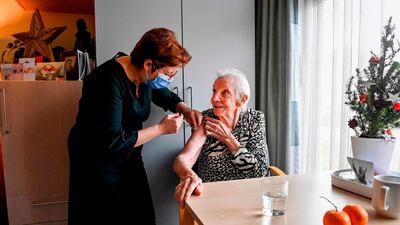
Resident Maria receives a Pfizer-BioNTech Covid-19 vaccine at a care home in Puurs, Belgium as the country starts its national vaccination campaign. AFP -
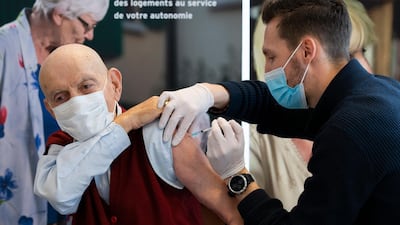
Nurses vaccinate Leon T, aged 80, as he becomes the first person in Geneva to receive the Pfizer-BioNtech vaccine in Switzerland. AP Photo -
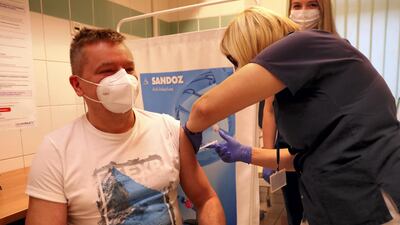
A nurse administers the Pfizer-BioNTech vaccine at Podhale Specialist Hospital of John Paul II in Nowy Targ, south Poland. EPA -
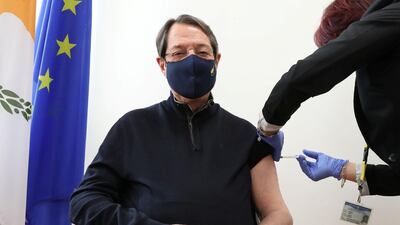
Cypriot President Nicos Anastasiades receives the Pfizer-BioNTech vaccine in the capital Nicosia. Reuters -
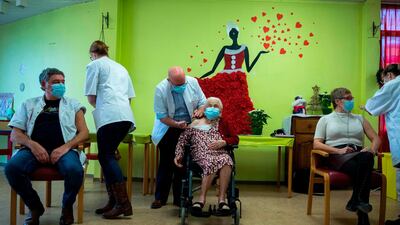
Josepha Delmotte, 102, receives a dose of the Pfizer-BioNTech Covid-19 vaccine at a care home in Mons, Belgium. AFP -

Jos Hermans, 96, who is the first to receive a Pfizer-BioNTech Covid-19 vaccine, waves to journalists in Puurs, Belgium. AFP -
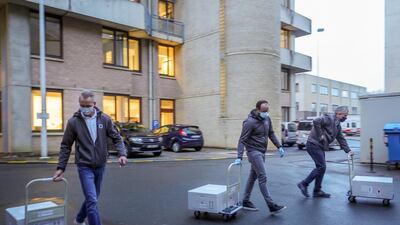
Staff pull boxes of Pfizer-BioNTech Covid-19 vaccines to be delivered to several care homes in Leuven, Belgium. AFP -
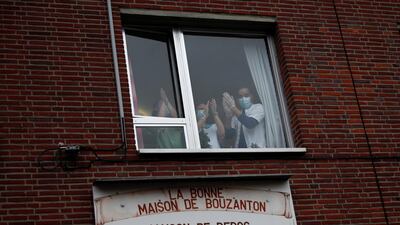
Staff members applaud as vials of the Covid-19 vaccine are delivered to the La Bonne Maison de Bouzanton care home in Mons, Belgium. Reuters -
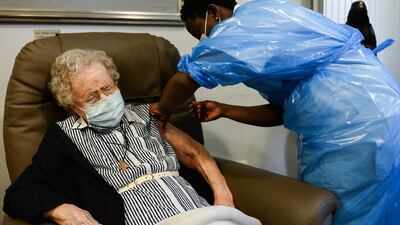
Lucie Danjou, 101, receives a dose of the Pfizer-BioNtech COVID-19 vaccine at the Notre-Dame hospital in Brussels, Belgium. AFP -

Jacques Collineau, 75, receives a dose of the Pfizer-BioNTech Covid-19 vaccine in Joue-les-Tours, France. AFP


British media reports say the Medicines and Healthcare Products Regulatory Agency is likely to give the green light to the vaccine made by AstraZeneca and the University of Oxford.
The regulator authorised a drug made by US pharmaceutical company Pfizer and German firm BioNTech on December 2, making Britain the first country to gain access to a rigorously tested vaccine.
More than 600,000 people in the UK have received the first of the two injections they need to be inoculated.
If the AstraZeneca-Oxford vaccine is authorised this week, people could start receiving it from January 4.
Britain has ordered 100 million doses, compared to 40 million doses of the Pfizer-BioNTech vaccine. The AstraZeneca-Oxford vaccine is considered a potential game-changer in global immunisation efforts because it is less expensive than the Pfizer drug and does not need to be stored at freezer temperatures, making it easier to distribute.
However, it had less clear-cut results in clinical trials than its main rivals. Partial results suggested that the vaccine is about 70 per cent effective for preventing illness from coronavirus, compared to the 95 per cent efficacy reported for the Pfizer-BioNTech vaccine.
AstraZeneca chief executive Pascal Soriot told The Sunday Times newspaper that he was confident the vaccine would work against the new strain and would prove as effective as its rivals.
“We think we have figured out the winning formula and how to get efficacy that, after two doses, is up there with everybody else,” Mr Soriot said.

