


Jurgen Klopp has urged the city of Liverpool to launch its “fightback” against coronavirus as he appeals for everyone to get tested.
The Liverpool Football Club manager's plea comes as troops were posted to the northern English city this week for the UK government's first citywide testing regime, which began on Friday.
Liverpool residents are being offered repeat tests - regardless of whether they have symptoms or not.
Klopp is a star recruit in the government’s efforts to get as many Liverpudlians tested as possible.
“Let’s start the fightback against Covid - let’s get tested,” the Liverpool boss said.
“Regular testing has kept the Premier League going and allowed us to be out on the pitch every week.
“It takes 10 seconds to take a test and 10 days to make a difference.
“Let’s help Liverpool get out of Tier 3. Do it for yourself, your family, your colleagues and your city. Let’s do it together, let’s do it for Liverpool.”
If the two-week pilot is successful, the rapid testing scheme could be rolled out elsewhere as part of Prime Minister Boris Johnson's lockdown "exit strategy".
About 2,000 soldiers were sent to the city this week to help carry out the tests.
Liverpool testing commander Lieutenant-General Tyrone Richard Urch said the rapid tests could deliver a result in under an hour.
He told BBC Radio 4's Today programme: "We're piloting the lateral flow device, which is the test that can be done very quickly.
“I’m led to believe we can have results in under an hour.”
Liverpool was the first area to be put into the very high alert level of England's three-tier system of Covid-19 restrictions.
A national lockdown in England began on Thursday.
New infections have stabilised at about 50,000 a day, the Office for National Statistics (ONS) said on Friday, indicating a levelling off in the steep rise of cases even before the country was pushed into its second shutdown.
The ONS said there was an estimated daily 45,700 new cases per day in the week to Oct 31, down slightly from the previous week's estimate of 51,900.
-

Soldiers wearing protective equipment get prepared to collect swab samples at a testing centre in Liverpool. Reuters -

Soldiers from the Yorkshire Regiment carry out tests on each other as they prepare a mass Covid-19 testing site at Wavertree Sports Park in Liverpool. Getty Images -

A soldier gives a swab sample at a testing centre in Liverpool. Reuters -

Members of the military help to set up a mass Covid-19 testing site at Wavertree Sports Park in Liverpool. Getty Images -

A bus carrying soldiers leaves the Pontins Southport Holiday Park to support Liverpool ahead of mass testing. Reuters -

A worker speaks to a member of the public at a testing facility in Liverpool. AFP -

A woman gives a swab sample at a testing centre in Liverpool. Reuters -

A worker speaks to a member of the public arriving by car at a testing facility in Liverpool. AFP -

A worker photographs the information on swabs provided by members of the public. AFP -

Covid-19 testing is carried out at an NHS Test and Trace facility at Wavertree Sports Park in Liverpool. Getty Images -

Soldiers from the Yorkshire Regiment prepare a testing site at Wavertree Sports Park. Getty Images
Liverpool's director of public health Matthew Ashton said the aim of the pilot was to lower levels of the virus in the city and exit national lockdown in a “stronger” position to tackle further outbreaks, hinting that the pilot could go on for longer than 10 days if it proved successful.
Mr Ashton told the BBC: "One of the things I want to make sure of is that the pilot lasts long enough for us to be able to see the impact of it.
"We are open for an initial 10 days, but I'm not getting the readings that it's 10 days and turn off.
“We are able to expand it, extend it, to make sure the pilot fits."
Liverpool mayor Joe Anderson, whose brother died of Covid-19 last month, said the pilot could save lives and "get the city out of tier three restrictions".
Mr Johnson said on Thursday the kind of cheap new tests being used in Liverpool "can be a massive and possibly decisive use to us in this country in defeating the virus".
The government has already spent £12 billion ($16 billion) on testing programmes across the UK.
But researchers say most members of the public have been failing to isolate after testing positive, and support staff have struggled to reach all of their contacts to limit the spread of the virus.
Pressure is continuing to build on the government to ensure England emerges from lockdown on December 2.
MPs including former prime minister Theresa May this week criticised Number 10 for using data that was “riddled with errors” to justify the second shutdown.
Modelling had suggested that virus deaths could hit 1,500 per day - surpassing the first peak in spring.
The projection was quietly revised down last night, with the incorrect graph removed and replaced with another.
Mrs May asked whether “figures were chosen to support the policy rather than the policy being based on the figures”.
Chief scientific adviser Sir Patrick Vallance said he “regretted” that he did not make clear that the scenarios were models rather than projections.

Meanwhile, a leading Oxford geneticist suggested people should be paid to receive the Covid vaccine in an attempt to build up herd immunity.
Prof Julian Savulescu said such incentives could help overcome public resistance to getting the inoculation due to health and safety fears.
The incentive could be either financial or “payment in kind” - such as being allowed to take off a face mask in public, he suggested.
He wrote in the Journal of Medical Ethics: "The advantage of payment for risk is that people are choosing voluntarily to take it on.
“As long as we are accurate in conveying the limitations in our confidence about the risks and benefits of a vaccine, then it is up to individuals to judge whether they are worth payment.”
Scientists say 50 to 80 per cent of the population needs to be vaccinated to achieve herd immunity but the government won’t be making the any vaccine mandatory.
Prof Savulescu did not believe mandatory vaccinations were ethical without eliminating the risk of a vaccine.
"However, another way of looking at this is that those at low risk are being asked to do a job, which entails some risk, albeit a very low one,” he said.
“So they should be paid for the risk they are taking for the sake of providing a public good.”
-
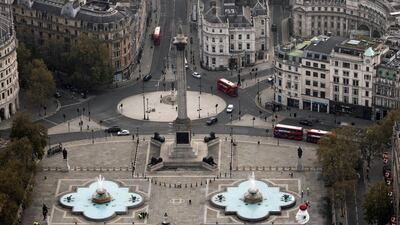
A quiet Trafalgar Square in London. Getty Images -

England today began a second national lockdown to curb a surge in Covid-19 cases, closing pubs, restaurants and an array of shops deemed non-essential. Getty Images -
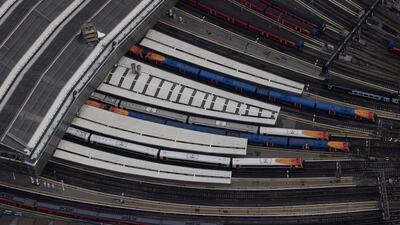
Trains at Waterloo Station. The new rules, which will expire on 2 December, also ban most indoor and outdoor household mixing and grass-roots sports. Getty Images -
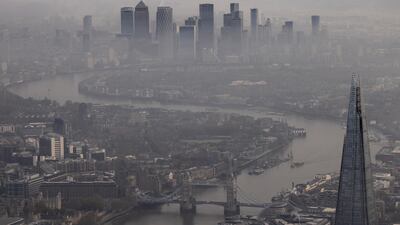
Fog shrouds the Shard and the view towards the Canary Wharf business district. Unlike the first lockdown earlier this year, schools in England will remain open. Getty Images -

People walk through Hyde Park. Getty Images -

Sports pitches near the Barbican. Getty Images -
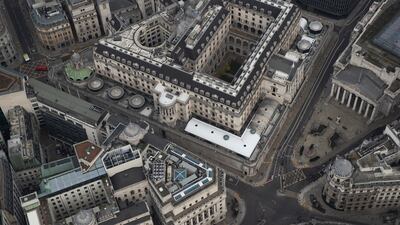
The Bank of England in the City of London's Square Mile. Getty Images -
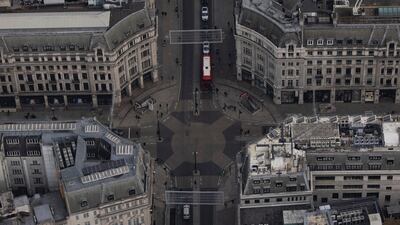
A quiet Oxford Circus. Getty Images -

Fog shrouds the Canary Wharf business district. Getty Images -

A quiet Piccadilly Circus. Getty Images -

City Hall on the first day of the new national lockdown. Getty Images



