
Britain’s two-week quarantine could be cut to only five days as the government plans for a “test and release” system.
If introduced, people returning to the UK could be released from quarantine if they test negative for coronavirus after five days, less than half the time they currently need to isolate, The Times reported.
UK ministers are keeping a close eye on a similar arrangement announced in Ireland this week to see if it is successful.
Over the summer, the government relied on its air bridge system to maintain quarantine-free travel between the UK and low-risk countries.
However, the list of travel corridors has been gradually cut as the second wave of coronavirus cases takes hold in Europe.
The government on Thursday confirmed Germany and Sweden would be removed from the safe travel list, leaving only seven quarantine-free countries in Europe.
The new system could be in place by next month.
Meanwhile, citywide coronavirus testing begins in Liverpool on Friday - a move Prime Minister Boris Johnson said was his lockdown "exit strategy".
About 2,000 soldiers were deployed to the city this week to begin mass testing.
While the tests are not compulsory, residents will be entitled to repeat testing - regardless of whether they have symptoms or not.
The pilot will last for about two weeks.
Liverpool testing commander Lieutenant-General Tyrone Richard Urch said the tests could deliver a result in under an hour.
He told BBC Radio 4's Today programme: "We're piloting the lateral flow device, which is the test that can be done very quickly.
“I’m led to believe we can have results in under an hour.”
Laboratory-based PCR tests are currently the most common tests in the UK and take about two days to give a result.
Lateral flow tests use similar technology to pregnancy tests and do not require lab analysis.
Mr Johnson said he was planning a “steady but rapid expansion” of fast testing.
He said: "The way out is to get the R [the reproduction number and growth rate of coronavirus in the UK] down now to beat this autumn surge and to use this moment to exploit the medical and technical advances we are making to keep it low.
"We have the immediate prospect of many millions of cheap, reliable and rapid turnaround tests with a result within minutes.
"These tests identify people who are infectious but do not have symptoms, allowing them to immediately self-isolate and stop the spread of the disease, and allowing those who are not infectious to continue as normal."
-

Soldiers walk at the Pontins Southport Holiday Park as they prepare to support Liverpool ahead of a mass testing for the coronavirus disease. Reuters -

Members of the military arrive at Pontins. The UK government are piloting loop mediated isothermal amplification (LAMP) testing technology, offering all Liverpool residents quick-result tests. Getty Images -
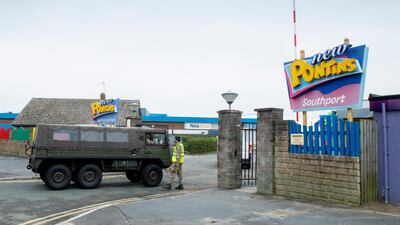
Army vehicles arrive Pontins holiday camp where the Army are based ahead of the testing. EPA -

A member of the military stands alongside a Welcome billboard at Pontins. AFP -
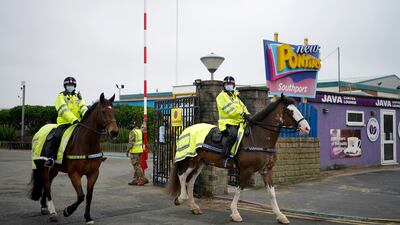
Mounted policde officers leave Pontins camp to exercise their horses as members of the military arrive at Pontins. Getty Images -

Members of the military arrive at Pontins. Getty Images -

An NHS worker speaks with soldiers as they carry supplies at Pontins. AFP -

British Army soldiers walk around Pontins holiday camp. EPA



