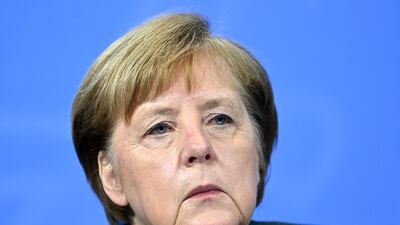
German Chancellor Angela Merkel attends a press conference. Getty Images

Germany tightens shutdown as virus variants fuel fears


Soraya Ebrahimi
  • English
  • Arabic

Germany on Tuesday toughened a partial lockdown and extended it to February 14, in a bid to halt the spread of coronavirus, including new variants believed to be more contagious.

Following hours of crisis talks, Chancellor Angela Merkel and the leaders of 16 states also agreed to make medical masks mandatory on public transport and in shops - meaning only surgical masks or the so-called FFP2 masks will be allowed.

They also said employers must make it possible for staff work from home whenever possible, according to a final text seen by AFP.

The measure goes beyond previous appeals to companies to allow for more "home office" in Germany.

"All our efforts to contain the virus are threatened by a serious danger," Ms Merkel told reporters, referring to new strains of the virus that have caused a surge in infections in Britain and Ireland.

"There is still time to contain the danger," she said. "We must act now."

She added that the stricter curbs were necessary as "a precaution for our country, the health of our citizens and also for the economy".

Germany closed restaurants, leisure and sporting facilities in November, then expanded the shutdown in mid-December to include schools and most shops to halt runaway growth in new coronavirus infections.

Schools, daycare centres and non-essential shops will remain closed under the new measures.

Ms Merkel's spokesman Steffen Seibert said earlier the measures had brought about a "flattening of the infections curve", noting that the number of patients in intensive care had fallen slightly.

Tuesday's talks between Ms Merkel and state premiers were brought forward by a week because of concerns over the new variants discovered in South Africa and Britain.

Ms Merkel said Germany would use an EU summit on Thursday to call for "synchronised measures" to rein in the spread of the new strains in member states.

Germany survived the first wave of the coronavirus pandemic relatively well, but a second wave hit Europe's biggest economy hard.

New infections have soared far above the 50 per 100,000 people threshold set by the government. And last Thursday, the country saw a new high in daily deaths with 1,244.

On Tuesday, daily deaths reached 989 though health authorities said they might have been inflated after a lag in weekend reporting. More than 11,000 new cases were recorded.

Mr Seibert noted on Monday that the incidence rate was still at over 130 per 100,000 people, and that Germany "must more quickly" bring that down to 50.

Experts have been alarmed by data showing that Germans appeared to be moving around almost as normal this winter, unlike in the spring when a shutdown appeared to have caused a drastic drop in mobility.

The mobility of Germans was only 15 percent below that of a year ago, according to data from mobile phone signals analysed by disease control agency Robert Koch Institute and Berlin's Humboldt University.

Ahead of Tuesday's talks, Economy Minister Peter Altmaier promised to simplify the procedure for businesses to get aid more quickly to help them cope with the prolonged shutdown.

Germany took on a record 130.5 billion euros ($160 billion) in new borrowing last year to fund its mega bailouts to companies and support schemes for families as the economy crashed due to the pandemic.

RKI chief Lothar Wieler has meanwhile pleaded for rigorous implementation of curbs that have already been ordered, saying that there were too many exceptions allowed.

In northern Germany, officials were planning to take more drastic measures against people who breach quarantine rules.

Schleswig-Holstein state's justice ministry is turning a youth detention centre into a forced quarantine site for those who do not isolate themselves when required to.


RESULTS

Lightweight (female)
Sara El Bakkali bt Anisha Kadka
Bantamweight
Mohammed Adil Al Debi bt Moaz Abdelgawad
Welterweight
Amir Boureslan bt Mahmoud Zanouny
Featherweight
Mohammed Al Katheeri bt Abrorbek Madaminbekov
Super featherweight
Ibrahem Bilal bt Emad Arafa
Middleweight
Ahmed Abdolaziz bt Imad Essassi
Bantamweight (female)
Ilham Bourakkadi bt Milena Martinou
Welterweight
Mohamed Mardi bt Noureddine El Agouti
Middleweight
Nabil Ouach bt Ymad Atrous
Welterweight
Nouredine Samir bt Marlon Ribeiro
Super welterweight
Brad Stanton bt Mohamed El Boukhari

UAE%20v%20West%20Indies
%3Cp%3EFirst%20ODI%20-%20Sunday%2C%20June%204%20%0D%3Cbr%3ESecond%20ODI%20-%20Tuesday%2C%20June%206%20%0D%3Cbr%3EThird%20ODI%20-%20Friday%2C%20June%209%26nbsp%3B%3C%2Fp%3E%0A%3Cp%3EMatches%20at%20Sharjah%20Cricket%20Stadium.%20All%20games%20start%20at%204.30pm%0D%3Cbr%3E%0D%3Cbr%3E%3Cstrong%3EUAE%20squad%3C%2Fstrong%3E%0D%3Cbr%3EMuhammad%20Waseem%20(captain)%2C%20Aayan%20Khan%2C%20Adithya%20Shetty%2C%20Ali%20Naseer%2C%20Ansh%20Tandon%2C%20Aryansh%20Sharma%2C%20Asif%20Khan%2C%20Basil%20Hameed%2C%20Ethan%20D%E2%80%99Souza%2C%20Fahad%20Nawaz%2C%20Jonathan%20Figy%2C%20Junaid%20Siddique%2C%20Karthik%20Meiyappan%2C%20Lovepreet%20Singh%2C%20Matiullah%2C%20Mohammed%20Faraazuddin%2C%20Muhammad%20Jawadullah%2C%20Rameez%20Shahzad%2C%20Rohan%20Mustafa%2C%20Sanchit%20Sharma%2C%20Vriitya%20Aravind%2C%20Zahoor%20Khan%0D%3C%2Fp%3E%0A
What are the influencer academy modules?
  1. Mastery of audio-visual content creation. 
  2. Cinematography, shots and movement.
  3. All aspects of post-production.
  4. Emerging technologies and VFX with AI and CGI.
  5. Understanding of marketing objectives and audience engagement.
  6. Tourism industry knowledge.
  7. Professional ethics.
TRAP

Starring: Josh Hartnett, Saleka Shyamalan, Ariel Donaghue

Director: M Night Shyamalan

Rating: 3/5

COMPANY PROFILE
Name: ARDH Collective
Based: Dubai
Founders: Alhaan Ahmed, Alyina Ahmed and Maximo Tettamanzi
Sector: Sustainability
Total funding: Self funded
Number of employees: 4
A State of Passion

Directors: Carol Mansour and Muna Khalidi

Stars: Dr Ghassan Abu-Sittah

Rating: 4/5

MATCH INFO

Uefa Champions League quarter-final, second leg (first-leg score)

Porto (0) v Liverpool (2), Wednesday, 11pm UAE

Match is on BeIN Sports

Ten tax points to be aware of in 2026

1. Domestic VAT refund amendments: request your refund within five years

If a business does not apply for the refund on time, they lose their credit.

2. E-invoicing in the UAE

Businesses should continue preparing for the implementation of e-invoicing in the UAE, with 2026 a preparation and transition period ahead of phased mandatory adoption. 

3. More tax audits

Tax authorities are increasingly using data already available across multiple filings to identify audit risks. 

4. More beneficial VAT and excise tax penalty regime

Tax disputes are expected to become more frequent and more structured, with clearer administrative objection and appeal processes. The UAE has adopted a new penalty regime for VAT and excise disputes, which now mirrors the penalty regime for corporate tax.

5. Greater emphasis on statutory audit

There is a greater need for the accuracy of financial statements. The International Financial Reporting Standards standards need to be strictly adhered to and, as a result, the quality of the audits will need to increase.

6. Further transfer pricing enforcement

Transfer pricing enforcement, which refers to the practice of establishing prices for internal transactions between related entities, is expected to broaden in scope. The UAE will shortly open the possibility to negotiate advance pricing agreements, or essentially rulings for transfer pricing purposes. 

7. Limited time periods for audits

Recent amendments also introduce a default five-year limitation period for tax audits and assessments, subject to specific statutory exceptions. While the standard audit and assessment period is five years, this may be extended to up to 15 years in cases involving fraud or tax evasion. 

8. Pillar 2 implementation 

Many multinational groups will begin to feel the practical effect of the Domestic Minimum Top-Up Tax (DMTT), the UAE's implementation of the OECD’s global minimum tax under Pillar 2. While the rules apply for financial years starting on or after January 1, 2025, it is 2026 that marks the transition to an operational phase.

9. Reduced compliance obligations for imported goods and services

Businesses that apply the reverse-charge mechanism for VAT purposes in the UAE may benefit from reduced compliance obligations. 

10. Substance and CbC reporting focus

Tax authorities are expected to continue strengthening the enforcement of economic substance and Country-by-Country (CbC) reporting frameworks. In the UAE, these regimes are increasingly being used as risk-assessment tools, providing tax authorities with a comprehensive view of multinational groups’ global footprints and enabling them to assess whether profits are aligned with real economic activity. 

Contributed by Thomas Vanhee and Hend Rashwan, Aurifer