Chinese President Xi Jinping attends a video summit on climate change with German Chancellor Angela Merkel and French President Emmanuel Macron. Reuters

France and Germany back China’s carbon reduction plans


Jamie Prentis
  • English
  • Arabic

France and Germany backed China's drive for carbon neutrality by 2060 as the leaders of the three countries held an online meeting focused on climate change.

The talks on Friday between France's Emmanuel Macron, Germany's Angela Merkel and Xi Jinping of China also covered Covid-19 and the global vaccine supply, the German chancellery said.

The talks rival the climate diplomacy of the US, which is hosting a summit this month dedicated to global warming with 40 world leaders from some of the highest-polluting countries.

Experts say China needs to halve carbon dioxide emissions from its coal-fired power plants by the end of the decade.

The talks came as US climate envoy John Kerry toured China seeking greater co-operation on the issue. He is not scheduled to meet Mr Xi on the visit, which is being downplayed by state media.


Despite disagreeing on several key issues, it was hoped that the US and China could find some sort of common ground on environmental issues.

But on Friday, China’s foreign ministry criticised the US for withdrawing from the Paris Climate Agreement in 2017 and for not meeting greenhouse gas reduction targets.

  • Around $3.5 trillion is required between now and 2050 to meet targets for a 'sustainable path', according to the International Energy Agency. AP Photo
    Around $3.5 trillion is required between now and 2050 to meet targets for a 'sustainable path', according to the International Energy Agency. AP Photo
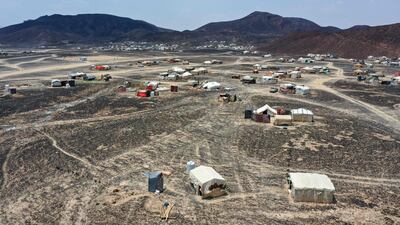
  • The makeshift Suweida camp for internally displaced people in Yemen’s Marib province. The effects of climate change have exacerbated the displacement of local populations during the country’s war. AFP
    The makeshift Suweida camp for internally displaced people in Yemen’s Marib province. The effects of climate change have exacerbated the displacement of local populations during the country’s war. AFP
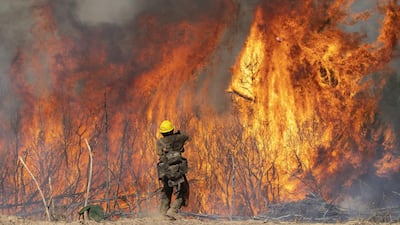
  • A firefighter monitors a controlled burn, near Jolon, California.Frequent wildfires are an indication of climate change further getting out of control, say environmentalists. Bloomberg
    A firefighter monitors a controlled burn, near Jolon, California.Frequent wildfires are an indication of climate change further getting out of control, say environmentalists. Bloomberg
  • Wildfire burns through the Angeles National Forest in Los Angeles County, north of Azusa, California. AFP
    Wildfire burns through the Angeles National Forest in Los Angeles County, north of Azusa, California. AFP
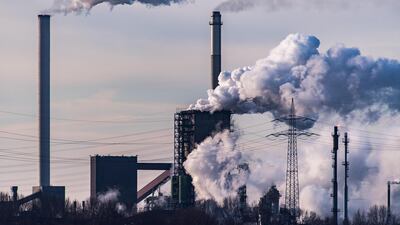
  • Steam rises from a steel mill in Duisburg, Germany. Some countries are using the coronavirus pandemic to wind back climate change commitments, say environmentalists. Getty Images
    Steam rises from a steel mill in Duisburg, Germany. Some countries are using the coronavirus pandemic to wind back climate change commitments, say environmentalists. Getty Images
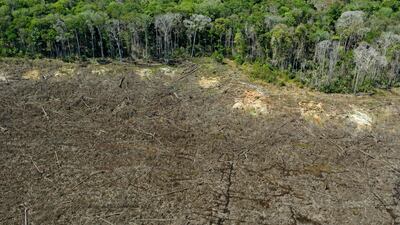
  • A deforested area close to Sinop, Mato Grosso State, Brazil. Deforestation in Brazil's Amazon rainforest rose by almost 22 percent from August 2020 to July 2021, compared with the same period the year before, reaching a 15-year high. AFP
    A deforested area close to Sinop, Mato Grosso State, Brazil. Deforestation in Brazil's Amazon rainforest rose by almost 22 percent from August 2020 to July 2021, compared with the same period the year before, reaching a 15-year high. AFP

The decision to leave the Paris accord was made by former US president Donald Trump and was reversed by his successor, Joe Biden.

“Its return is by no means a glorious comeback but rather the pupil playing truant getting back to class,” said foreign ministry spokesman Zhao Lijian.


Indoor cricket in a nutshell
Indoor Cricket World Cup - Sept 16-20, Insportz, Dubai

16 Indoor cricket matches are 16 overs per side
8 There are eight players per team
9 There have been nine Indoor Cricket World Cups for men. Australia have won every one.
5 Five runs are deducted from the score when a wickets falls
4 Batsmen bat in pairs, facing four overs per partnership

Scoring In indoor cricket, runs are scored by way of both physical and bonus runs. Physical runs are scored by both batsmen completing a run from one crease to the other. Bonus runs are scored when the ball hits a net in different zones, but only when at least one physical run is score.

Zones

A Front net, behind the striker and wicketkeeper: 0 runs
B Side nets, between the striker and halfway down the pitch: 1 run
C Side nets between halfway and the bowlers end: 2 runs
D Back net: 4 runs on the bounce, 6 runs on the full

Europe’s rearming plan
  • Suspend strict budget rules to allow member countries to step up defence spending
  • Create new "instrument" providing €150 billion of loans to member countries for defence investment
  • Use the existing EU budget to direct more funds towards defence-related investment
  • Engage the bloc's European Investment Bank to drop limits on lending to defence firms
  • Create a savings and investments union to help companies access capital

Mercer, the investment consulting arm of US services company Marsh & McLennan, expects its wealth division to at least double its assets under management (AUM) in the Middle East as wealth in the region continues to grow despite economic headwinds, a company official said.

Mercer Wealth, which globally has $160 billion in AUM, plans to boost its AUM in the region to $2-$3bn in the next 2-3 years from the present $1bn, said Yasir AbuShaban, a Dubai-based principal with Mercer Wealth.

Within the next two to three years, we are looking at reaching $2 to $3 billion as a conservative estimate and we do see an opportunity to do so,” said Mr AbuShaban.

Mercer does not directly make investments, but allocates clients’ money they have discretion to, to professional asset managers. They also provide advice to clients.

“We have buying power. We can negotiate on their (client’s) behalf with asset managers to provide them lower fees than they otherwise would have to get on their own,” he added.

Mercer Wealth’s clients include sovereign wealth funds, family offices, and insurance companies among others.

From its office in Dubai, Mercer also looks after Africa, India and Turkey, where they also see opportunity for growth.

Wealth creation in Middle East and Africa (MEA) grew 8.5 per cent to $8.1 trillion last year from $7.5tn in 2015, higher than last year’s global average of 6 per cent and the second-highest growth in a region after Asia-Pacific which grew 9.9 per cent, according to consultancy Boston Consulting Group (BCG). In the region, where wealth grew just 1.9 per cent in 2015 compared with 2014, a pickup in oil prices has helped in wealth generation.

BCG is forecasting MEA wealth will rise to $12tn by 2021, growing at an annual average of 8 per cent.

Drivers of wealth generation in the region will be split evenly between new wealth creation and growth of performance of existing assets, according to BCG.

Another general trend in the region is clients’ looking for a comprehensive approach to investing, according to Mr AbuShaban.

“Institutional investors or some of the families are seeing a slowdown in the available capital they have to invest and in that sense they are looking at optimizing the way they manage their portfolios and making sure they are not investing haphazardly and different parts of their investment are working together,” said Mr AbuShaban.

Some clients also have a higher appetite for risk, given the low interest-rate environment that does not provide enough yield for some institutional investors. These clients are keen to invest in illiquid assets, such as private equity and infrastructure.

“What we have seen is a desire for higher returns in what has been a low-return environment specifically in various fixed income or bonds,” he said.

“In this environment, we have seen a de facto increase in the risk that clients are taking in things like illiquid investments, private equity investments, infrastructure and private debt, those kind of investments were higher illiquidity results in incrementally higher returns.”

The Abu Dhabi Investment Authority, one of the largest sovereign wealth funds, said in its 2016 report that has gradually increased its exposure in direct private equity and private credit transactions, mainly in Asian markets and especially in China and India. The authority’s private equity department focused on structured equities owing to “their defensive characteristics.”

Tips from the expert

Dobromir Radichkov, chief data officer at dubizzle and Bayut, offers a few tips for UAE residents looking to earn some cash from pre-loved items.

  1. Sellers should focus on providing high-quality used goods at attractive prices to buyers.
  2. It’s important to use clear and appealing photos, with catchy titles and detailed descriptions to capture the attention of prospective buyers.
  3. Try to advertise a realistic price to attract buyers looking for good deals, especially in the current environment where consumers are significantly more price-sensitive.
  4. Be creative and look around your home for valuable items that you no longer need but might be useful to others.