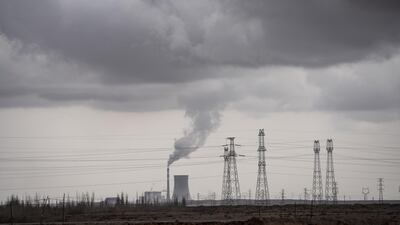
Global CO2 emissions need to fall by 45 per cent by from 2010 levels by 2030 to limit the worst effects of climate change. Bloomberg

Finance sector called Britain’s ‘dirty secret’ on climate change


Paul Peachey
  • English
  • Arabic

Britain’s finance sector is responsible for more carbon emissions than most countries, according to a new study by WWF and Greenpeace UK.

The study found that banks and asset managers invested in projects that caused 805 million tonnes of CO2 in 2019 – nearly double the UK’s annual net emissions.

The two conservation bodies said the findings would rank the City of London, the capital’s financial district, as the ninth biggest emitter in the world if it was a country.

They said research pointed to the sector being one of the biggest UK contributors to climate change and called on the government to legislate so it is aligned with the carbon-cutting ambitions of the 2015 Paris climate accord.

"Trying to set a path to net-zero emissions without tackling the UK financial sector is like sticking a plaster when the patient needs open heart surgery,” said WWF UK's chief executive, Tanya Steele.

The sector is one of the biggest drivers of the UK economy and contributed £132 billion ($186.755bn) in 2019, representing 7 per cent of total economic output. Exports of UK financial services in that year were worth £60 billion.

The international panel on climate change says that global emissions need to fall by 45 per cent by from 2010 levels by 2030. That will be the first stage to keeping global temperature rises to 1.5°C above pre-industrial levels and prevent the worst effects of climate change.

But the world’s largest 60 banks alone have provided $3.8 trillion to the fossil fuel industry since 2015, when countries committed to reducing their emissions under the Paris climate accord, said the report.

The UK has put tackling climate change at the forefront of its agenda as it prepares to host a major summit, Cop26, later this year. The government last month announced a new target to reduce emissions by 78% by 2035.

Greenpeace UK's executive director, John Sauven, said: “Finance is the UK’s dirty little secret. Banks and investors are responsible for more emissions than most nations and the UK government is giving them a free pass.

“How can we say we’re ‘leading the world on climate action’ while allowing financial institutions to plough billions into fossil fuel production every year?”

The analysis was carried out by researchers South Pole. It sought to calculate carbon emissions based on the lending and investment activities of the UK’s financial sector, including 15 banks and 10 asset managers, taking into account loans and investments in industries such as energy, IT, mining and construction.

Mercer, the investment consulting arm of US services company Marsh & McLennan, expects its wealth division to at least double its assets under management (AUM) in the Middle East as wealth in the region continues to grow despite economic headwinds, a company official said.

Mercer Wealth, which globally has $160 billion in AUM, plans to boost its AUM in the region to $2-$3bn in the next 2-3 years from the present $1bn, said Yasir AbuShaban, a Dubai-based principal with Mercer Wealth.

Within the next two to three years, we are looking at reaching $2 to $3 billion as a conservative estimate and we do see an opportunity to do so,” said Mr AbuShaban.

Mercer does not directly make investments, but allocates clients’ money they have discretion to, to professional asset managers. They also provide advice to clients.

“We have buying power. We can negotiate on their (client’s) behalf with asset managers to provide them lower fees than they otherwise would have to get on their own,” he added.

Mercer Wealth’s clients include sovereign wealth funds, family offices, and insurance companies among others.

From its office in Dubai, Mercer also looks after Africa, India and Turkey, where they also see opportunity for growth.

Wealth creation in Middle East and Africa (MEA) grew 8.5 per cent to $8.1 trillion last year from $7.5tn in 2015, higher than last year’s global average of 6 per cent and the second-highest growth in a region after Asia-Pacific which grew 9.9 per cent, according to consultancy Boston Consulting Group (BCG). In the region, where wealth grew just 1.9 per cent in 2015 compared with 2014, a pickup in oil prices has helped in wealth generation.

BCG is forecasting MEA wealth will rise to $12tn by 2021, growing at an annual average of 8 per cent.

Drivers of wealth generation in the region will be split evenly between new wealth creation and growth of performance of existing assets, according to BCG.

Another general trend in the region is clients’ looking for a comprehensive approach to investing, according to Mr AbuShaban.

“Institutional investors or some of the families are seeing a slowdown in the available capital they have to invest and in that sense they are looking at optimizing the way they manage their portfolios and making sure they are not investing haphazardly and different parts of their investment are working together,” said Mr AbuShaban.

Some clients also have a higher appetite for risk, given the low interest-rate environment that does not provide enough yield for some institutional investors. These clients are keen to invest in illiquid assets, such as private equity and infrastructure.

“What we have seen is a desire for higher returns in what has been a low-return environment specifically in various fixed income or bonds,” he said.

“In this environment, we have seen a de facto increase in the risk that clients are taking in things like illiquid investments, private equity investments, infrastructure and private debt, those kind of investments were higher illiquidity results in incrementally higher returns.”

The Abu Dhabi Investment Authority, one of the largest sovereign wealth funds, said in its 2016 report that has gradually increased its exposure in direct private equity and private credit transactions, mainly in Asian markets and especially in China and India. The authority’s private equity department focused on structured equities owing to “their defensive characteristics.”

UAE currency: the story behind the money in your pockets
EMILY%20IN%20PARIS%3A%20SEASON%203
%3Cp%3ECreated%20by%3A%20Darren%20Star%3C%2Fp%3E%0A%3Cp%3EStarring%3A%20Lily%20Collins%2C%20Philippine%20Leroy-Beaulieu%2C%20Ashley%20Park%3C%2Fp%3E%0A%3Cp%3ERating%3A%202.75%2F5%3C%2Fp%3E%0A
Quick pearls of wisdom

Focus on gratitude: And do so deeply, he says. “Think of one to three things a day that you’re grateful for. It needs to be specific, too, don’t just say ‘air.’ Really think about it. If you’re grateful for, say, what your parents have done for you, that will motivate you to do more for the world.”

Know how to fight: Shetty married his wife, Radhi, three years ago (he met her in a meditation class before he went off and became a monk). He says they’ve had to learn to respect each other’s “fighting styles” – he’s a talk it-out-immediately person, while she needs space to think. “When you’re having an argument, remember, it’s not you against each other. It’s both of you against the problem. When you win, they lose. If you’re on a team you have to win together.” 

Company%20profile
%3Cp%3EName%3A%20Tabby%3Cbr%3EFounded%3A%20August%202019%3B%20platform%20went%20live%20in%20February%202020%3Cbr%3EFounder%2FCEO%3A%20Hosam%20Arab%2C%20co-founder%3A%20Daniil%20Barkalov%3Cbr%3EBased%3A%20Dubai%2C%20UAE%3Cbr%3ESector%3A%20Payments%3Cbr%3ESize%3A%2040-50%20employees%3Cbr%3EStage%3A%20Series%20A%3Cbr%3EInvestors%3A%20Arbor%20Ventures%2C%20Mubadala%20Capital%2C%20Wamda%20Capital%2C%20STV%2C%20Raed%20Ventures%2C%20Global%20Founders%20Capital%2C%20JIMCO%2C%20Global%20Ventures%2C%20Venture%20Souq%2C%20Outliers%20VC%2C%20MSA%20Capital%2C%20HOF%20and%20AB%20Accelerator.%3Cbr%3E%3C%2Fp%3E%0A
'Cheb%20Khaled'
%3Cp%3E%3Cstrong%3EArtist%3A%20%3C%2Fstrong%3EKhaled%3Cbr%3E%3Cstrong%3ELabel%3A%20%3C%2Fstrong%3EBelieve%3Cbr%3E%3Cstrong%3ERating%3A%3C%2Fstrong%3E%204%2F5%3C%2Fp%3E%0A
Disability on screen

Empire — neuromuscular disease myasthenia gravis; bipolar disorder; post-traumatic stress disorder (PTSD)

Rosewood and Transparent — heart issues

24: Legacy — PTSD;

Superstore and NCIS: New Orleans — wheelchair-bound

Taken and This Is Us — cancer

Trial & Error — cognitive disorder prosopagnosia (facial blindness and dyslexia)

Grey’s Anatomy — prosthetic leg

Scorpion — obsessive compulsive disorder and anxiety

Switched at Birth — deafness

One Mississippi, Wentworth and Transparent — double mastectomy

Dragons — double amputee
