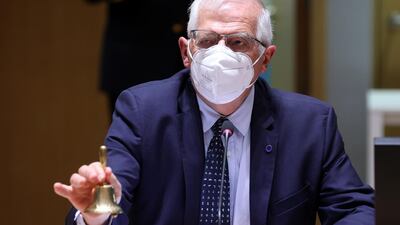

The EU said it holds Russia responsible for the health of Alexei Navalny, after doctors warned the condition of the Kremlin critic was rapidly deteriorating.
Josep Borrell, the EU’s foreign policy chief, also described the situation on the Russia-Ukraine border as “very dangerous”, amid a build-up of Russian troops there.
He said that more than 100,000 Russian soldiers had massed on Ukraine's border and in the annexed Crimea, although there were currently no further EU sanctions against Russia being proposed.
Mr Navalny, who is in a Russian jail, began a hunger strike on March 31, demanding treatment for back and leg pain.
He was moved to a prison hospital on Monday, although Russian authorities insisted his condition was "satisfactory" and said he was taking vitamin supplements as part of medical treatment.
He was arrested in Russia in January, after surviving a nerve agent poisoning he claims was ordered by the Kremlin.
"We make the Russian authorities responsible for the health situation of Mr Navalny," Mr Borrell said, ahead of the video conference with EU foreign ministers where Russia was top of the agenda.
Lithuania said its foreign minister Gabrielius Landsbergis would propose that the EU "take immediate measures" at the talks on Monday.
"If the international community does not respond, the regime's opposition leader will be sent silently to his death," Mr Landsbergis said.
Ukraine’s foreign minister Dmytro Kuleba briefed his EU counterparts on the tensions with Russia.
"I proposed a step-by-step plan on how to discourage Moscow from further escalation," he said on Twitter.
"Key element: preparing a new set of sectoral sanctions. Individual ones are not sufficient anymore."
German foreign minister Heiko Maas said; "the good news is that Mr Navalny now finally appears to receive urgently necessary medical aid.
"We will follow very closely if this actually happens," he added
-

Russian opposition leader Alexei Navalny, with his wife Yulia, daughter Daria and son Zakhar. AP, file -
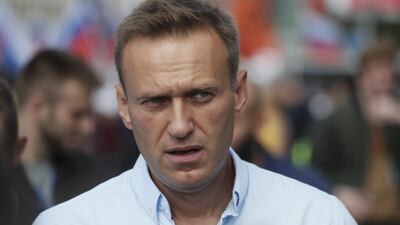
Russian Opposition activist Alexei Navalny attends a rally in support of opposition candidates in the Moscow City Duma elections in downtown of Moscow. EPA, file -
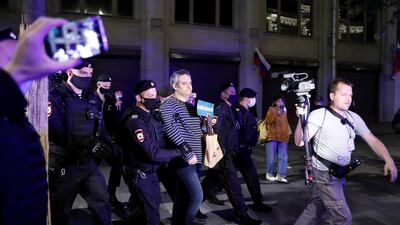
Police officers detain a man during a single-person demonstration in support of Russian opposition leader Alexei Navalny near the presidential administration headquarters in central Moscow. Reuters -
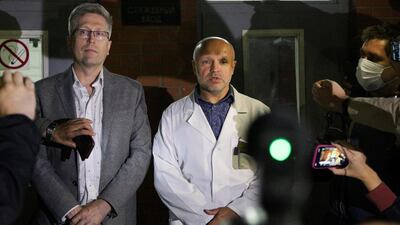
Anatoly Kalinichenko, deputy chief doctor of the Omsk Ambulance Hospital No. 1, right, and Boris Teplykh, head of the department of anaesthesiology and resuscitation of the Pirogov's medical centre, speak to the media at the intensive care unit where Alexei Navalny was hospitalised. AP -
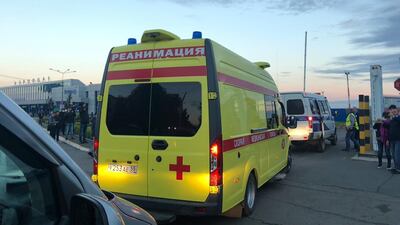
An ambulance carrying Alexei Navalny from the Omsk Ambulance Hospital No. 1, intensive care unit to the airport. Alexei Navalny's press team via AP -
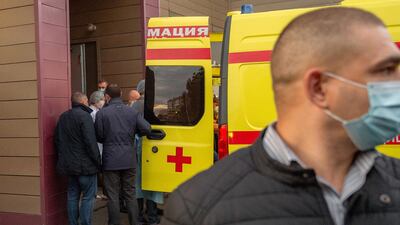
Russian medics put opposition politician Alexei Navalny into an ambulance to transport him from an emergency care hospital to an airport. EPA -

Medics upload Alexei Navalny into a German special medical plane at an airport in Omsk. Alexei Navalny's press team via AP -
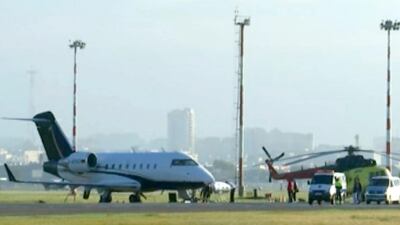
Russian opposition leader Alexei Navalny, centre on stretcher, is transported to a German special medical plane at an airport in Omsk. AP -
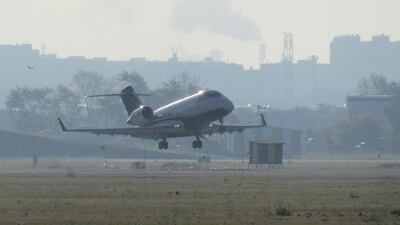
An ambulance aircraft evacuating Russian opposition leader Alexei Navalny for medical treatment in a German hospital takes off. Reuters


Mr Borrell said Russia’s live fire exercises and deployment of troops on its border with Ukraine had made for a very dangerous situation.
"All in all, relations with Russia are not improving. On the contrary, the tension is increasing on different fronts."
Initially Mr Borrell had told a press conference that more than 150,000 Russian soldiers had built up on the Ukraine border and in the Crimea. But his office later retracted that figure and corrected it to more than 100,000.
At the weekend, French President Emmanuel Macron said that while dialogue with Russia is essential, “clear red lines” carrying possible sanctions must also be drawn with Moscow over Ukraine.
Mr Kuleba has repeatedly asked for more western backing, saying “words of support aren’t enough”.

