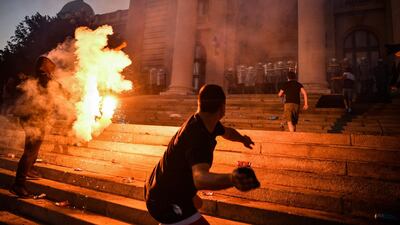
TOPSHOT - Protesters clash with police in front of Serbia's National Assembly building in Belgrade on July 8, 2020 during a demonstration against a weekend curfew announced to combat a resurgence of COVID-19 infections despite Serbia's president said today it might be scrapped  after the measure sparked the day before angry protests that ended in clashes with police. Chaotic scenes rocked Belgrade on July 7 at night after thousands of people streamed into the city centre to protest the president's announcement that authorities would reimpose a round-the-clock weekend lockdown. Around 20 people were arrested and dozens were injured in running battles between police, who used tear gas, and protesters who stormed into parliament, threw rocks at officers and were accused of setting police cars alight.  / AFP / ANDREJ ISAKOVIC
Chaotic scenes rocked Belgrade on July 7 at night after thousands of people streamed into the city centre to protest. AFP

Coronavirus: Serbs protest against government's handling of pandemic


Protests have spread across Serbia against the government’s handling of the coronavirus outbreak as infections surge and lockdown measures are reintroduced.

President Aleksandar Vucic claimed that “criminal hooligans” were behind the demonstrations that injured 10 policeman on Wednesday, according to the government.

The interior minister, Nebojsa Stefanovic, said one man had fractured both his legs as protesters threw rocks and police were forced to use teargas in Belgrade, Serbia’s capital.

The protests began on Tuesday after Mr Vucic said a curfew would be brought back into force, although this order has since been withdrawn.

On Thursday, gatherings of more than 10 people were banned as officials feared the health system could be threatened.

Critics claim the authorities have underreported the number of deaths while hastily lifting almost all virus restrictions before a national election in late June. Serbia has reported more than 17,000 infections and 340 deaths among a population of seven million.

TOPSHOT - Protestors clash with police in Belgrade on July 8, 2020 as violence erupts against a weekend curfew announced to combat a resurgence of COVID-19 infections despite Serbia's President Aleksandar Vucic saying that the weekend curfew is likely to be scrapped. Chaotic scenes rocked Belgrade on July 7 at night after thousands of people streamed into the city centre to protest the president's announcement that authorities would reimpose a round-the-clock weekend lockdown. Around 20 people were arrested and dozens were injured in running battles between police, who used tear gas, and protesters who stormed into parliament, threw rocks at officers and were accused of setting police cars alight.  / AFP / Oliver BUNIC
Tear gas was used by police and protesters threw rocks at officers. AFP

"I have promised you that we will be able to protect peace and stability despite the violent attacks by criminal hooligans, which shock us all," Mr Vucic said as he travelled to France to meet President Emmanuel Macron.

On Thursday, Hungary’s government said it was reviewing rules on travel to neighbouring countries as Covid-19 cases rose in Serbia, Austria, Croatia, Romania, Slovenia and Slovakia.


TOPSHOT - Protestors face police in Belgrade on July 8, 2020 as clashes erupt with demonstrators against a weekend curfew announced to combat a resurgence of COVID-19 infections despite Serbia's President Aleksandar Vucic saying that the weekend curfew is likely to be scrapped. Chaotic scenes rocked Belgrade on July 7 at night after thousands of people streamed into the city centre to protest the president's announcement that authorities would reimpose a round-the-clock weekend lockdown. Around 20 people were arrested and dozens were injured in running battles between police, who used tear gas, and protesters who stormed into parliament, threw rocks at officers and were accused of setting police cars alight.  / AFP / Andrej ISAKOVIC
Protesters face police in Belgrade on July 8, 2020 as clashes erupt. AFP
