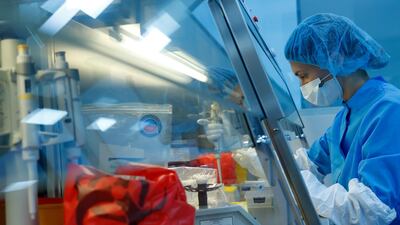
The WHO assists countries in collecting dangerous specimens and ensures labs follow appropriate biosafety and biosecurity measures. Reuters

Boom in high-security bio labs brings greater pandemic risk


Thomas Harding
  • English
  • Arabic

BIOSAFETY LABS SECURITY LEVELS

Biosafety Level 1

The lowest safety level. These labs work with viruses that are minimal risk to humans.

Hand washing is required on entry and exit and potentially infectious material decontaminated with bleach before thrown away.

Must have a lock. Access limited. Lab does not need to be isolated from other buildings.

Used as teaching spaces.

Study microorganisms such as Staphylococcus which causes food poisoning.

Biosafety Level 2

These labs deal with pathogens that can be harmful to people and the environment such as Hepatitis, HIV and salmonella.

Working in Level 2 requires special training in handling pathogenic agents.

Extra safety and security precautions are taken in addition to those at Level 1

Biosafety Level 3

These labs contain material that can be lethal if inhaled. This includes SARS coronavirus, MERS, and yellow fever.

Significant extra precautions are taken with staff given specific immunisations when dealing with certain diseases.

Infectious material is examined in a biological safety cabinet.

Personnel must wear protective gowns that must be discarded or decontaminated after use.

Strict safety and handling procedures are in place. There must be double entrances to the building and they must contain self-closing doors to reduce risk of pathogen aerosols escaping.

Windows must be sealed. Air from must be filtered before it can be recirculated.

Biosafety Level 4

The highest level for biosafety precautions. Scientist work with highly dangerous diseases that have no vaccine or cure.

All material must be decontaminated.

Personnel must wear a positive pressure suit for protection. On leaving the lab this must pass through decontamination shower before they have a personal shower.

Entry is severely restricted to trained and authorised personnel. All entries are recorded.

Entrance must be via airlocks.

The risk of a devastating viral outbreak has increased significantly with the rapid increase in laboratories that handle the world's deadliest diseases, a top biosecurity expert has warned.

The World Health Organisation (WHO) faces calls to reinforce its rules and send more inspectors to Biosafety Level 4 security labs, more than 100 of which are expected worldwide within a few years.

Without greater legislation and security there was a high chance of a ‘Covid 25’ or similar virus outbreak that would harm the world’s population, said biosecurity expert Hamish de Bretton-Gordon. “The WHO say they stipulate this but it doesn’t seem anybody is policing it," he said "We need a complete review of biological security. We have to sort it out now otherwise we are going to be brought to our knees by Covid-25.”

The WHO assists countries in collecting dangerous specimens and ensures labs follow appropriate biosafety and biosecurity measures. This means that countries must meet commitments under the International Health Regulations.

The number of Level 4 labs has risen from only a handful a few decades ago to around 70 and will total more than 100 in a few years. Countries such as Iran, Syria, Sudan and North Korea are all understood to have or have been developing the labs along with India and the Philippines.

"There has been an 'eruption in growth' of Level 4 labs," Mr De Bretton-Gordon told The National. "Recent developments in the pharmaceutical industry have seen them appear all over the world dealing with the deadliest pathogens. That's a real concern."

The high-security Level 4 labs contain viruses that can be easily transmitted, causing fatal disease in humans for which there is no available vaccine or cure. Among other deadly pathogens, they will hold stores of Ebola, plague, anthrax bacteria and Marburg virus for research purposes. Many are built in earthquake and bombproof bunkers and are protected by the highest level of security.

Early Level 4 labs were started by militaries researching biological warfare but this was outlawed by the Biological Weapons Convention in 1972. Under the UN charter, proliferation of biological weapons “constitutes a threat to international peace and security”. States are obliged to prevent the manufacture or development of biological weapons.

But without tougher laws and regulations there are concerns that countries, terrorists or criminals could deliberately or accidentally release a deadly virus on the world population.

Outside established labs in Europe and the United States there are worries about security elsewhere, especially over unsubstantiated reports that Covid-19 might have escaped from the Level 4 lab in Wuhan, China.

Mr De Bretton-Gordon, who helped tackle ISIS’s biological and chemical programmes, has called for detailed legislation to govern development of labs.

“When it comes to protocols and legislation, biological is a very poor relation to the chemical world where you have the Chemical Weapons Convention, which is policed by the OPCW [Organisation for Prohibition of Chemical Weapons] and has been very successful.”

The former British Army officer, who led Nato's rapid reaction Chemical Biological Radiological and Nuclear Battalion, suggested the best way to pass laws was through the Biological Weapons Convention using weapons inspectors similar to the OPCW who have the remit to go to all countries.

The expert has already briefed the US Senate and British authorities about the proposal. He added: “The 1972 Convention is really very poor relation to chemical one. It’s poorly funded and doesn’t have anyone policing it because people thought bio was a thing of past.”

While research has been done on pandemics from SARS and MERS to Ebola it was thought scientists could handle a coronavirus outbreak.

“The thing about Covid is that it’s not very toxic and it was thought this would not create much trouble but we now know it’s brought the world to its knees and will take years to resolve it. Essentially we have been undone by a not very toxic pathogen.”


Electric scooters: some rules to remember
  • Riders must be 14-years-old or over
  • Wear a protective helmet
  • Park the electric scooter in designated parking lots (if any)
  • Do not leave electric scooter in locations that obstruct traffic or pedestrians
  • Solo riders only, no passengers allowed
  • Do not drive outside designated lanes
Company%20profile
%3Cp%3E%3Cstrong%3ECompany%20name%3A%3C%2Fstrong%3E%20Letswork%3Cbr%3E%3Cstrong%3EStarted%3A%3C%2Fstrong%3E%202018%3Cbr%3E%3Cstrong%3EBased%3A%3C%2Fstrong%3E%20Dubai%3Cbr%3E%3Cstrong%3EFounders%3A%20%3C%2Fstrong%3EOmar%20Almheiri%2C%20Hamza%20Khan%3Cbr%3E%3Cstrong%3ESector%3A%3C%2Fstrong%3E%20co-working%20spaces%3Cbr%3E%3Cstrong%3EInvestment%20stage%3A%3C%2Fstrong%3E%20%242.1%20million%20in%20a%20seed%20round%20with%20investors%20including%20500%20Global%2C%20The%20Space%2C%20DTEC%20Ventures%20and%20other%20angel%20investors%3Cbr%3E%3Cstrong%3ENumber%20of%20employees%3A%3C%2Fstrong%3E%20about%2020%3C%2Fp%3E%0A
The%20specs
%3Cp%3E%3Cstrong%3EEngine%3A%20%3C%2Fstrong%3E2.3-litre%204cyl%20turbo%0D%3Cbr%3E%3Cstrong%3EPower%3A%20%3C%2Fstrong%3E299hp%20at%205%2C500rpm%0D%3Cbr%3E%3Cstrong%3ETorque%3A%20%3C%2Fstrong%3E420Nm%20at%202%2C750rpm%0D%3Cbr%3E%3Cstrong%3ETransmission%3A%20%3C%2Fstrong%3E10-speed%20auto%0D%3Cbr%3E%3Cstrong%3EFuel%20consumption%3A%20%3C%2Fstrong%3E12.4L%2F100km%0D%3Cbr%3E%3Cstrong%3EOn%20sale%3A%20%3C%2Fstrong%3ENow%0D%3Cbr%3E%3Cstrong%3EPrice%3A%20%3C%2Fstrong%3EFrom%20Dh157%2C395%20(XLS)%3B%20Dh199%2C395%20(Limited)%3C%2Fp%3E%0A
Other workplace saving schemes
  • The UAE government announced a retirement savings plan for private and free zone sector employees in 2023.
  • Dubai’s savings retirement scheme for foreign employees working in the emirate’s government and public sector came into effect in 2022.
  • National Bonds unveiled a Golden Pension Scheme in 2022 to help private-sector foreign employees with their financial planning.
  • In April 2021, Hayah Insurance unveiled a workplace savings plan to help UAE employees save for their retirement.
  • Lunate, an Abu Dhabi-based investment manager, has launched a fund that will allow UAE private companies to offer employees investment returns on end-of-service benefits.
MATCH INFO

Wales 1 (Bale 45 3')

Croatia 1 (Vlasic 09')

Company info

Company name: Entrupy 

Co-founders: Vidyuth Srinivasan, co-founder/chief executive, Ashlesh Sharma, co-founder/chief technology officer, Lakshmi Subramanian, co-founder/chief scientist

Based: New York, New York

Sector/About: Entrupy is a hardware-enabled SaaS company whose mission is to protect businesses, borders and consumers from transactions involving counterfeit goods.  

Initial investment/Investors: Entrupy secured a $2.6m Series A funding round in 2017. The round was led by Tokyo-based Digital Garage and Daiwa Securities Group's jointly established venture arm, DG Lab Fund I Investment Limited Partnership, along with Zach Coelius. 

Total customers: Entrupy’s customers include hundreds of secondary resellers, marketplaces and other retail organisations around the world. They are also testing with shipping companies as well as customs agencies to stop fake items from reaching the market in the first place. 

UAE currency: the story behind the money in your pockets
PRESIDENTS CUP

Draw for Presidents Cup fourball matches on Thursday (Internationals first mention). All times UAE:

02.32am (Thursday): Marc Leishman/Joaquin Niemann v Tiger Woods/Justin Thomas
02.47am (Thursday): Adam Hadwin/Im Sung-jae v Xander Schauffele/Patrick Cantlay
03.02am (Thursday): Adam Scott/An Byeong-hun v Bryson DeChambeau/Tony Finau
03.17am (Thursday): Hideki Matsuyama/CT Pan v Webb Simpson/Patrick Reed
03.32am (Thursday): Abraham Ancer/Louis Oosthuizen v Dustin Johnson/Gary Woodland

if you go

The flights

Emirates have direct flights from Dubai to Glasgow from Dh3,115. Alternatively, if you want to see a bit of Edinburgh first, then you can fly there direct with Etihad from Abu Dhabi.

The hotel

Located in the heart of Mackintosh's Glasgow, the Dakota Deluxe is perhaps the most refined hotel anywhere in the city. Doubles from Dh850

 Events and tours

There are various Mackintosh specific events throughout 2018 – for more details and to see a map of his surviving designs see glasgowmackintosh.com

For walking tours focussing on the Glasgow Style, see the website of the Glasgow School of Art. 

More information

For ideas on planning a trip to Scotland, visit www.visitscotland.com

COMPANY%20PROFILE
%3Cp%3E%3Cstrong%3ECompany%20name%3A%3C%2Fstrong%3E%20Alaan%3Cbr%3E%3Cstrong%3EStarted%3A%3C%2Fstrong%3E%202021%3Cbr%3E%3Cstrong%3EBased%3A%3C%2Fstrong%3E%20Dubai%3Cbr%3E%3Cstrong%3EFounders%3A%3C%2Fstrong%3E%20Parthi%20Duraisamy%20and%20Karun%20Kurien%3Cbr%3E%3Cstrong%3ESector%3A%3C%2Fstrong%3E%20FinTech%3Cbr%3E%3Cstrong%3EInvestment%20stage%3A%3C%2Fstrong%3E%20%247%20million%20raised%20in%20total%20%E2%80%94%20%242.5%20million%20in%20a%20seed%20round%20and%20%244.5%20million%20in%20a%20pre-series%20A%20round%3Cbr%3E%3Cbr%3E%3C%2Fp%3E%0A
BIOSAFETY LABS SECURITY LEVELS

Biosafety Level 1

The lowest safety level. These labs work with viruses that are minimal risk to humans.

Hand washing is required on entry and exit and potentially infectious material decontaminated with bleach before thrown away.

Must have a lock. Access limited. Lab does not need to be isolated from other buildings.

Used as teaching spaces.

Study microorganisms such as Staphylococcus which causes food poisoning.

Biosafety Level 2

These labs deal with pathogens that can be harmful to people and the environment such as Hepatitis, HIV and salmonella.

Working in Level 2 requires special training in handling pathogenic agents.

Extra safety and security precautions are taken in addition to those at Level 1

Biosafety Level 3

These labs contain material that can be lethal if inhaled. This includes SARS coronavirus, MERS, and yellow fever.

Significant extra precautions are taken with staff given specific immunisations when dealing with certain diseases.

Infectious material is examined in a biological safety cabinet.

Personnel must wear protective gowns that must be discarded or decontaminated after use.

Strict safety and handling procedures are in place. There must be double entrances to the building and they must contain self-closing doors to reduce risk of pathogen aerosols escaping.

Windows must be sealed. Air from must be filtered before it can be recirculated.

Biosafety Level 4

The highest level for biosafety precautions. Scientist work with highly dangerous diseases that have no vaccine or cure.

All material must be decontaminated.

Personnel must wear a positive pressure suit for protection. On leaving the lab this must pass through decontamination shower before they have a personal shower.

Entry is severely restricted to trained and authorised personnel. All entries are recorded.

Entrance must be via airlocks.