


More than 70 per cent of Nagorno-Karabakh’s population has now fled to Armenia, part of a continuing stream after the swift fall of the separatist enclave.
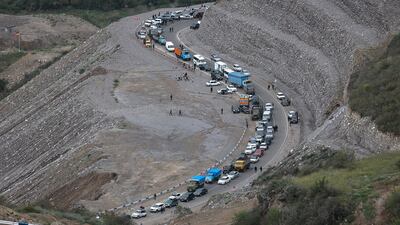
More than 88,000 people have crossed into Armenia from Nagorno-Karabakh and the total could reach 120,000, according to UN refugee agency officials on Friday.
On Thursday it was announced that the separatist government will cease to exist on January 1, after a decree signed by President Samvel Shakhramanyan, who declared the dissolution of all state institutions by the new year – an apparent death knell for its 30-year de facto independence.
Azerbaijan, which routed the region’s Armenian forces in a lightning offensive last week, has pledged to respect the rights of the territory’s Armenian community and urged the population not to leave.
But many in Armenia and the diaspora fear a centuries-long community in the territory they call Artsakh will disappear in what they say is a new wave of ethnic cleansing.
They accuse European countries, Russia and the United States – and the government of Armenia itself – of failing to protect ethnic Armenians during months when the territory was blockaded by Azerbaijan’s military and in the lightning blitz earlier this month that defeated separatist forces.
Armenians say the loss is a historic blow.
Outside the modern country of Armenia itself, the mountainous land was one of the only surviving parts of a heartland that centuries ago stretched across what is now eastern Turkey, into the Caucasus region and western Iran.
Many in the diaspora had pinned their dreams on it gaining independence or being joined to Armenia.
Nagorno-Karabakh was “a page of hope in Armenian history”, said Narod Seroujian, a Lebanese-Armenian university lecturer in Beirut.
“It showed us that there is hope to gain back a land that is rightfully ours. For the diaspora, Nagorno-Karabakh was already part of Armenia.”
Ethnic Armenians have communities around Europe and the Middle East and in the United States. Lebanon is home to one of the largest, with an estimated 120,000 people of Armenian origin, 4 per cent of the population.
Most are descendants of those who fled the 1915 campaign by Ottoman Turks in which about 1.5 million Armenians died in massacres, deportations and forced marches.
The atrocities, which emptied many ethnic Armenian areas in eastern Turkey, are widely viewed by historians as genocide. Turkey rejects the description, saying the toll has been inflated and that those killed were victims of civil war and unrest during the First World War.
Thousands flee Nagorno-Karabakh - in pictures
-
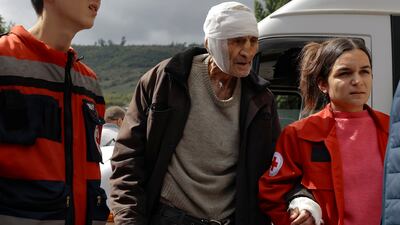
A wounded Armenian man from Stepanakert, Nagorno-Karabakh, is helped by volunteers as he arrives in Goris, Armenia. AP -
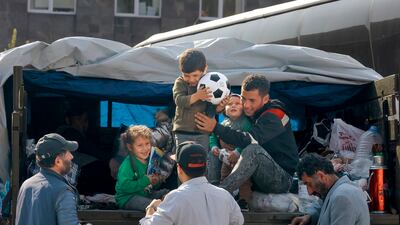
A family from Nagorno-Karabakh are helped as they leave a truck with their belongings after arriving at Goris. AP -
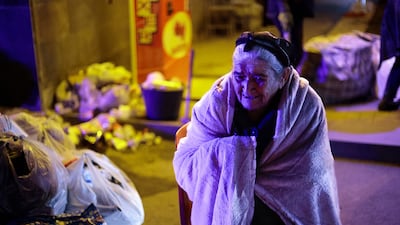
An Armenian woman from Nagorno-Karabakh warms herself near a tent camp after arriving in Goris. AP -
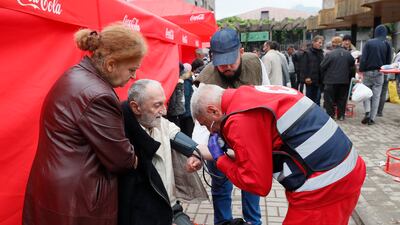
A medic helps an Armenian man from Nagorno-Karabakh near the registration and distribution centre in Goris. EPA -
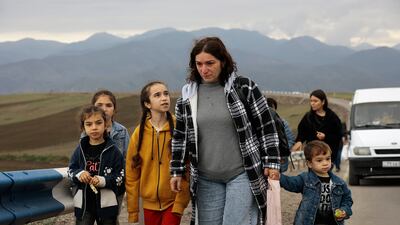
Ethnic Armenians fleeing Nagorno-Karabakh walk on a road to Kornidzor, in Armenia's Syunik region. AP -
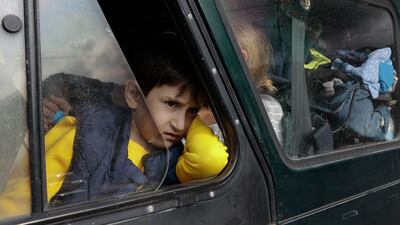
An ethnic Armenian boy from Nagorno-Karabakh, looks out from a car window upon his arrival in Goris, Armenia's Syunik region. AP -
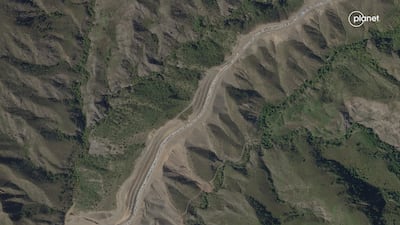
A satellite view of a long traffic jam of vehicles along the highway approaching to the Armenian border with Azerbaijan, at the Lachin corridor in the Nagorno-Karabakh region. AP -
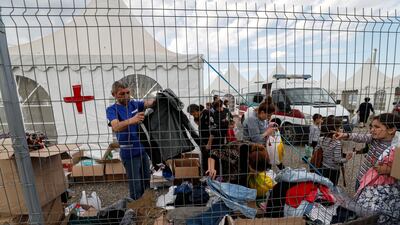
Armenian volunteers distribute clothes to ethnic Armenians fleeing Nagorno-Karabakh, after they crossed the Azerbaijan-Armenia border near the village of Kornidzor, Armenia. EPA -
Ethnic Armenians flee Nagorno-Karabakh to Kornidzor, in Armenia's Syunik region. AP -
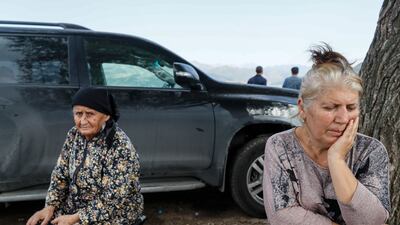
Ethnic Armenians fleeing Nagorno-Karabakh region rest on a roadside after crossing the border with Azerbaijan, near the village of Kornidzor. EPA -
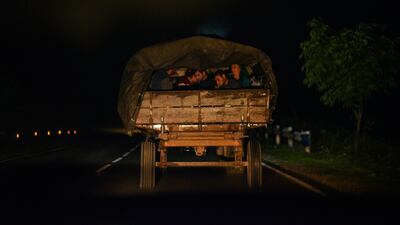
Ethnic Armenians from Nagorno-Karabakh sit in the back of a vehicle after crossing the border on their way to an Armenian Ministry of Foreign Affairs registration centre in Kornidzor, Armenia. EPA -
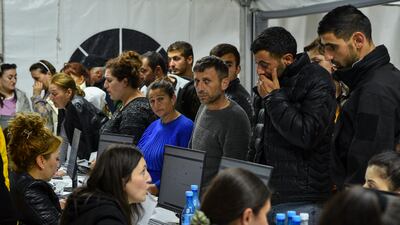
Ethnic Armenians at the registration centre. EPA -
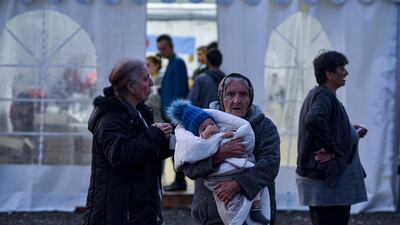
An elderly woman holds an infant. EPA -
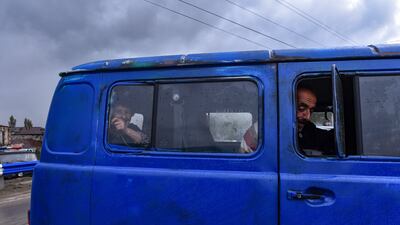
Ethnic Armenians from Nagorno-Karabakh look on from inside a van. EPA -

Ethnic Armenians arrive at the registration centre. EPA -
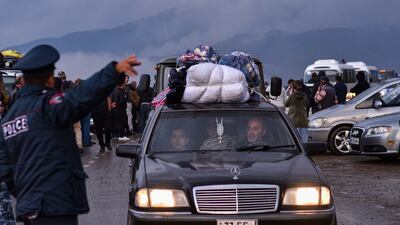
Ethnic Armenians arrive at the registration centre. EPA -

Ethnic Armenians from Nagorno-Karabakh wait near Kornidzor, the town in Syunik region, Armenia. AP -
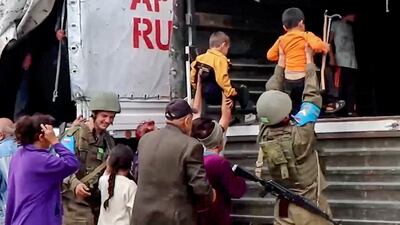
Russian peacekeepers evacuate Nagorno-Karabakh civilians at an undisclosed location. AFP -
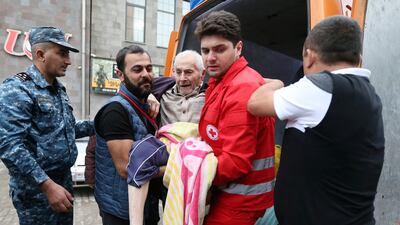
A refugee from Nagorno-Karabakh region is carried out of a vehicle upon arrival at a temporary accommodation centre in the town of Goris, Armenia. Reuters -
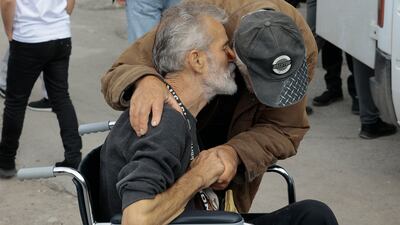
An ethnic Armenian embraces a man upon arrival in Armenia's Goris. AP -
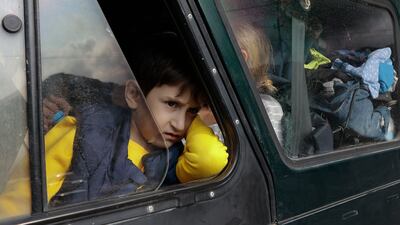
An ethnic Armenian boy from Nagorno-Karabakh, looks on from a car upon arrival in Goris. AP


In Bourj Hammoud, the main Armenian district in the capital Beirut, memories are still raw, with anti-Turkey graffiti common on the walls. The red, blue and orange Armenian flag flies from many buildings.
“This is the last migration for Armenians,” said Harout Bshidikian, 55, sitting in front of an Armenian flag in a Bourj Hamoud cafe. “There is no other place left for us to migrate from.”
Azerbaijan says it is reuniting its territory, pointing out that even Armenia’s prime minister recognised that Nagorno-Karabakh is part of Azerbaijan.
Although its population has been predominantly ethnic Armenian Christians, Turkish Muslim Azeris have communities and cultural ties to the territory as well, particularly the city of Shusha, famed as a cradle of Azeri poetry.
Nagorno-Karabakh came under control of ethnic Armenian forces backed by the Armenian military in separatist fighting that ended in 1994.
Azerbaijan took parts of the area in a war in 2020. Now, after this month’s defeat, separatist authorities surrendered their weapons and are holding talks with Azerbaijan on reintegration of the territory into Azerbaijan.
In December, Azerbaijan imposed a blockade of the only road connecting Nagorno-Karabakh with Armenia, alleging that the Armenian government was using the road for mineral extraction and illicit weapons shipments to the region’s separatist forces.
Armenia claimed that the closure denied basic food and fuel supplies to Nagorno-Karabakh.
Azerbaijan rejected the accusation, saying that the region could receive supplies through the Azerbaijani city of Aghdam – a solution long resisted by Nagorno-Karabakh authorities, who called it a strategy for Baku to gain control of the region.
Meanwhile, 170 people are known to have died after a fuel reservoir exploded at a petrol station where people trying to leave were queuing for fuel that, due to the blockade, had been in short supply.
"To date, a total of 170 remains ... have been found in the same area and handed over to the forensic medical examination bureau," the separatist authorities said on social media on Friday.
Authorities had earlier said the blast claimed the lives of 68 people and injured another 200. They said on Monday that remains would be transferred to Armenia for identification.
The fireball erupted as refugees were stocking up on fuel for the long drive along the lone mountain road leading to Armenia.

