



A Ukraine bridgehead could penetrate Russian lines after it is reinforced by almost 1,000 British-trained marines, military analysts have said.
The new amphibious combat troops could prove a formidable force if used to cross the Dnipro River, where at least two small Ukrainian bridgeheads have already been established.
A new front could be exploited in the Kherson region, where Russian forces have been weakened by redeployments and are not as deep as elsewhere along the 1,000km front.
Russia is also struggling to send reinforcements across the front as Ukraine makes small but important advances in three other combat zones.
On Wednesday it was reported that it had "liberated" the small town of Urozhaine in the Donetsk region and taken the majority of Robotyne to the west, an important strategic settlement of 150 homes.
It has now become clear that in the past few weeks, Ukrainian infantry units have managed to cross the kilometre-wide Dnipro after its waters abated following Russian’s destruction of the Nova Kakhovka dam in early June.
A light force of about 100 soldiers has maintained a foothold across from the Antonovsky bridge, south of Kherson city, and is threatening the Russian-held town of Oleshky.
But since last week, another similar sized force has established a bridgehead 20km to the east that is attacking the Russian-held town of Kozachi Laheri.
According to the UK’s Defence Intelligence report, the assault has been timed for when Moscow was forced to move highly capable VDV airborne troops out of the area to defend against Ukraine advances in the Zaporizhzhia and Donetsk regions as well as the town of Bakhmut.
“Over the last week, there has been an uptick in small-scale combat along the banks of the lower reaches of the Dnipro River,” the report said.
“Ukrainian forces have worked to raid or set up small bridgeheads at new locations on the Russian-held east bank. Some of these operations likely took advantage of a local Russian force rotation.”
There are also reports that Ukraine has established a third bridgehead at Hola Prystan, west of the Antonovsky bridge, giving them a section of riverfront in Russian territory.

Marine raiders
The footholds could now be reinforced by the imminent arrival of the 900 troops who have spent the past six months being trained by Britain’s Royal Marines and Army Commandos.
“The training has seen British commandos training Ukraine’s forces in small boat amphibious operations – conducting beach raids using inflatable boats,” the UK’s Ministry of Defence announced on Friday.
The soldiers are now accomplished in both day and night amphibious raids, use of NLAW anti-tank weapons, Stinger anti-aircraft missiles, mortars and drones.
The ministry also disclosed they had been trained in “explosive demolition of obstacles such as Dragon’s Teeth anti-vehicle fortifications”.
These defences have been planted in depth by Russia, and if the Ukrainians can get tanks and other armour across the Dnipro, the explosives training will assist a potential breakthrough.
The Institute for the Study of War think tank also suggested that the Russians are increasingly concerned that Ukrainian forces have established “semi-lasting positions” across the river.

Linking up
If the three bridgeheads can link up and forces move inland to take Oleshky and Kozachi Laheri, this could allow Ukraine enough space to bring over armoured vehicles and artillery.
That could then create enough defended space to allow a pontoon bridge to be built, although this is among the most challenging military tasks and would be vulnerable to Russian air and artillery strikes.
But if the bridgehead can be exploited, then the most direct route to Crimea will have opened up in an area that is likely to be less heavily mined or protected than others along the front.
If Crimea comes under direct attack, this will have both severe military and political repercussions for President Vladimir Putin’s regime.
“If I was the Ukrainian military commander and I thought that the Russian opposition against one of my bridgeheads was sufficiently weak, that I could break out from it, then I'd be seeking to get weapons and vehicles across that would help me break out,” said Brig Ben Barry of the IISS think tank.
“If the Russians don't contest these bridgeheads, then you can be absolutely certain Ukrainians will advance.”
In addition, the 900 British-trained marines could make a “considerable difference” being trained in river crossings.

He added that at an east-bank Dnipro footprint would also distract Russian forces from other Ukrainian offensive operations, forcing them to further thin out their lines.
Brig Barry that it was possible that the marines could also be used for direct seaborne attack on the Crimea peninsula “which is vulnerable to amphibious raids”.
Sam Cranny-Evans, an associate of the Rusi think tank, said it was likely the 900 marines would be used in a more substantial Dnipro crossing but “there's really difficulty for either side to concentrate any kind of mass”.
While building a pontoon bridge was “fairly straightforward”, an “opposed bridge crossing is probably one of the hardest military operations to do”.
He added that the Ukrainians also had amphibious BMP2 armoured vehicles that can swim through water and T72 tanks can – “in theory” – snorkel underwater.

Elastic defence
Elsewhere along the front, Ukraine is making small but steady gains with the seizure of Urozhaine and Robotyne potential opening up routes deeper into Russian-held territory towards the Sea of Azov.
But with huge Russian minefields making swift advance near impossible, it appears Kyiv is undertaking an attritional campaign simultaneously on three main pressure points.
In response, Russia is using an “elastic defence”, moving whatever reserves it has left laterally along the front line, but these forces are under-resourced and have been fighting continuously for months.
There are also increasing reports that the Russians lack counter-battery fire, allowing Ukraine to press home its precision artillery advantage, including the use of cluster munitions.
“The Ukrainians are hoping that if they keep stretching the Russian defences sooner or later the Russian elastic band will snap,” said Brig Barry.
Mr Cranny-Evans added: “The idea of a very rapid Ukrainian breakout is not formal priority, it's now mostly a slower, more considered attritional approach.
“But Russia has committed nearly all its reserves making it difficult to hold back the gradual advance.”
-
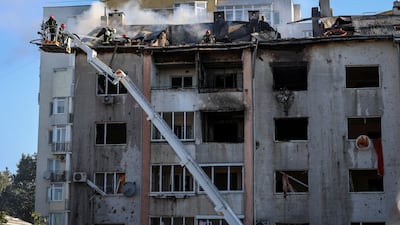
First responders work at the site of a block of flats destroyed by a Russian missile strike in Lviv. Reuters -

A Ukrainian woman practices with a rifle during volunteer military training for civilians near Kyiv. AP -
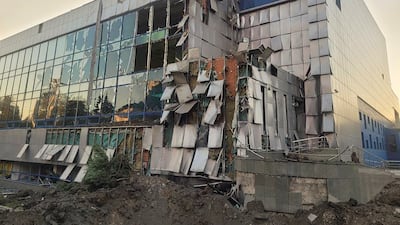
A sport complex damaged by Russian missiles during an attack in Dnipro. EPA -
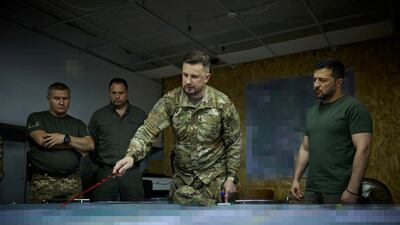
Ukrainian President Volodymyr Zelenskyy is briefed at the front line near Soledar in the eastern Donetsk region. Reuters -
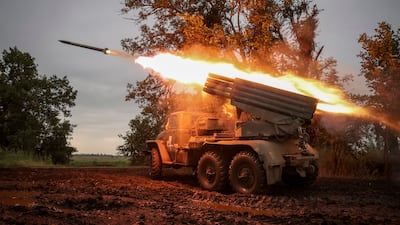
Ukrainian troops fire a BM-21 Grad multiple rocket launcher near the front line in Donetsk region. Reuters -
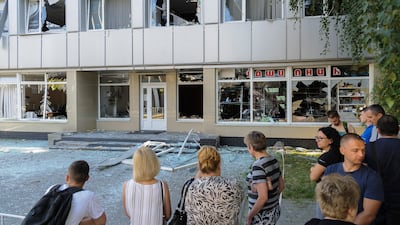
Locals inspect the damage to a building near the impact area of a rocket strike in Lviv. EPA -
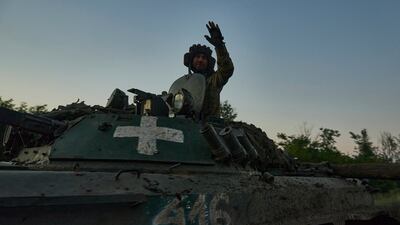
A Ukrainian soldier waves from atop an APC at the front line near Bakhmut in Donetsk region. AP -

A Ukrainian woman holds her daughter in the back of an ambulance operated by Red Cross volunteers in Kupyansk, Kharkiv region. AP -
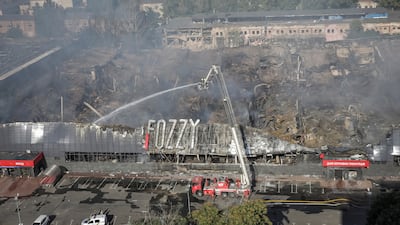
First responders work at the site of a shopping centre destroyed by a Russian attack in Odesa. Reuters -
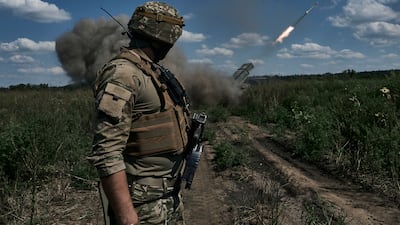
A Ukrainian soldier watches a Grad multiple rocket launcher firing near Bakhmut in Donetsk region. AP -

A Ukrainian woman walks through the destroyed home of her son, who was killed the day before by shelling in Donetsk. Reuters -
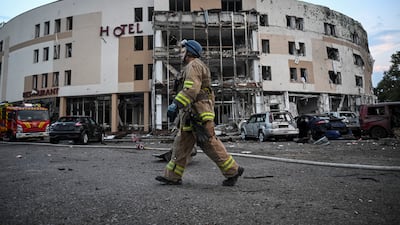
Firefighters work at the scene where a hotel was damaged by Russian missile fire in Zaporizhzhia. Reuters


He also warned that if Ukraine did manage a breakout using an armoured column, it would be extremely vulnerable to Russian aviation, particularly the K-52 attack helicopters.
The Russians were using a highly effective tactic of scattering mines, either with missiles or artillery, in front of Ukraine armoured advances, creating a block then using the K-52 anti-tank missiles to pick them off from up to 8km away.
However, Russia has lost an estimated 40 K-52s, with another destroyed on Monday, out of its stock of 133 helicopters.
Brig Barry argued that if, before the autumn rains, the Ukrainians manage to advance within artillery range of the M14 motorway, a key supply route that goes through southern Ukraine close to the Sea of Azov, this would be a major step.

