


German Chancellor Olaf Scholz told Russian President Vladimir Putin on Friday that Moscow bore a "responsibility" for disruptions in the global food supply after its invasion of Ukraine.
Germany's Agriculture Minister, Cem Oezdemir, also criticised grain theft by Russia in eastern Ukraine, as G7 countries met to discuss the effect of the war on the global food supply.
"The chancellor and the Russian president also spoke about the global food situation, which is particularly strained due to Russia's war of aggression," Mr Scholz's office said after a 75-minute call between the leaders.
"The chancellor reminded him that Russia bears a particular responsibility here."
Before the invasion, Ukraine was seen as the world's bread basket, exporting 4.5 million tonnes of agricultural produce a month. It provided 12 per cent of the world's wheat, 15 per cent of its corn and half of its sunflower oil.
But with the ports of Odesa, Chornomorsk and others cut off from the world by Russian warships, supplies can only be moved on land routes that are much less efficient.
Mr Scholz said the conversation with Mr Putin on Friday morning, after a call with Ukrainian President Volodymyr Zelenskyy on Wednesday, was focused on "the war in Ukraine and efforts to end it".
He urged Mr Putin "given the gravity of the military situation and the consequences of the war in Ukraine, especially in Mariupol", to implement a "ceasefire as soon as possible to improve the humanitarian situation and make progress in the search for a diplomatic solution to the conflict".
Mr Scholz also "firmly rejected" Moscow's accusation "that Nazism is widespread in Ukraine".

At the start of a meeting in Stuttgart with colleagues from G7 countries, Ukraine, the EU, the OECD and the UN Food and Agricultural Organisation, Mr Oezdemir said Russia was stealing grain from Ukraine.
"This is an especially repugnant form of war that Russia is leading," he said.
Russia was "stealing, robbing, taking for itself grain from eastern Ukraine," Mr Oezdemir said, describing it as an "economic war".
The Russian occupation in the fertile eastern regions of the country would also have an effect on this year's crops.
"Ukraine is in a very difficult situation with regard to grain exports," Ukrainian Agriculture Minister Mykola Solsky said before the meeting.
"We cannot get away from the fact that the harvest will be smaller than last year."
Discussions had already begun on how to move more grain out of Ukraine "over land, by train and along the Danube", which flows from Germany to Ukraine, to "rescue" the produce stuck in the country, Mr Oezdemir said.
Food security was already on the agenda for the G7 meeting of foreign ministers, which began on Thursday in the northern German resort of Wangels.
Ukraine’s Foreign Minister, Dmytro Kuleba, said on Friday that his country was willing to engage in diplomatic talks with Russia to unblock grain supplies and to achieve a political solution to the war in Ukraine, but will not accept ultimatums from Moscow.

Mr Kuleba said the Ukrainian government had received “no positive feedback” from Russia, which he claimed “prefers wars to talks.”
“We are ready to talk, but we are ready for a meaningful conversation based on mutual respect, not on the Russian ultimatums thrown on the table,” he said outside the meeting.
At that conference, Ukraine again asked the G7 to increase weapons supply to put pressure on Russia.
Mr Kuleba said his talks with G7 ministers had been “helpful, fruitful, very honest and result-oriented". He praised them for the financial and military support they had so far provided to Ukraine.
But he urged Ukraine’s supporters to supply more weapons, including rocket systems and military planes, and to put more pressure on Russia’s economy by increasing sanctions and following Canada’s lead in seizing Russian sovereign assets to pay for rebuilding Ukraine.
The EU’s foreign affairs chief, Josep Borrell, announced plans to give Ukraine another €500 million ($520m) to buy heavy weapons to fend off the Russian invasion.
“We will provide a new tranche of 500 more millions to support the military of Ukraine,” Mr Borrell said.
The funds would be allocated to buy heavy weapons and take the EU’s total financial support for Ukraine to €2 billion, he said.
-
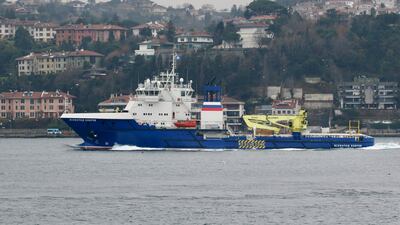
Russian Navy logistics support ship the 'Vsevolod Bobrov', pictured off Istanbul in January, has reportedly caught fire after a Ukrainian airstrike in the Black Sea. Reuters -
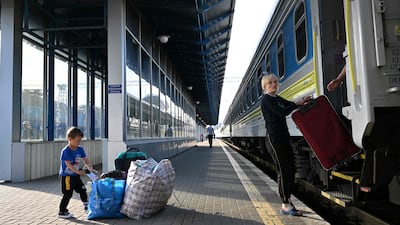
A mother and child who fled Ukraine arrive back in Kyiv from Poland. The daily number returning has exceeded those leaving for the first time since the February invasion. AFP -
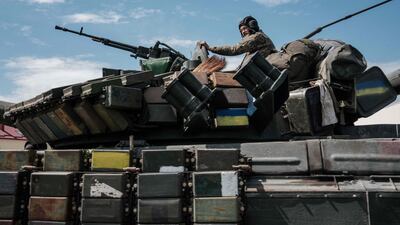
A Ukrainian tank - with a soldier in it - is carried by a transporter near Bakhmut. AFP -
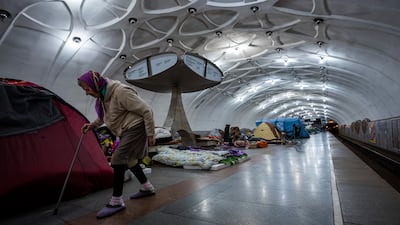
A metro station used as a bomb shelter in Kharkiv, Ukraine. AFP -
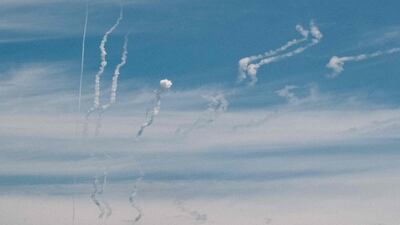
Rocket trails in the sky over Pylypchatyne, eastern Ukraine. AFP -
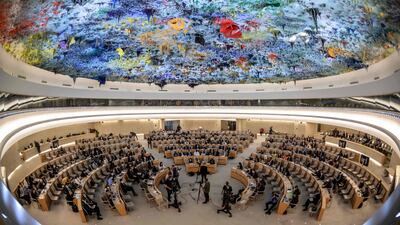
A special session of the UN Human Rights Council on Ukraine is held in Geneva, Switzerland. AFP -
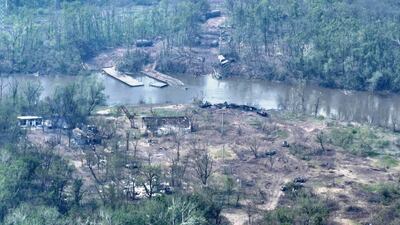
Burnt vehicles and the remains of what appears to be a makeshift bridge across the Siverskyi Donets River in eastern Ukraine. Reuters -
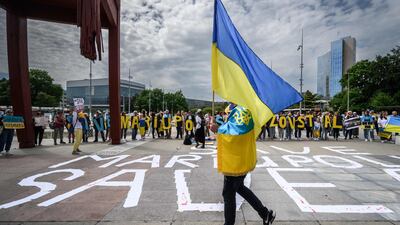
Protesters outside a special session of the UN Human Rights Council on the war in Ukraine, in Geneva. Inside, Ukrainians lambasted the 'sheer horror' and 'pure evil' being inflicted on their country by Russian forces. AFP -
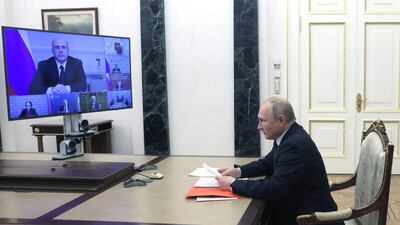
Russian President Vladimir Putin chairs a meeting on economic issues via a video link in Moscow. AFP -
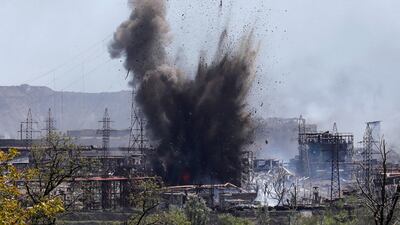
An explosion at the Azovstal steel works in Mariupol, Ukraine. Reuters -
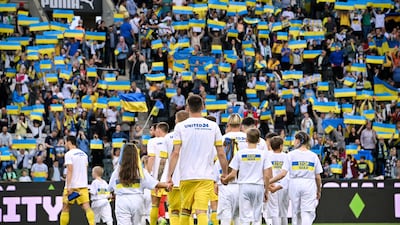
Players walk onto the pitch before a benefit football match between Borussia Moenchengladbach and the national team of Ukraine at Borussia-Park in Moenchengladbach, Germany. EPA -
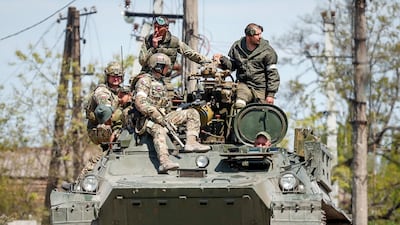
Russian service members atop an armoured vehicle in Mariupol. Reuters -
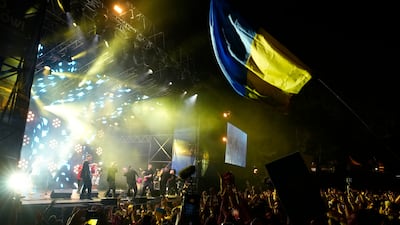
The Kalush Orchestra from Ukraine perform at the Eurovision Village in Turin, Italy. AP Photo -
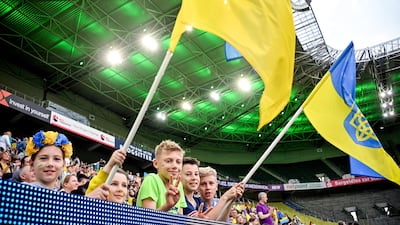
Borussia Moenchengladbach fans and Ukraine supporters stand united ahead of the benefit football match between Borussia Moenchengladbach and the national team of Ukraine. EPA -
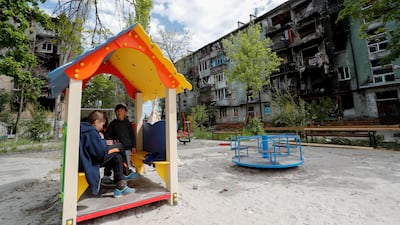
Children gather at a playground in Mariupol. Reuters -
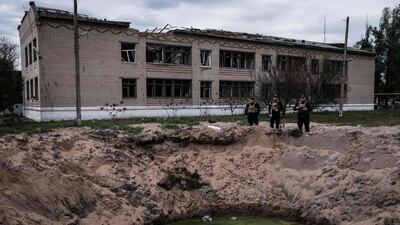
Three Ukrainian policemen stand at an explosion site in Novomykolaivka, eastern Ukraine. AFP -
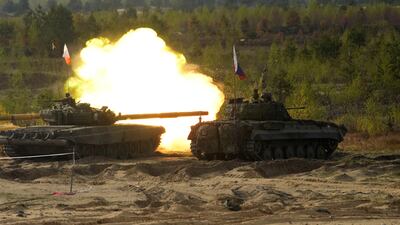
The Iron Spear 2022 military exercise led by Nato-enhanced Forward Presence battlegroup in Adazi, Latvia, on May 11. Reuters / Ints Kalnins -
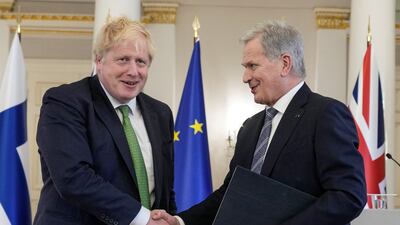
British Prime Minister Boris Johnson and Finnish President Sauli Niinisto shake hands in Helsinki, Finland, after signing a declaration between the UK and Finland to deepen their defence and security co-operation. Reuters -

Russian paratroopers go on the attack in Ukraine's Kharkiv region. EPA


EU diplomats cautioned that any disbursement requires backing from all of the bloc’s 27 members. Some countries are expressing misgivings, and approval is unlikely before next week.
European Council President Charles Michel, who represents the governments of EU members in Brussels, threw his “full support” behind the plan.
“Time is of the essence,” Mr Michel wrote on Twitter.
Mr Borrell expressed hope of soon getting the bloc’s member states to agree to an oil embargo against Russia, despite resistance from Hungary, which is heavily dependent on Moscow's exports.
French Foreign Minister Jean-Yves Le Drian said the G7 was "very strongly united" in their will to "continue in the long term to support Ukraine's fight for its sovereignty until Ukraine's victory".
British Foreign Secretary Liz Truss also called for more support for Ukraine.
"It is very important at this time that we keep up the pressure on Vladimir Putin by supplying more weapons to Ukraine, by increasing the sanctions," Ms Truss said.

