Live updates: follow the latest news on Russia-Ukraine
Russian strikes slammed into central Kyiv on Thursday as UN Secretary General Antonio Guterres was visiting, wounding 10 people in the first such rocket attack on the city since mid-April.
A loud blast rocked the Ukrainian capital about around 5.15pm GMT, sending emergency vehicles racing to a neighbourhood in an attack that shook Mr Guterres and his team.
Emergency services said one strike hit a 25-storey residential block, partially destroying two floors, while AFP reported that a low-rise building was in flames, with rescuers at the scene.
Twelve fire lorries were called in to put out the blaze, with rescuers confirming 10 people were wounded in the strikes, raising an earlier toll of three.
Kyiv mayor Vitali Klitschko said there had been "two hits in the Shevchenkovsky district", one of which struck "the lower floors of a residential building".
A spokesman confirmed that all of the UN delegation were "safe".
"It is a war zone but it is shocking that it happened close to us," Saviano Abreu, spokesman for the UN's humanitarian office, told AFP.
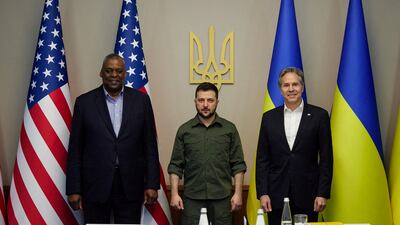
The attack took place less than an hour after Mr Guterres and Volodymyr Zelenskyy held a joint media briefing 3.5 kilometres from the point of impact.
"Today, immediately after the end of our talks in Kyiv, Russian missiles flew into the city. Five rockets," Mr Zelenskyy said.
"This says a lot … about the Russian leadership's efforts to humiliate the UN and everything that the organisation represents."
He said the attack required "a correspondingly powerful reaction".
Ukrainian Foreign Minister Dmytro Kuleba denounced it as a "heinous act of barbarism", while Defence Minister Oleksiy Reznikov said it was "an attack on the security of the Secretary General and on world security".
The strikes came two days after Mr Guterres held talks in Moscow with Russian President Vladimir Putin, who told him he remained hopeful that negotiations could end the conflict.
The timing was not lost on Mykhaylo Podolyak, a senior aide to Mr Zelenskyy.
"Missile strikes in the downtown of Kyiv during the official visit of Antonio Guterres," Mr Podolyak tweeted.
The day before, he was sitting at a long table in the Kremlin, and today explosions are above his head."
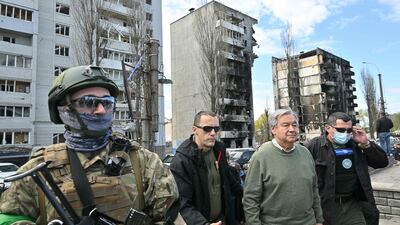
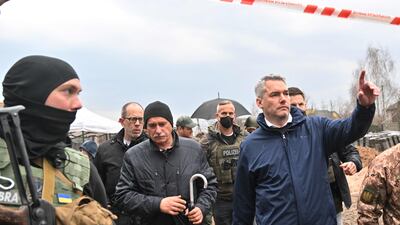
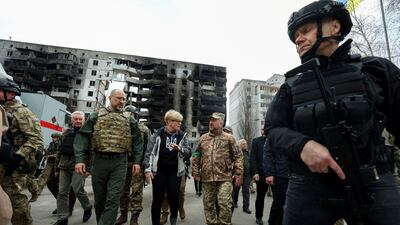
Earlier, on his first visit to Ukraine since Russia launched a full-scale invasion on February 24, Mr Guterres toured towns and villages near Kyiv where Russian forces are accused of killing civilians.
"War is an absurdity in the 21st century. The war is evil," he said after visiting places including Bucha, where dozens of bodies in civilian clothes were found, some with their hands bound and others buried in shallow graves.
Later, alongside Mr Zelenskyy, Mr Guterres admitted the Security Council, in which Russia as a permanent member holds a right of veto, had failed to go far enough in its efforts to "prevent and end" Moscow's war in Ukraine.
"Let me be very clear: the Security Council failed to do everything in its power to prevent and end this war. And this is the source of great disappointment, frustration and anger," he said.

Crops that could be introduced to the UAE
1: Quinoa
2. Bathua
3. Amaranth
4. Pearl and finger millet
5. Sorghum
What is a calorie?
A food calorie, or kilocalorie, is a measure of nutritional energy generated from what is consumed.
One calorie, is the amount of heat needed to raise the temperature of 1 kilogram of water by 1°C.
A kilocalorie represents a 1,000 true calories of energy.
Energy density figures are often quoted as calories per serving, with one gram of fat in food containing nine calories, and a gram of protein or carbohydrate providing about four.
Alcohol contains about seven calories a gram.
Profile of VoucherSkout
Date of launch: November 2016
Founder: David Tobias
Based: Jumeirah Lake Towers
Sector: Technology
Size: 18 employees
Stage: Embarking on a Series A round to raise $5 million in the first quarter of 2019 with a 20 per cent stake
Investors: Seed round was self-funded with “millions of dollars”
Silent Hill f
Publisher: Konami
Platforms: PlayStation 5, Xbox Series X/S, PC
Rating: 4.5/5
Mercer, the investment consulting arm of US services company Marsh & McLennan, expects its wealth division to at least double its assets under management (AUM) in the Middle East as wealth in the region continues to grow despite economic headwinds, a company official said.
Mercer Wealth, which globally has $160 billion in AUM, plans to boost its AUM in the region to $2-$3bn in the next 2-3 years from the present $1bn, said Yasir AbuShaban, a Dubai-based principal with Mercer Wealth.
“Within the next two to three years, we are looking at reaching $2 to $3 billion as a conservative estimate and we do see an opportunity to do so,” said Mr AbuShaban.
Mercer does not directly make investments, but allocates clients’ money they have discretion to, to professional asset managers. They also provide advice to clients.
“We have buying power. We can negotiate on their (client’s) behalf with asset managers to provide them lower fees than they otherwise would have to get on their own,” he added.
Mercer Wealth’s clients include sovereign wealth funds, family offices, and insurance companies among others.
From its office in Dubai, Mercer also looks after Africa, India and Turkey, where they also see opportunity for growth.
Wealth creation in Middle East and Africa (MEA) grew 8.5 per cent to $8.1 trillion last year from $7.5tn in 2015, higher than last year’s global average of 6 per cent and the second-highest growth in a region after Asia-Pacific which grew 9.9 per cent, according to consultancy Boston Consulting Group (BCG). In the region, where wealth grew just 1.9 per cent in 2015 compared with 2014, a pickup in oil prices has helped in wealth generation.
BCG is forecasting MEA wealth will rise to $12tn by 2021, growing at an annual average of 8 per cent.
Drivers of wealth generation in the region will be split evenly between new wealth creation and growth of performance of existing assets, according to BCG.
Another general trend in the region is clients’ looking for a comprehensive approach to investing, according to Mr AbuShaban.
“Institutional investors or some of the families are seeing a slowdown in the available capital they have to invest and in that sense they are looking at optimizing the way they manage their portfolios and making sure they are not investing haphazardly and different parts of their investment are working together,” said Mr AbuShaban.
Some clients also have a higher appetite for risk, given the low interest-rate environment that does not provide enough yield for some institutional investors. These clients are keen to invest in illiquid assets, such as private equity and infrastructure.
“What we have seen is a desire for higher returns in what has been a low-return environment specifically in various fixed income or bonds,” he said.
“In this environment, we have seen a de facto increase in the risk that clients are taking in things like illiquid investments, private equity investments, infrastructure and private debt, those kind of investments were higher illiquidity results in incrementally higher returns.”
The Abu Dhabi Investment Authority, one of the largest sovereign wealth funds, said in its 2016 report that has gradually increased its exposure in direct private equity and private credit transactions, mainly in Asian markets and especially in China and India. The authority’s private equity department focused on structured equities owing to “their defensive characteristics.”
Skewed figures
In the village of Mevagissey in southwest England the housing stock has doubled in the last century while the number of residents is half the historic high. The village's Neighbourhood Development Plan states that 26% of homes are holiday retreats. Prices are high, averaging around £300,000, £50,000 more than the Cornish average of £250,000. The local average wage is £15,458.
COMPANY%20PROFILE
%3Cp%3E%3Cstrong%3ECompany%20name%3A%20%3C%2Fstrong%3ESupy%0D%3Cbr%3E%3Cstrong%3EStarted%3A%20%3C%2Fstrong%3E2021%0D%3Cbr%3E%3Cstrong%3EFounders%3A%20%3C%2Fstrong%3EDani%20El-Zein%2C%20Yazeed%20bin%20Busayyis%2C%20Ibrahim%20Bou%20Ncoula%0D%3Cbr%3E%3Cstrong%3EBased%3A%20%3C%2Fstrong%3EDubai%0D%3Cbr%3E%3Cstrong%3EIndustry%3A%20%3C%2Fstrong%3EFood%20and%20beverage%2C%20tech%2C%20hospitality%20software%2C%20Saas%0D%3Cbr%3E%3Cstrong%3EFunding%20size%3A%20%3C%2Fstrong%3EBootstrapped%20for%20six%20months%3B%20pre-seed%20round%20of%20%241.5%20million%3B%20seed%20round%20of%20%248%20million%0D%3Cbr%3E%3Cstrong%3EInvestors%3A%20%3C%2Fstrong%3EBeco%20Capital%2C%20Cotu%20Ventures%2C%20Valia%20Ventures%20and%20Global%20Ventures%3C%2Fp%3E%0A
What are the GCSE grade equivalents?
- Grade 9 = above an A*
- Grade 8 = between grades A* and A
- Grade 7 = grade A
- Grade 6 = just above a grade B
- Grade 5 = between grades B and C
- Grade 4 = grade C
- Grade 3 = between grades D and E
- Grade 2 = between grades E and F
- Grade 1 = between grades F and G
Dr Afridi's warning signs of digital addiction
Spending an excessive amount of time on the phone.
Neglecting personal, social, or academic responsibilities.
Losing interest in other activities or hobbies that were once enjoyed.
Having withdrawal symptoms like feeling anxious, restless, or upset when the technology is not available.
Experiencing sleep disturbances or changes in sleep patterns.
What are the guidelines?
Under 18 months: Avoid screen time altogether, except for video chatting with family.
Aged 18-24 months: If screens are introduced, it should be high-quality content watched with a caregiver to help the child understand what they are seeing.
Aged 2-5 years: Limit to one-hour per day of high-quality programming, with co-viewing whenever possible.
Aged 6-12 years: Set consistent limits on screen time to ensure it does not interfere with sleep, physical activity, or social interactions.
Teenagers: Encourage a balanced approach – screens should not replace sleep, exercise, or face-to-face socialisation.
Source: American Paediatric Association
BLACKBERRY
%3Cp%3EDirector%3A%20Matt%20Johnson%3C%2Fp%3E%0A%3Cp%3EStars%3A%20Jay%20Baruchel%2C%20Glenn%20Howerton%2C%20Matt%20Johnson%3C%2Fp%3E%0A%3Cp%3ERating%3A%204%2F5%3C%2Fp%3E%0A
Day 3, Dubai Test: At a glance
Moment of the day Lahiru Gamage, the Sri Lanka pace bowler, has had to play a lot of cricket to earn a shot at the top level. The 29-year-old debutant first played a first-class game 11 years ago. His first Test wicket was one to savour, bowling Pakistan opener Shan Masood through the gate. It set the rot in motion for Pakistan’s batting.
Stat of the day – 73 Haris Sohail took 73 balls to hit a boundary. Which is a peculiar quirk, given the aggressive intent he showed from the off. Pakistan’s batsmen were implored to attack Rangana Herath after their implosion against his left-arm spin in Abu Dhabi. Haris did his best to oblige, smacking the second ball he faced for a huge straight six.
The verdict One year ago, when Pakistan played their first day-night Test at this ground, they held a 222-run lead over West Indies on first innings. The away side still pushed their hosts relatively close on the final night. With the opposite almost exactly the case this time around, Pakistan still have to hope they can salvage a win from somewhere.
The burning issue
The internal combustion engine is facing a watershed moment – major manufacturer Volvo is to stop producing petroleum-powered vehicles by 2021 and countries in Europe, including the UK, have vowed to ban their sale before 2040. The National takes a look at the story of one of the most successful technologies of the last 100 years and how it has impacted life in the UAE.
Read part four: an affection for classic cars lives on
Read part three: the age of the electric vehicle begins
Read part one: how cars came to the UAE
UAE squad
Rohan Mustafa (captain), Ashfaq Ahmed, Ghulam Shabber, Rameez Shahzad, Mohammed Boota, Mohammed Usman, Adnan Mufti, Shaiman Anwar, Ahmed Raza, Imran Haider, Qadeer Ahmed, Mohammed Naveed, Amir Hayat, Zahoor Khan
Our legal consultant
Name: Dr Hassan Mohsen Elhais
Position: legal consultant with Al Rowaad Advocates and Legal Consultants.
How to protect yourself when air quality drops
Install an air filter in your home.
Close your windows and turn on the AC.
Shower or bath after being outside.
Wear a face mask.
Stay indoors when conditions are particularly poor.
If driving, turn your engine off when stationary.