


Russia is working on a long-term plan to sanction-proof itself as the escalating punitive measures imposed by the West over the war in Ukraine destabilise global markets and inflate prices worldwide, the head of Russia's largest state-run corporation has said.
In an exclusive interview with The National and the first to an international media outlet since the self-described special military operation in Ukraine in February, director general of Rostec Sergei Chemezov acknowledged that the western sanctions have had an impact but vowed that Russia would emerge stronger.

“You know, I’m into boxing. So, the opponent’s punch was strong, but it didn’t knock us out. We’re still standing. For us, this is an opportunity to regroup, muster our forces, change tactics and continue the fight,” said the head of Rostec, a defence and civilian goods conglomerate with a turnover of nearly $23 billion in 2020.
“The current circumstances are a harsh reality that Russia has been forced into. But it is also an excellent chance to develop and strengthen our technological independence,” added the senior executive.
A close ally of Russian President Vladimir Putin, Mr Chemezov was one of the dozens of officials and businesspeople placed under sanctions by the West in response to Russia's invasion of Ukraine.
-
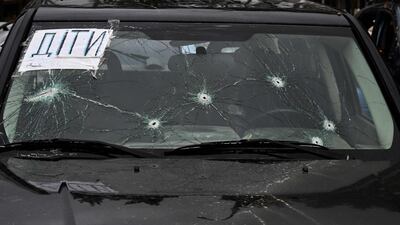
A sign that reads 'Children' is fixed on to a car windscreen riddled with bulletholes in Irpin, Ukraine. AFP -
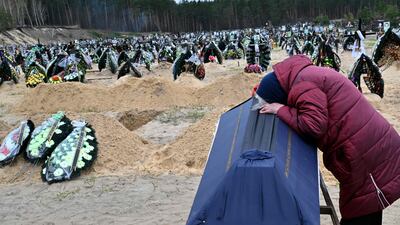
A woman weeps next to her husband's coffin at a cemetery in Irpin. AFP -
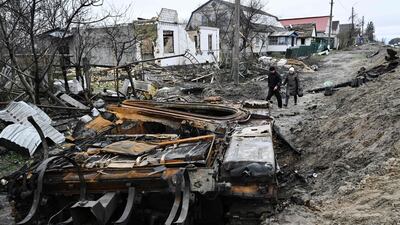
Residents walk amid debris of a charred Russian tank next to destroyed houses in the village of Zalissya. AFP -
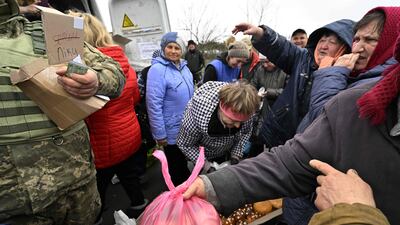
Volunteers distribute food to residents in Zalissya. AFP -
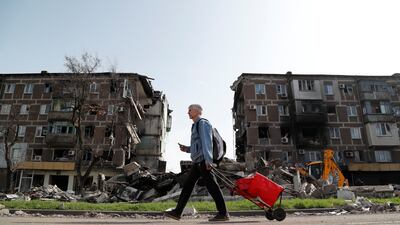
A man walks past a damaged apartment building in the southern port city of Mariupol. Reuters -
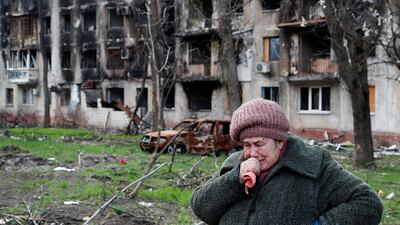
Tamara, 71, cries in front of a destroyed apartment building in Mariupol. Reuters -
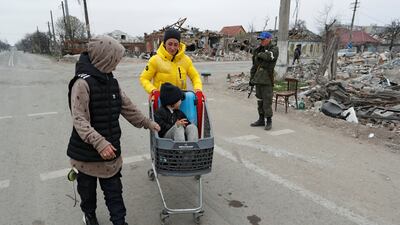
Local residents push a cart with a child past destroyed buildings in Mariupol. Reuters -
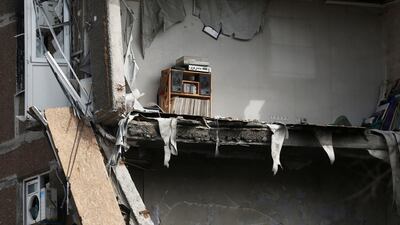
A record player sits among debris inside an apartment in Mariupol. Reuters -
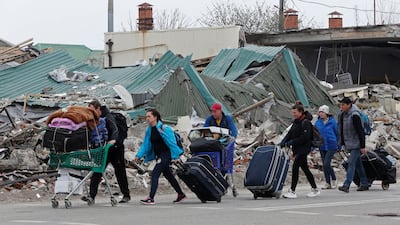
Residents carry belongings past a destroyed building in Mariupol. Reuters -
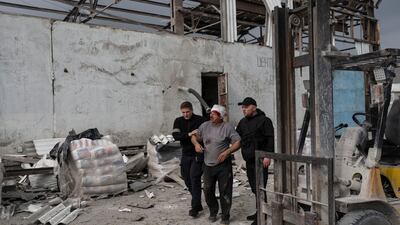
Security guards help an injured man following a Russian bombing of a factory in Kramatorsk. AP -

A man receives first aid treatment. AP -

Soldiers collect explosives after recent battles in the village of Moshchun, close to Kyiv. AP -
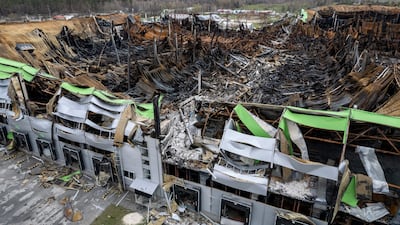
The Komodor logistics park lies in ruins after being bombed and burnt during the Russian invasion near Makarov. Getty Images -
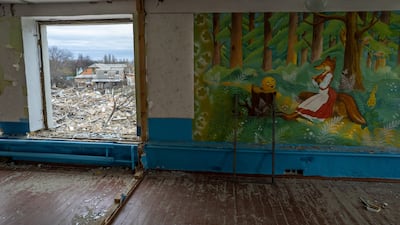
A room in a kindergarten stands windowless in Makarov. Getty Images -
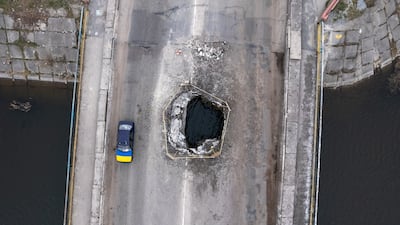
A vehicle draped with a Ukrainian flag passes over a war-damaged bridge in Makarov. Getty Images -
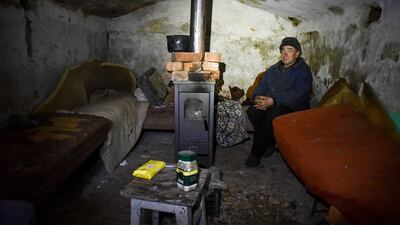
A man sits in a basement that was used as a bomb shelter in the village of Kukhari. EPA -
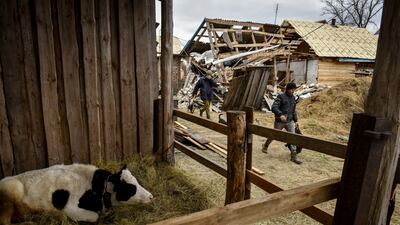
Local residents clean the area around a destroyed farm in Kukhari. EPA -
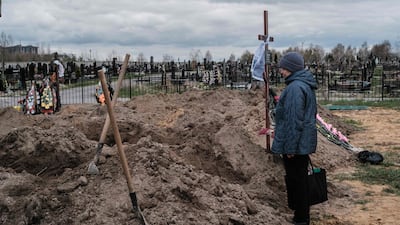
Nadia looks at her husband's coffin at a cemetery in Bucha. He was killed during the war. AFP -
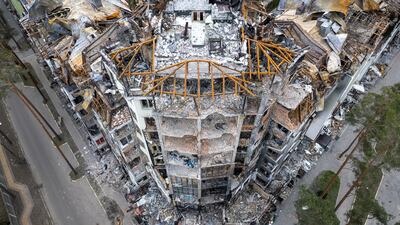
Mangled buildings in Irpin point to the ravages of the ongoing war. Getty Images -
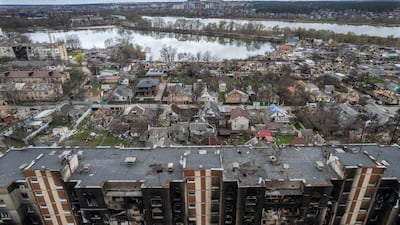
A burnt apartment tower in Irpin. Getty Images -
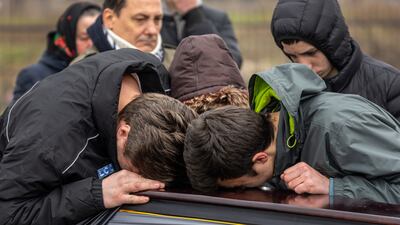
Family members grieve during the funeral of Ruslan Nechyporenko, 47, in Bucha. Getty Images -

An abandoned Russian military position in Borodyanka town near Kyiv. EPA -

Heavily pregnant Dr Marta Kopan, who fled Kyiv with her husband Dr Maxim Motsya and their three-year-old son Makar, narrates their ordeal at a relative's place in Lviv. AP -

A Ukrainian officer searches for unexploded explosives as he passes by an Antonov An-225, the world's biggest cargo aircraft, destroyed during the war on the outskirts of Kyiv. AP -

A woman stands amid the destruction caused when a civilian building was hit by a Russian missile in Lviv, western Ukraine. Getty Images -
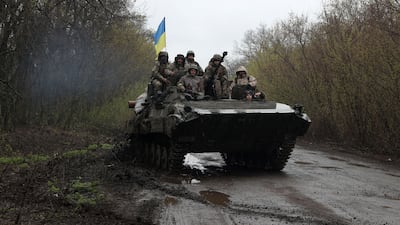
Ukrainian soldiers on an armoured personnel carrier, near the front line with Russian troops, in Izyum district, Kharkiv region, north-eastern Ukraine. AFP -
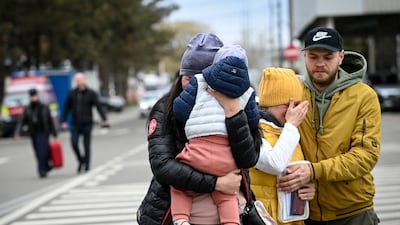
Ukrainian refugees arrive at the Siret border crossing between Romania and Ukraine. AFP -

Ukranian soldiers in a trench look out across the front line near Kharkiv. AFP -
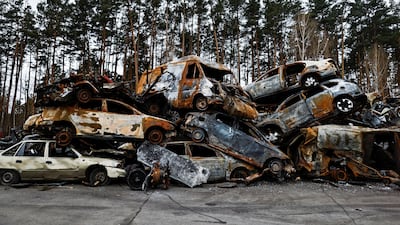
Cars destroyed in Russian attacks, in Irpin, near Kyiv. The scene of fierce fighting, the town was occupied by Russian forces. Reuters -
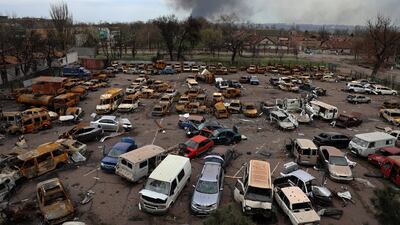
Damaged and destroyed vehicles at Illich Iron and Steel Works Metallurgical Plant, in an area controlled by Russian-backed separatists in besieged south-eastern city Mariupol. AP -
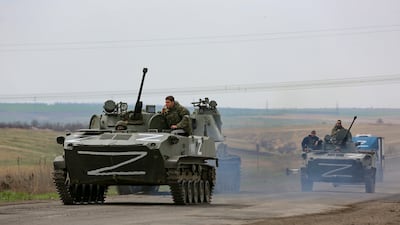
Russian military vehicles in an area controlled by Moscow-backed separatists near Mariupol. AP -
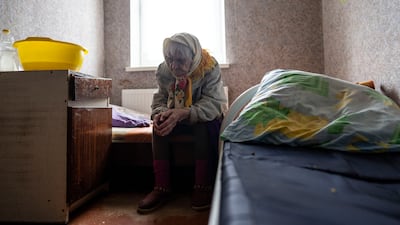
An elderly woman waits do be evacuated from a hospice in Chasiv Yar city, in Donetsk, eastern Ukraine. At least 35 residents have been helped to flee from the region that has been under attack for weeks. AP -
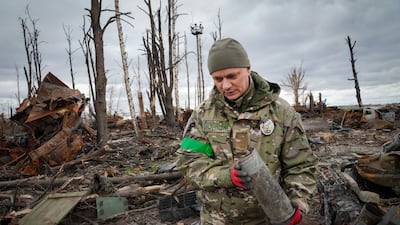
A Ukrainian Interior Ministry serviceman collects unexploded shells, grenades and mines, following fierce fighting in Hostomel. AP


Mr Chemezov says that western sanctions aren’t new to Russia but the scale of the recent measures imposed by the EU, UK and US and allies, including Japan, was tantamount to a ‘’declaration of war”.
Ever since 2014, Russia has been under some form of sanctions from the West over the annexation of Crimea from Ukraine. In response, Mr Chemezov says Russia has become focused on producing goods domestically, including crucial industries like defence and aeronautics.
“Since 2014, Rostec has carried out a deep modernisation, a serious re-equipment of our industry. And, look, we began to produce a lot of what we used to buy abroad,” the former KGB agent said.
“After the ban on the supply of composite materials for the MC-21 civil aircraft, we were able to switch to domestic substitutes quickly. The liner is equipped with a composite wing, produced entirely from domestic components,” added the head of Rostec, which is celebrating its 15th anniversary this year.
In 2007, Mr Putin signed a law to establish Rostec. It has become a conglomerate of dozens of state companies operating in various fields but mainly defence, smart cities, telemedicine, military aviation and online education.
The new sanctions “entail a revision of economic chains and the need to substitute a large number of parts and components that we used to import”, Mr Chemezov said. “This applies to the automotive industry, aircraft industry, electronics and other sectors.”
After the start of the invasion of Ukraine on February 24, the West imposed its harshest-ever sanctions on Russia with the aim of isolating it from the global and financial markets. The US and allies also provided Ukraine with military equipment.
The retaliatory sanctions mainly target Russia’s financial nerve centre — the central bank. Last month, the US added the energy sector — which is the backbone of the Russian economy, making up 45 per cent of last year’s budget — to western sanctions.

It unilaterally banned Russian oil and gas exports in an escalation against the world’s second-largest exporter of crude oil and petroleum products.
The Russian oil and other petroleum products to the US represent only 3 per cent of its overall imports, according to the American Fuel and Petrochemical Manufacturers.
But economists say the move is aimed at encouraging Europe countries, some of which rely heavily on Russian energy, to follow suit.
Former and current European officials, however, said weaning Europe completely off Russian oil and gas overnight isn’t realistic and might take years to materialise. The EU plans to cut its imports of Russian natural gas by two-thirds by the end of this year.
Europe and the UK imported more than a quarter of their oil needs and 40 per cent of liquefied natural gas from Russia last year, according to the European Commission’s Eurostat.
Away from Europe
Mr Chemezov says that damaging the national economy is the outcome Russia’s adversaries — championed by the US, the UK and their European allies — have been scheming to bring about.
He claims that the architects of the new sanctions have connived with one another to “oust” Russia from the global markets under the pretext of the war.
“A year ago, I said in an interview that disconnecting Russia from SWIFT and other tough sanctions would actually mean war. Today, such war has been declared on our country. It is waged against our citizens, our industry, our financial sector, culture and sports,” he said, referring to the decision to kick some of Russia’s largest banks out of the global financial messaging system.
The new western sanctions are mainly aimed at freezing Russia’s $630bn of foreign-exchange reserves and sharply weakening its foreign currency, which has plummeted since the start of the war.
director general of Russia’s main state corporation, Rostec
In a globalised economy, targeting one of the major economies in the world has caused shudders across the world with spikes in the prices of energy products and grains.
Mr Chemezov believes that the exodus of foreign companies from Russia is staged.
“We are well aware of the real attitude of foreign businesses towards the current events. Most of them are against leaving Russia but their internal protest is inarticulate, many leave due to the pressure exerted on them. They face tremendous political pressure from Washington and their national governments. They are forced to leave and suffer losses.”
Many western brands and companies operating in a variety of fields, from food and drinks to technology and entertainment, said business won’t be as usual after the Russian invasion.
It isn’t clear whether the foreign companies have decided to suspend operations in Russia either due to US and European pressure, as Mr Chemezov indicates, or in protest at the war, which has resulted in the killing of thousands, displacement of millions and has reduced residential areas to rubble.
Ukraine has accused Russia of committing war crimes and genocide in towns near the capital of Kyiv that came under Russian control. US President Joe Biden has also described the invasion as a “genocide.”
-
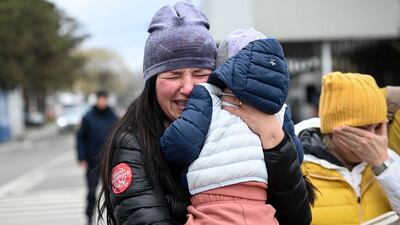
A Ukrainian refugee clings to her child, unable to hold back the despair of upheaval as she arrives at the Romanian border. The number of Ukrainian refugees who have fled has exceeded the 5 million mark as the war enters its ninth week, UN data has indicated. AFP -
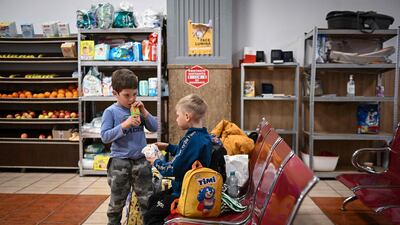
Children who fled the war take a break at a railway station in Bucharest, Romania, a country which has taken in more than 757,000 Ukrainian refugees to date. AFP -
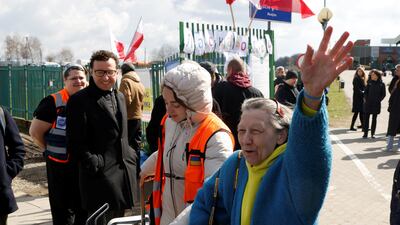
A woman gives a wave after crossing the border from Ukraine into Medyka, Poland. Reuters -
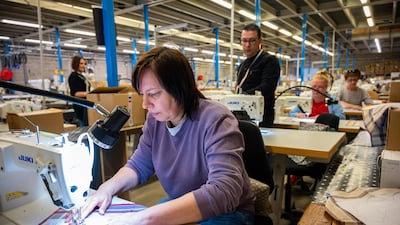
An Ukrainian refugee woman sews in Strasbourg, France, as part of a job scheme for people who have fled the war with Russia. AFP -
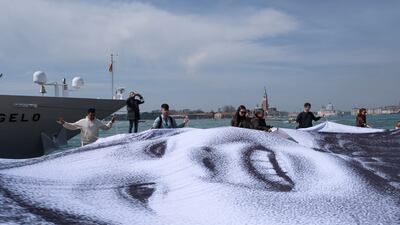
A giant photograph of a young refugee is unveiled as part of an art installation by French contemporary artist JR to show solidarity with Ukraine, in Venice, Italy. Reuters -
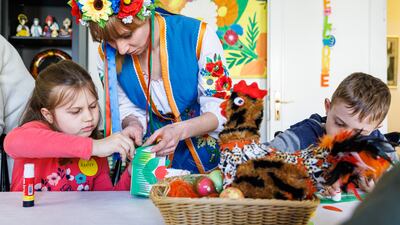
Vladimir and Avigeja Radionow with Kseniia Temcheniuk, who fled war-torn Ukraine, prepare an Easter basket at a cultural centre in Halle, Germany. Getty Images -

Refugees at the border crossing in Medyka, Poland, a country which has to date taken in more than 2,825,000 people from Ukraine. AP Photo -
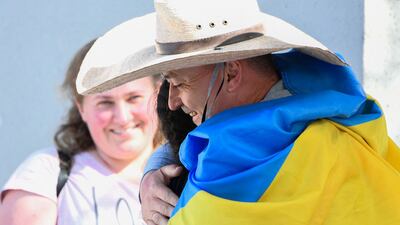
Oleksii Yeromin hugs a Ukrainian refugee at the US-Mexico border. AFP -
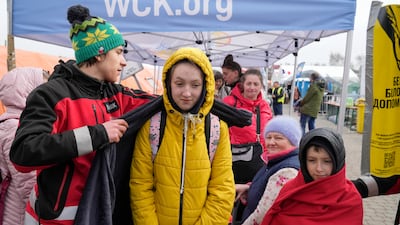
A volunteer covers a refugee with a blanket as she queues at the border crossing in south-eastern Poland. AP Photo


The Kremlin said Mr Biden’s comments were unacceptable and denied that its forces had carried out atrocities in Ukraine.
Mr Chemezov says the West’s sanctions won’t isolate Russia and will help it create new opportunities as it diversifies exports and energy supplies to markets outside Europe.
“Our task is to mitigate the consequences as much as possible. One should understand that international economic relations are neither limited to the dollar or the western payment systems nor monopolised by them,” he said.
Russia has asked European importers of oil and gas to pay in roubles. Most EU governments have dismissed the demand as illegitimate and a breach of existing contracts, which stipulate either paying in dollars or euros.
Without mentioning which new markets Rostec was aiming at, Mr Chemezov said the company was updating a development strategy that takes into account the new reality.
“Regardless of the sanctions, Rostec will increase co-operation with countries that have not become hostage of someone else’s pragmatic business tasks,” he said.

