


Live updates: follow the latest news on Russia-Ukraine
German Chancellor Olaf Scholz is facing dissent from MPs in his own ruling coalition over what many regard as the slow pace of weapons deliveries to Ukraine and a failure by Europe's biggest economy to pull its weight during the crisis.
Accused of damaging Germany’s reputation by offering half-hearted support to Ukraine, Mr Scholz failed to convince his doubters with a defiant statement late on Tuesday insisting he was acting in concert with allies.
Critics seized on a newly published ranking of military and financial aid to Ukraine, which showed Germany’s financial help well down the table and defensive assistance being dwarfed by Britain, the US and much smaller Estonia.
While Estonian Prime Minister Kaja Kallas revelled in her country’s “deeds speaking louder than words”, German MPs bemoaned what they called a lack of leadership from Berlin during Europe’s worst military crisis for decades.
“Let’s face the truth – since February 24, Germany’s standing and reputation have taken an enormous hit in Ukraine,” said Michael Roth, an MP from the chancellor’s Social Democratic Party, referring to the date of Russia’s invasion.
“The perception of Germany is now on a par with Hungary as one of the countries that are blocking the really hard-hitting energy sanctions and arms deliveries.”
Senior figures in Mr Scholz’s party, including President Frank-Walter Steinmeier, are blamed by critics for spearheading a decades-long policy of conciliation towards post-Soviet Russia whose flaws were brutally exposed by the invasion.
Mr Scholz was initially praised for declaring a break with the past, approving the shipment of weapons to Ukraine for the first time and announcing a €100 billion ($108bn) upgrade to a long-neglected military.
But criticism has grown in recent weeks over Germany’s opposition to an urgent energy embargo and its perceived reluctance to hand over heavy weapons, with Kyiv’s ambassador in Berlin regularly taking to Twitter to needle politicians and accuse them of betraying the country's post-Second World War mantra of "never again".
The government counters this by saying it is acting in harmony with allies on weapons and that an immediate fossil fuel ban would punish German consumers at a time when energy prices are already high. It also emphasises its military presence in Lithuania to defend Nato's eastern flank.
But the strained ties between Germany and Ukraine were underlined by a row over a proposed visit to Kyiv by Mr Steinmeier, who said he had cancelled the trip after learning he was not welcome.
A delegation of MPs from the SPD and its two coalition partners, the Greens and the Free Democratic Party, did recently visit Kyiv and called for more weapons to be delivered.

“We are wasting too much time telling Ukraine what the soldiers on the ground can’t do,” said Ulrich Lechte, a foreign policy spokesman for the FDP.
“They’re the ones who have been defending Ukraine for almost two months in this gruesome war. We have to commit ourselves more clearly and deliver corresponding weapons.”
Senior Green politicians have also called for more weapons deliveries, putting the party’s peace activist heritage to one side and touting its longstanding warnings about Germany’s energy dependence on Russia.
A recent poll for German TV suggested Green voters were the most likely of any major party’s supporters to back an energy embargo on Russia and the export of heavy weapons to Ukraine.
The rankings by the Kiel Institute for the World Economy, which showed German financial aid trailing far behind allies, is “embarrassing for us”, said Green MP Claudia Mueller.
“Instead of dwelling on domestic finger-pointing, we should finally ramp up our support,” she said. “And yes, that means delivering heavy weapons.”
Although the table showed Germany in fifth place in total military assistance to Ukraine, it was behind the smaller economies of Britain and Italy, as well as the much smaller one of Estonia, and a long way behind the United States.
-
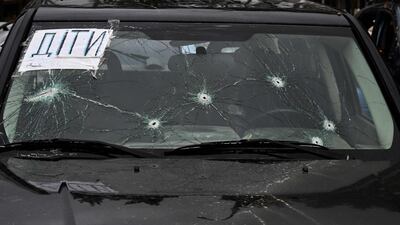
A sign that reads 'Children' is fixed on to a car windscreen riddled with bulletholes in Irpin, Ukraine. AFP -
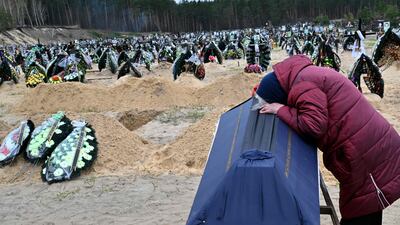
A woman weeps next to her husband's coffin at a cemetery in Irpin. AFP -
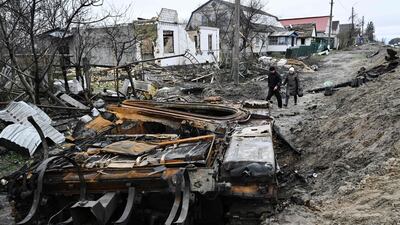
Residents walk amid debris of a charred Russian tank next to destroyed houses in the village of Zalissya. AFP -
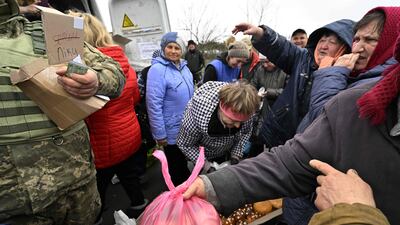
Volunteers distribute food to residents in Zalissya. AFP -
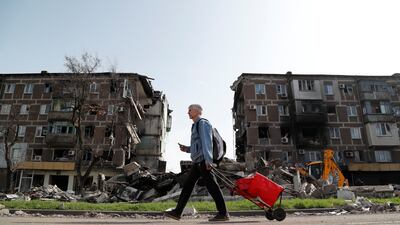
A man walks past a damaged apartment building in the southern port city of Mariupol. Reuters -
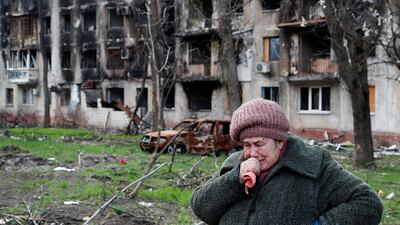
Tamara, 71, cries in front of a destroyed apartment building in Mariupol. Reuters -
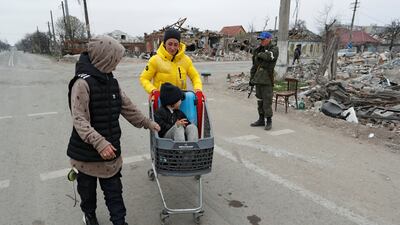
Local residents push a cart with a child past destroyed buildings in Mariupol. Reuters -
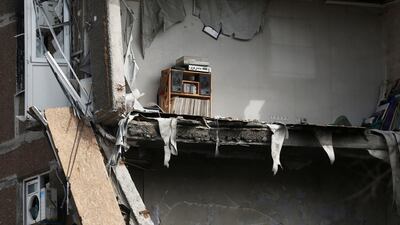
A record player sits among debris inside an apartment in Mariupol. Reuters -
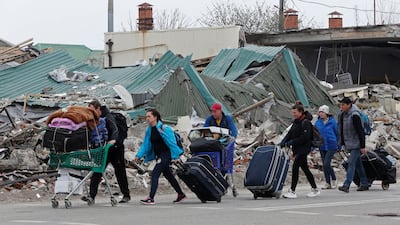
Residents carry belongings past a destroyed building in Mariupol. Reuters -
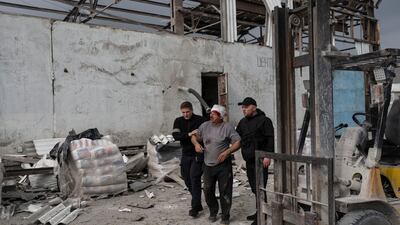
Security guards help an injured man following a Russian bombing of a factory in Kramatorsk. AP -

A man receives first aid treatment. AP -

Soldiers collect explosives after recent battles in the village of Moshchun, close to Kyiv. AP -
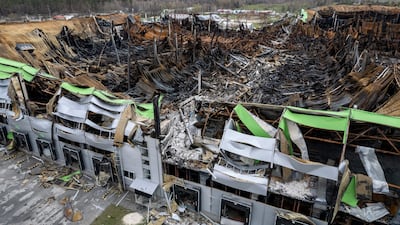
The Komodor logistics park lies in ruins after being bombed and burnt during the Russian invasion near Makarov. Getty Images -
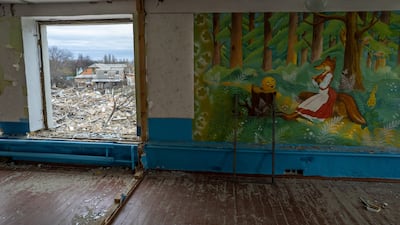
A room in a kindergarten stands windowless in Makarov. Getty Images -
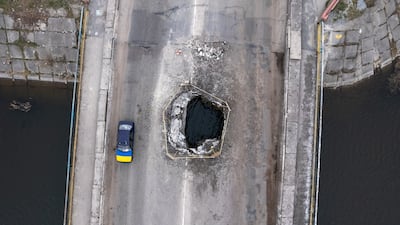
A vehicle draped with a Ukrainian flag passes over a war-damaged bridge in Makarov. Getty Images -
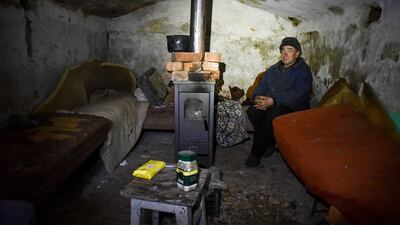
A man sits in a basement that was used as a bomb shelter in the village of Kukhari. EPA -
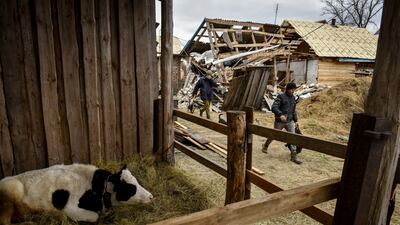
Local residents clean the area around a destroyed farm in Kukhari. EPA -
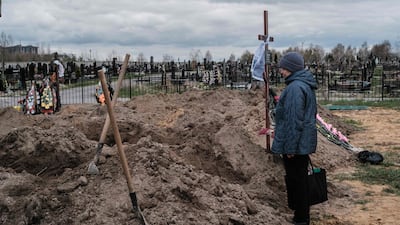
Nadia looks at her husband's coffin at a cemetery in Bucha. He was killed during the war. AFP -
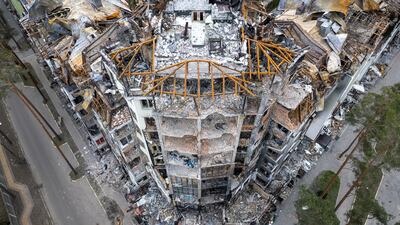
Mangled buildings in Irpin point to the ravages of the ongoing war. Getty Images -
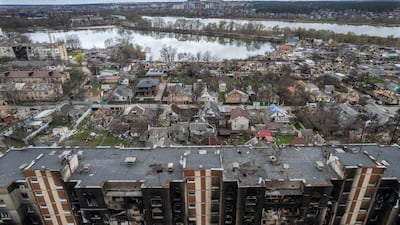
A burnt apartment tower in Irpin. Getty Images -
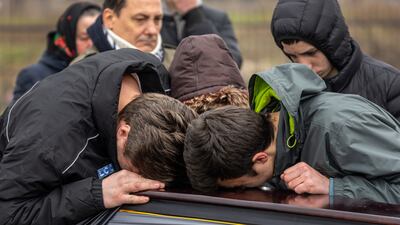
Family members grieve during the funeral of Ruslan Nechyporenko, 47, in Bucha. Getty Images -

An abandoned Russian military position in Borodyanka town near Kyiv. EPA -

Heavily pregnant Dr Marta Kopan, who fled Kyiv with her husband Dr Maxim Motsya and their three-year-old son Makar, narrates their ordeal at a relative's place in Lviv. AP -

A Ukrainian officer searches for unexploded explosives as he passes by an Antonov An-225, the world's biggest cargo aircraft, destroyed during the war on the outskirts of Kyiv. AP -

A woman stands amid the destruction caused when a civilian building was hit by a Russian missile in Lviv, western Ukraine. Getty Images -
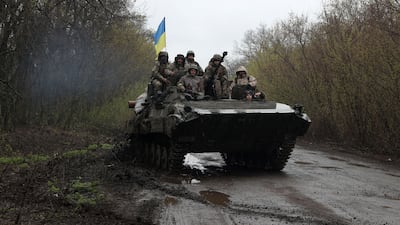
Ukrainian soldiers on an armoured personnel carrier, near the front line with Russian troops, in Izyum district, Kharkiv region, north-eastern Ukraine. AFP -
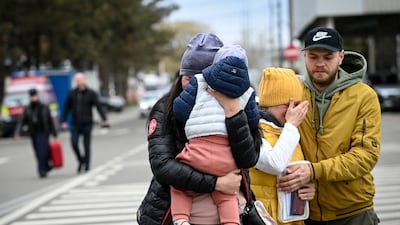
Ukrainian refugees arrive at the Siret border crossing between Romania and Ukraine. AFP -

Ukranian soldiers in a trench look out across the front line near Kharkiv. AFP -
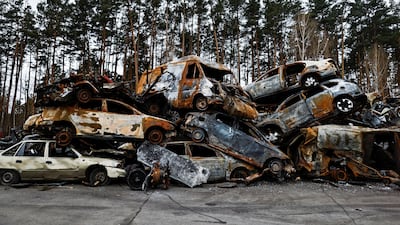
Cars destroyed in Russian attacks, in Irpin, near Kyiv. The scene of fierce fighting, the town was occupied by Russian forces. Reuters -
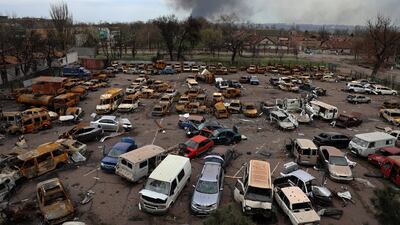
Damaged and destroyed vehicles at Illich Iron and Steel Works Metallurgical Plant, in an area controlled by Russian-backed separatists in besieged south-eastern city Mariupol. AP -
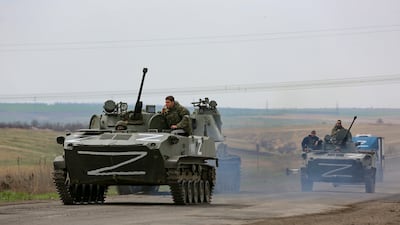
Russian military vehicles in an area controlled by Moscow-backed separatists near Mariupol. AP -
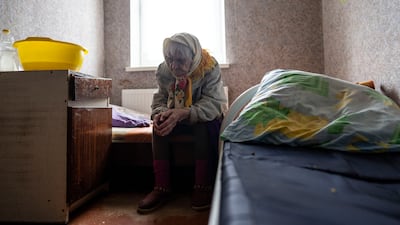
An elderly woman waits do be evacuated from a hospice in Chasiv Yar city, in Donetsk, eastern Ukraine. At least 35 residents have been helped to flee from the region that has been under attack for weeks. AP -
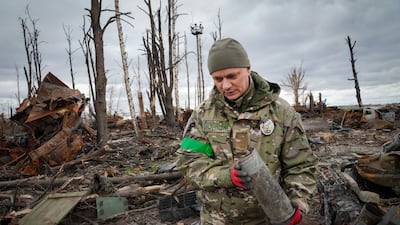
A Ukrainian Interior Ministry serviceman collects unexploded shells, grenades and mines, following fierce fighting in Hostomel. AP


An unrepentant Mr Scholz said after talks with US President Joe Biden and other western leaders on Tuesday that Germany was running out of supplies from its own military stocks that it could send to Ukraine.
He said Germany would help instead by providing money for Ukraine to shop for weapons from arms exporters, and giving it a list of equipment that German manufacturers could produce at short notice.
This could include anti-tank weapons, air defence systems, ammunition and hardware that “can be used in an artillery battle”.
Britain, the US and Canada were more explicit on this point, each promising artillery exports to Ukraine as it fights a renewed Russian attack in the eastern Donbas region.
Echoing UK Prime Minister Boris Johnson, Mr Scholz said allies had agreed to provide weapons for countries in the former Eastern Bloc so that they could forward their Soviet-era equipment to Ukraine.
Marie-Agnes Strack-Zimmermann, the head of the German Parliament’s defence committee and one of the most prominent FDP MPs calling for more weapons, said Mr Scholz’s statement was a start but lacked detail.
She took issue with his assertion that “if you look around at what our close allies are doing … they and their militaries have come to the same conclusion as ours”.
“The assertion that if you look around the world everyone is acting like Germany is not correct,” she said. “We are still too far behind.”

