


Live updates: follow the latest news on Russia-Ukraine
Germany’s President Frank-Walter Steinmeier has become the most senior politician to admit failures in a years-long policy of conciliation with Russia whose flaws were brutally exposed by the invasion of Ukraine.
It comes amid a reckoning at home and frustration abroad at how Germany’s reliance on Russian gas, a reluctance to antagonise Moscow and a military in need of repair have left Berlin somewhat muffled in reacting to the war.
Ukraine’s president and its ambassador in Germany have not held back in lambasting German governments past and present for what they see as commercially-driven policies that make a mockery of its post-war quest for moral leadership and its mantra of “never again”.
As harrowing images emerging from Ukraine spur calls for tougher sanctions, Poland this week criticised Chancellor Olaf Scholz’s government for continuing to oppose an immediate energy embargo, which ministers say would punish German consumers rather than Russia.
Berlin had previously raised eyebrows by objecting to sanctions affecting international payments system Swift before eventually relenting.
“It is not the voices of German businesses, German billionaires… that should be heard loudly in Berlin. It is the voice of these innocent women and children, the voice of those murdered,” said Polish Prime Minister Mateusz Morawiecki.
But much of the criticism is directed not at Mr Scholz but at his two predecessors, Angela Merkel, whose legacy has been clouded by the war in Ukraine, and Gerhard Schroeder, a personal friend of President Vladimir Putin.
Mr Steinmeier’s record has also been called into question after his service under Mr Schroeder and Mrs Merkel, including two terms as foreign minister, made him one of the faces of Germany’s lenient posture towards Russia.
He further angered Ukraine by inviting musicians from Russia and Belarus to a benefit concert at the president’s mansion last week, prompting a boycott from irate Ukrainian ambassador Andrij Melnyk.

Mr Steinmeier on Monday said he had misread Mr Putin. He also admitted his attempts to bring Russia into a common European fold had failed and said he was wrong to support the now-cancelled Nord Stream 2 gas pipeline.
“We were sticking to a bridge in which Russia no longer believed and which other partners had warned us against,” he said.
“I did not believe Vladimir Putin would embrace his country's complete economic, political and moral ruin for the sake of his imperial madness.”
Mrs Merkel and former French leader Nicolas Sarkozy were invited by Ukraine’s President Volodymyr Zelenskyy to see the disturbing scenes of massacre in the town of Bucha which he blamed their policies for enabling.
But Mrs Merkel, who left office in December after 16 years, on Monday defended her actions at a 2008 Nato summit at which Germany was one of the countries blamed for stalling Ukraine’s membership bid for Nato.
The summit ended with an aspirational statement that Ukraine and Georgia “will become members of Nato” but Germany blocked the formal offer of a “membership action plan”, a more practical precursor to joining the alliance.
Mr Zelenskyy has described that as a miscalculation by western powers based on a false hope of appeasing Russia’s ambitions on Ukraine.
However, a short statement from a spokeswoman for Mrs Merkel on Monday said the former chancellor “stands by her decisions in relation to the 2008 Nato summit”.

Like Mr Steinmeier, Mrs Merkel supported the Nord Stream 2 project and regularly spoke of wanting to improve relations and build economic ties between Germany and Russia.
Her stance partly reflected Germany’s historic feeling of responsibility towards Russia and wariness of antagonising Moscow after the brutal war between Nazi Germany and the Soviet Union.
Mr Scholz’s party, the Social Democrats, regards West Germany’s détente with the eastern bloc in the 1970s as one of its proudest achievements and a precursor to German reunification in 1990.
Mr Schroeder, chancellor from 1998 to 2005, was the first German leader invited to Russia’s Victory Day parade commemorating the defeat of the Nazis, but more recently has caused embarrassment with Kremlin-friendly utterances.
Ministers in Mr Scholz’s government, which took office in December, have distanced itself from Mr Schroeder and openly criticised their predecessors for leaving Germany too reliant on imports of Russian oil and gas.
Now scrambling to replace those imports, they have angered allies such as Poland by arguing the economic pain of an immediate gas embargo would be too great.
Former European officials have compared Germany’s stance unfavourably to its hardline attitude towards Greece during the early 2010s debt crisis, when Berlin demanded painful economic measures in exchange for bailout funds.
-

After a long goodbye, Angela Merkel finally reached the end on Wednesday of her 16-year term as Germany’s first female chancellor, Europe’s most powerful leader and one of the world’s most durable crisis managers. Getty Images -
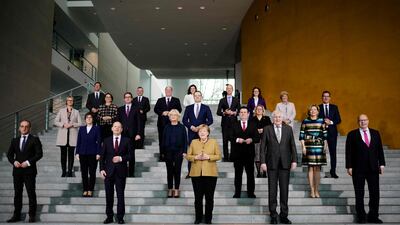
Mrs Merkel poses with ministers and other members of her government after a cabinet meeting in Berlin on November 24, 2021. AFP -
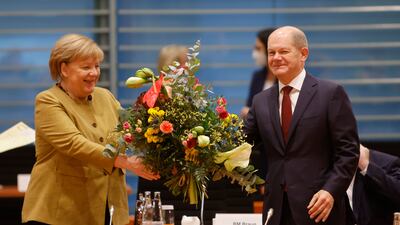
Mrs Merkel receives a bouquet of flowers from Olaf Scholz as she arrives for probably her last weekly cabinet meeting on November 24. Getty Images -
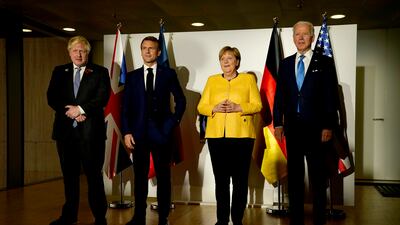
From right to left, US President Joe Biden, Ms Merkel, French President Emmanuel Macron and British Prime Minister Boris Johnson pose before a meeting on the sidelines of the G20 summit in Rome, in October 2021. AP -

Mrs Merkel visiting flood-ravaged areas to survey the damage and meet survivors in July 2021, in Schuld, near Bad Neuenahr-Ahrweiler. Getty Images -
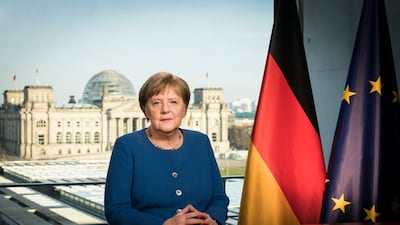
Mrs Merkel addressing the nation via a video statement about the continuing Covid-19 pandemic, on March 18, 2020. It was the first time in her 15-year tenure as chancellor that Mrs Merkel addressed citizens directly via a televised statement other than her New Year's Eve message. Getty Images -
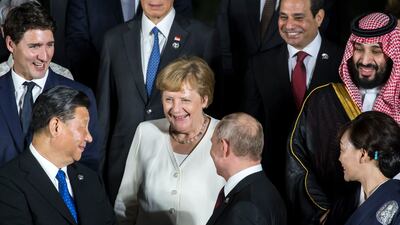
Mrs Merkel speaks to China's President Xi Jinping and Russia's President Vladimir Putin during a group photo session in front of Japan's Osaka Castle, at the G20 summit in June 2019. Getty Images -
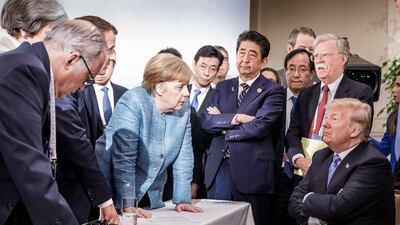
Mrs Merkel deliberates with former US president Donald Trump on the sidelines of the June 2018 G7 summit in Canada. Getty Images -
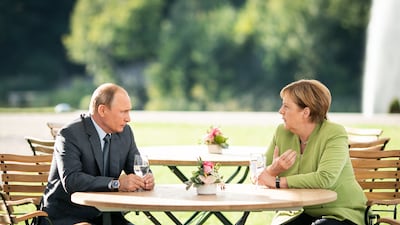
Mrs Merkel and Mr Putin meet at Schloss Meseberg palace, the German government retreat, in August 2018. Getty Images -

Mrs Merkel wears safety goggles during a visit to the European Astronauts Centre in Cologne, in 2016. Getty Images -
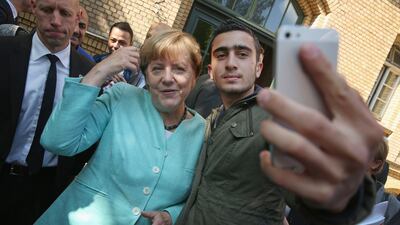
Mrs Merkel poses for a selfie with Anas Modamani, a refugee from Syria, as she visited the AWO Refugium Askanierring shelter for migrants and refugees in September 2015, in Berlin. Getty Images -
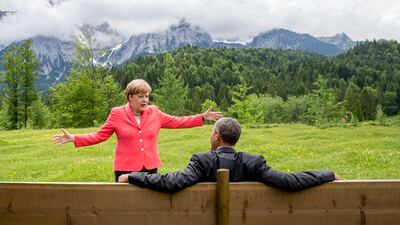
Mrs Merkel speaks with former US president Barack Obama during a G7 summit in 2015. AP Photo -
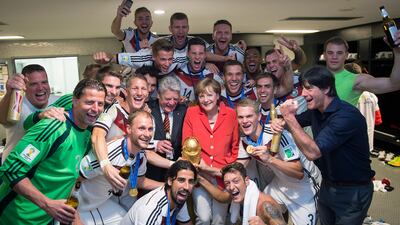
Mrs Merkel and German President Joachim Gauck celebrate with the German national football team after its 1-0 victory in the 2014 FIFA World Cup Brazil Final match against Argentina in 2014. Getty Images -

Mrs Merkel waves at an election campaign rally for federal elections in Dusseldorf, in 2013. Getty Images -

Mrs Merkel smiles as she sits in the chancellor's chair for the first time at the German lower house of parliament in November 2005. Getty Images -

Mrs Merkel raises her fists at the Lower Saxony Christian Democratic Party's annual general meeting in 2005. Getty Images -
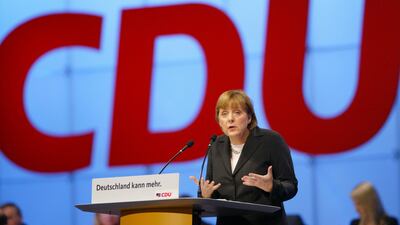
Mrs Merkel speaks at the CDU party congress in December 2003, in Leipzig. Getty Images


“As German officials liked to remind their Greek counterparts, bad luck is no excuse for bad policy,” said Thomas Philippon, a former adviser in the French finance ministry.
“Greek politicians did not want to pay the price of responsibility. They later imposed a cost on their fellow Europeans when the funds dried up. Germany did the same with its energy policy.”
Mr Scholz has sought to meet the moment by speaking of a watershed in German history, promising 100 billion euros ($110bn) to upgrade the military and presiding over a push to free the country from Russian energy by 2024.
In a break with Mrs Merkel’s policies, he has scrapped Nord Stream 2, approved the export of weapons to Ukraine and pledged to meet Nato spending targets by 2024, describing better defence as the route to success in Germany’s quest for peace.
One of Mrs Merkel's former defence ministers, Annegret Kramp-Karrenbauer, acknowledged after Russia's invasion that Germany had failed to deter Mr Putin despite previous instances of Russian aggression.
Mr Scholz’s moves have rallied public support that had flagged before the invasion and ensured public backing from allies including US President Joe Biden.
But his long-term plans have failed to win over critics such as Mr Melnyk who say Germany needs to act faster now to stop horrors such as those in Bucha from intensifying in Ukraine.
“Dear German government,” Mr Melnyk said on Tuesday, “how long will you keep watching?”.

