

Live updates: follow the latest news on Russia-Ukraine
Former German chancellor Angela Merkel on Monday defended her 2008 decision to block Ukraine from immediately joining Nato.
Mrs Merkel rejected Ukrainian President Volodymyr Zelenskyy's criticism as Russia's invasion clouds her 16-year legacy.
Mr Zelenskyy described as a "miscalculation" the decision led by France and Germany at the Nato summit in Bucharest that year not to admit his country to the alliance, despite a push from the US.
"I invite Ms Merkel and Mr (Nicolas) Sarkozy to visit Bucha and see what the policy of concessions to Russia has led to in 14 years," he said.
He was referring to the alleged atrocities against Ukrainian civilians by Russian troops, which world powers have described as "war crimes".
Mr Zelenskyy accused the European leaders of seeking to appease Russia with their stance that year.
But Mrs Merkel's spokeswoman said she "stands by her decisions in relation to the 2008 Nato summit in Bucharest".
"In view of the atrocities uncovered in Bucha and other places in Ukraine, all efforts by the government and the international community to stand by Ukraine's side and to bring an end to Russia's barbarism and war against Ukraine have the former chancellor's full support," the spokeswoman said.
Germany had considered it too early for Ukraine to join Nato because it found that the political conditions were not met at that point.
Mrs Merkel, who retired from politics late last year after four consecutive terms in power, had once been hailed as the leader of the free world.
-

After a long goodbye, Angela Merkel finally reached the end on Wednesday of her 16-year term as Germany’s first female chancellor, Europe’s most powerful leader and one of the world’s most durable crisis managers. Getty Images -
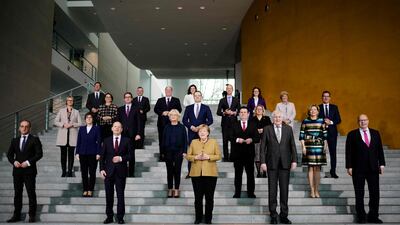
Mrs Merkel poses with ministers and other members of her government after a cabinet meeting in Berlin on November 24, 2021. AFP -
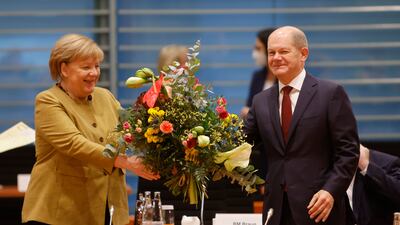
Mrs Merkel receives a bouquet of flowers from Olaf Scholz as she arrives for probably her last weekly cabinet meeting on November 24. Getty Images -
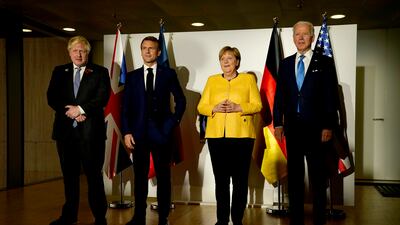
From right to left, US President Joe Biden, Ms Merkel, French President Emmanuel Macron and British Prime Minister Boris Johnson pose before a meeting on the sidelines of the G20 summit in Rome, in October 2021. AP -

Mrs Merkel visiting flood-ravaged areas to survey the damage and meet survivors in July 2021, in Schuld, near Bad Neuenahr-Ahrweiler. Getty Images -
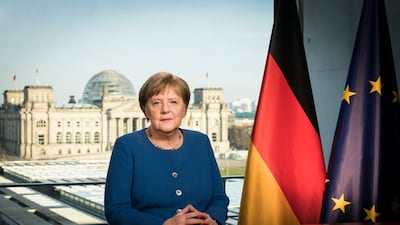
Mrs Merkel addressing the nation via a video statement about the continuing Covid-19 pandemic, on March 18, 2020. It was the first time in her 15-year tenure as chancellor that Mrs Merkel addressed citizens directly via a televised statement other than her New Year's Eve message. Getty Images -
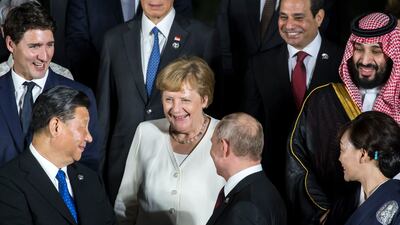
Mrs Merkel speaks to China's President Xi Jinping and Russia's President Vladimir Putin during a group photo session in front of Japan's Osaka Castle, at the G20 summit in June 2019. Getty Images -
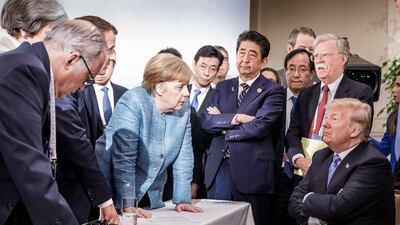
Mrs Merkel deliberates with former US president Donald Trump on the sidelines of the June 2018 G7 summit in Canada. Getty Images -
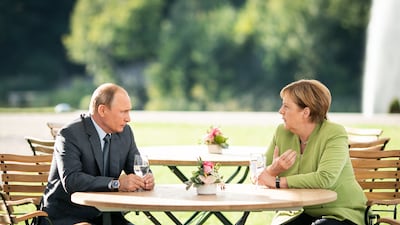
Mrs Merkel and Mr Putin meet at Schloss Meseberg palace, the German government retreat, in August 2018. Getty Images -

Mrs Merkel wears safety goggles during a visit to the European Astronauts Centre in Cologne, in 2016. Getty Images -
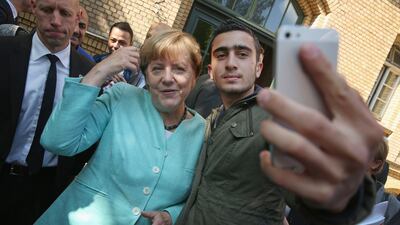
Mrs Merkel poses for a selfie with Anas Modamani, a refugee from Syria, as she visited the AWO Refugium Askanierring shelter for migrants and refugees in September 2015, in Berlin. Getty Images -
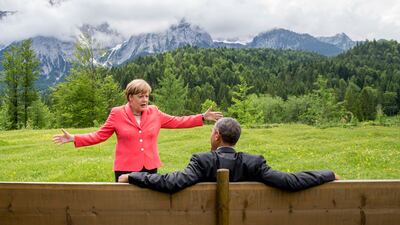
Mrs Merkel speaks with former US president Barack Obama during a G7 summit in 2015. AP Photo -
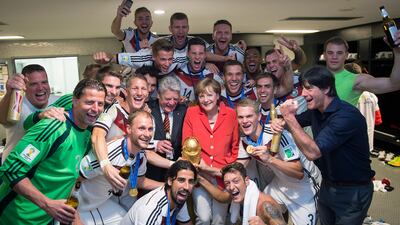
Mrs Merkel and German President Joachim Gauck celebrate with the German national football team after its 1-0 victory in the 2014 FIFA World Cup Brazil Final match against Argentina in 2014. Getty Images -

Mrs Merkel waves at an election campaign rally for federal elections in Dusseldorf, in 2013. Getty Images -

Mrs Merkel smiles as she sits in the chancellor's chair for the first time at the German lower house of parliament in November 2005. Getty Images -

Mrs Merkel raises her fists at the Lower Saxony Christian Democratic Party's annual general meeting in 2005. Getty Images -
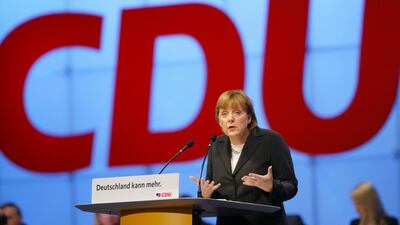
Mrs Merkel speaks at the CDU party congress in December 2003, in Leipzig. Getty Images


But Russian President Vladimir Putin's war on Ukraine has exposed flaws in her legacy, with critics saying she left Germany and Europe vulnerable with her detente policy towards the Kremlin leader.
Under particular scrutiny is Germany's reliance on Russian energy, which made up 36 per cent of its gas imports in 2014 that rose to 55 per cent by the time of the February 24 invasion.
The dependence on Russian power has left Berlin saying it is unable to follow a call by the US and other allies to impose a full energy embargo on Moscow.
President Frank-Walter Steinmeier, who was foreign minister in two of Mrs Merkel's cabinets, on Monday admitted that he made a "mistake" in pushing for Nord Stream 2, the controversial pipeline built to double Russian gas imports to Germany.
"My adherence to Nord Stream 2 was clearly a mistake," Mr Steinmeier told German media.
"We were holding on to bridges that Russia no longer believed in and from which our partners had warned us about."
The US and EU members such as Poland had deeply opposed the €10 billion ($10.97bn) pipeline that bypasses Ukraine, depriving Kyiv of gas transit fees.
After obstinately defending it through its construction, Germany finally put the project on ice following Russia's invasion of Ukraine.
Mr Steinmeier has also come under fire over the pipeline project. His Social Democrats in particular have over the years pushed for closer ties with Russia.
Mrs Merkel's predecessor Gerhard Schroeder, a Social Democrat, has refused to quit key posts at Russian energy giants Rosneft and Gazprom, despite the war on Ukraine.
Admitting his miscalculation, Mr Steinmeier said his "assessment was that Vladimir Putin would not accept the compete economic, political and moral ruin of his country for his imperial madness.
"Like others, I was wrong."

