


US and western leaders assembled in Brussels for back-to-back summits to formulate a response to Russia's invasion of Ukraine on Thursday with further arms shipments to Kyiv and new sanctions measures at the top of the agenda.
Once the handshakes and photographs with visiting US President Joe Biden are out of the way, the leaders of Nato, the G7 and the European Union will get down to grappling with the multifaceted fallout of Russia’s war in Ukraine.
The US says a new sanctions package will be unveiled this week and will include measures to close loopholes in existing embargoes.
Nato Secretary General Jens Stoltenberg said he expected the Brussels summit to produce major increases in troop deployments on the alliance’s eastern flank.
The Nato meeting will begin on Thursday morning exactly one month on from the start of an invasion that has driven 3.6 million people out of Ukraine, prompted unprecedented sanctions on Russia and led to a fundamental rethink of Europe’s energy and defence policies.
G7 leaders will then break off for talks before Mr Biden makes a guest appearance at a European Council summit stretching into Friday. Mr Biden is expected to announce sanctions on 300 members of the Russian State Duma, matching measures imposed by the EU a month ago.
Although diplomats have spoken of a surge of western unity in the face of Russia’s aggression, many of the issues arising from the war have the potential to cause political headaches as leaders decide how to proceed.
-
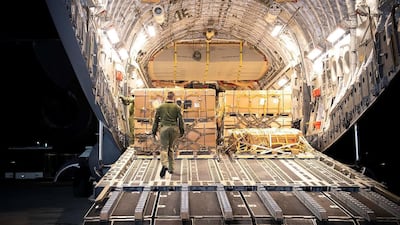
Workers unloading a Royal Canadian Air Force military transport plane to assist Ukraine at Lviv airport. AFP -
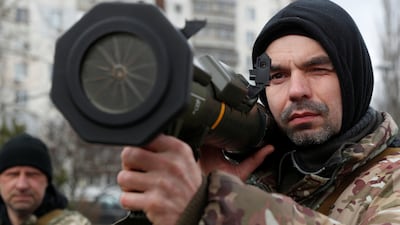
A new member of the Territorial Defence Forces trains to operate an AT4 anti-tank launcher in Kyiv. Reuters -
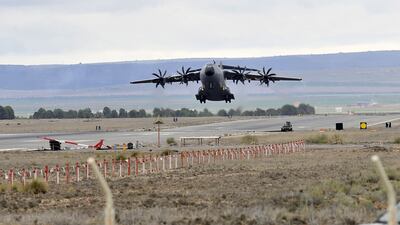
A plane loaded with military equipment for Ukrainian forces takes off from Albacete, Spain. EPA -
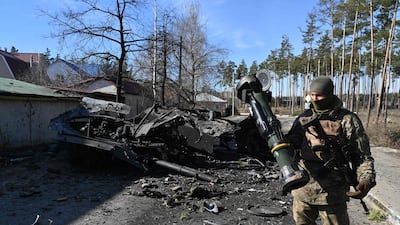
A Ukrainian soldier holds a Next Generation Light Anti-tank Weapon used to destroy a Russian armoured personal carrier in Irpin, north of Kyiv. AFP -
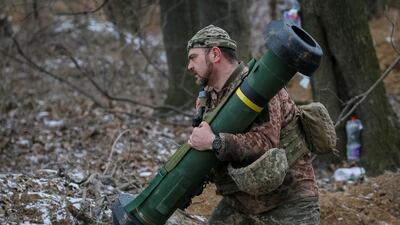
A Ukrainian serviceman with a Javelin missile system on the front line near Kyiv. Reuters -

A soldier holds a Panzerfaust 3 anti-tank rocket launcher at the Munster military training area in Germany in 2016. Getty Images -
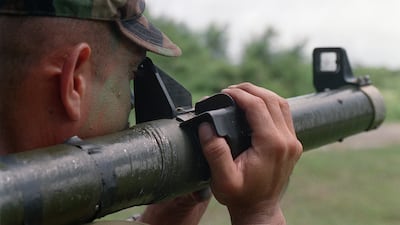
A US Marine Corps staff sergeant aims a M72 Light Anti-tank Weapon. Photo: US National Archives -

The Switchblade is a camera-equipped, remote-controlled flying bomb with a reputation for pinpoint delivery. AP Photo -

A coalition forces member fires a Carl Gustav recoilless rifle system during weapons practice on a range in Helmand province, Afghanistan, in 2013. US Army Photo -

A Starstreak surface-to-air missile system. PA


As well as Mr Biden working on long-term efforts to boost defences in Eastern Europe, where countries especially fear Russian aggression, the president is also aiming to reduce the continent’s reliance on Russian energy.
“This war will not end easily or rapidly,” Jake Sullivan, the US National Security Adviser, cautioned in a briefing before the four-day Europe trip.
The diplomatic preparations came as Ukrainian authorities reported a fightback on the ground against Russian forces near the capital Kyiv. Mayor Vitali Klitschko said Ukraine's military had wrested back control of areas to the north-west and north-east of the city as well as the western town of Makariv. He said 264 civilians had died in Kyiv since the war began, including four children. Pentagon spokesman John Kirby said the US had “seen indications that the Ukrainians are going a bit more on the offensive now” and are trying to regain territory around the Russian occupied-city of Kherson.
Kremlin spokesman Dmitry Peskov meanwhile maintained Moscow's insistence that what it calls a special military operation was going to plan.
Sanctions
The many faces of western power will assemble in Brussels on Thursday for a two-day diplomatic push aimed at showing solidarity with Ukraine, shoring up Europe’s defences and tightening the economic squeeze on Russia.
Mr Biden can expect to discuss those sanctions with European leaders as well as with Canada and Japan in the G7. Japanese Prime Minister Fumio Kishida said on Wednesday that Tokyo planned to strengthen its own measures.
The sanctions imposed so far have weakened Russia’s financial sector, cut off much of its economy from the world market and punished prominent individuals in the Kremlin's inner circle.
But some European countries want to go further by terminating fossil fuel imports from Russia, as the US has already done, and thereby cutting off one of Moscow's most lucrative sources of funding for the war.
Not all EU members are on board, however, and the energy-rich US says it understands that some import-reliant European partners will not be able to go this far.
Other proposals on the table include blocking land and sea trade from Russia, widening its ban from payments system Swift and barring its diplomats from the UN’s Human Rights Council.

Refugees
The daily flow of refugees from Ukraine into Poland and other neighbouring countries is beginning to strain Europe’s capacity despite repeated statements of goodwill.
Although many Ukrainians would like to return home as soon as possible, there is no knowing when the country will be safe and the task of integrating the women and children who make up the bulk of the refugees is considerable.
The issue goes beyond the EU because Poland has been lobbying the US and other allies for humanitarian assistance, after its border guards allowed more than two million people fleeing Ukraine into the country.
It will have another opportunity to make its case when Mr Biden visits Warsaw on Friday, where the White House said he would meet humanitarian experts.
Germany, France and Poland have been discussing ways to share out refugees — typically a thorny subject in the EU — with German Foreign Minister Annalena Baerbock notably looking to distribute them in Europe “and beyond”.
Nato is not immune from this issue either, with the UK’s former national security adviser Mark Sedwill urging countries to show a willingness to help to underscore their commitment to the Article 5 security guarantee.
-
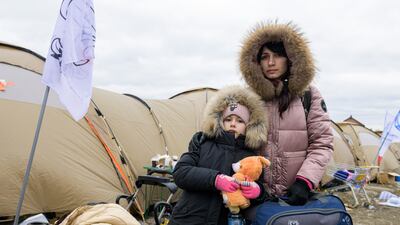
Mykhaila and her daughter from Loubny, central Ukraine, travelled by train to the Ukrainian city of Lviv then took a bus to Medyka on the Polish border, before walking across. Photo: DEC -
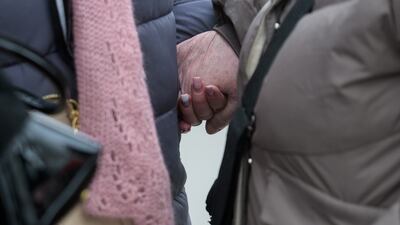
Women hold hands at the Medyka border crossing point, through which thousands of Ukrainian refugees have passed. Photo: DEC -
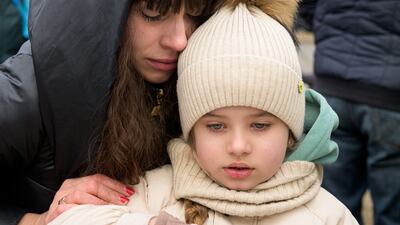
Angelika, 27, and her daughter Diana, 4, from Khmelnytskyi in Ukraine arrive at a reception centre on the outskirts of Przemysl, Poland. Photo: DEC -

Maria, 38, from Chernihiv, left Ukraine with a friend. They came to the Romanian border to wait for another friend before crossing. Photo: Panos Pictures -
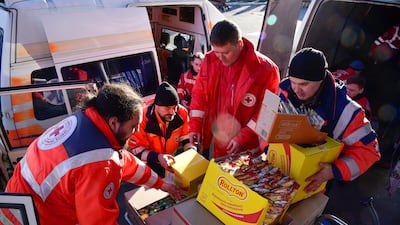
Ukrainian Red Cross staff and volunteers are providing food and other basic necessities to about 8,000 people sheltering in an underground station in Kyiv. Photo: Tebukhukhov Maksym -
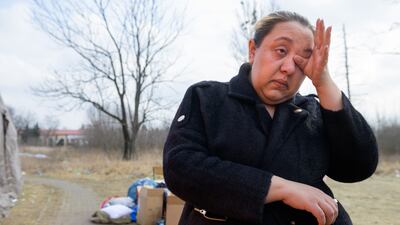
Kristina wipes away tears at Lwowska reception centre on the outskirts of Przemysl, Poland. Photo: DEC -
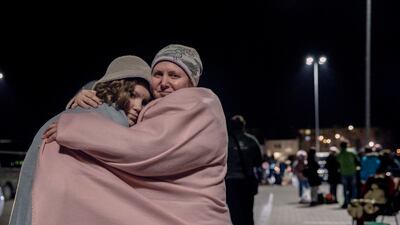
Ira, 45, and her daughter Olena, 12, outside a transit centre in Przemysl, Poland. Photo: Adrienne Surprenant -
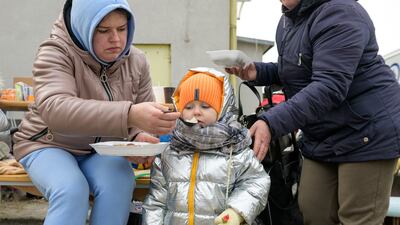
Veronika feeds her son Aleksander at the temporary refugee station in Medyka, eastern Poland. Photo: DEC


Energy
Beyond the question of an immediate energy embargo lies the longer-term debate over how to reduce Europe’s reliance on Russian fossil fuel imports.
EU leaders will consider making collective gas purchases from outside Russia, a proposal described by a senior official as similar to the bloc’s joint acquisition of coronavirus vaccines.
Another suggestion is to mandate a minimum level of gas storage going into the winter to reduce the risks of power cuts if Russia turns off the tap.
President Vladimir Putin added another complication by saying on Wednesday that Russia would only accept payments in roubles for gas deliveries to “unfriendly countries”.
Leaders will have to navigate these issues at a time when energy prices are already high and there is disagreement in Europe over whether nuclear power is part of the solution.
The G7 also touched on the energy issue in its last statement on Russia, when it called for constructive engagement among major producers to ensure stability in global markets.

Military
Leaders are likely to discuss “red lines” that could draw Nato out of its current defensive stance, with opinion divided between those who say they have already been crossed and others who fear a direct confrontation with Russia.
“In almost 80 years of postwar history we have successfully avoided the unthinkable — a direct military confrontation between our western defence alliance, Nato, and Russia,” said German Chancellor Olaf Scholz. “It must stay that way.”
Allies have issues to work out on how to equip Ukraine, with proposals from Poland and Slovakia to supply planes and missile systems both running into difficulty when the US gave a lukewarm response.
On top of those short-term considerations, Mr Stoltenberg has spoken of a need to rethink Nato’s posture towards Russia more generally amid what diplomats have described as a more hostile climate to the east.
One aspect of this is cyber defence. Mr Meagher said 21 American energy companies involved with LNG production had been targeted by hackers.
At the EU talks, meanwhile, leaders are expected to endorse a strategic blueprint agreed by foreign and defence ministers on Monday which envisages a more security-conscious bloc with a 5,000-troop rapid response force.

