• A shell fired by a Russian tank strikes an apartment building in the city of Mariupol in south-east Ukraine. AP Photo
    A shell fired by a Russian tank strikes an apartment building in the city of Mariupol in south-east Ukraine. AP Photo
  • Ukrainian officials say Russian forces destroyed Mariupol's drama theatre where hundreds of people were sheltering. AP
    Ukrainian officials say Russian forces destroyed Mariupol's drama theatre where hundreds of people were sheltering. AP
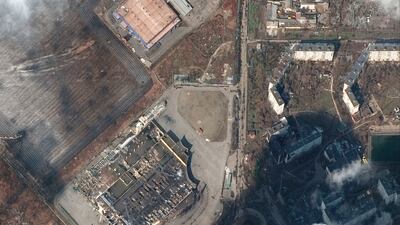
  • The theatre was located in the centre of Mariupol. EPA
    The theatre was located in the centre of Mariupol. EPA
  • The remains of the theatre. Reuters
    The remains of the theatre. Reuters
  • Mariupol residents pass shells and discarded munitions cases as they try to flee the besieged port city on the north coast of the Sea of Azov at the mouth of the Kalmius river. Reuters
    Mariupol residents pass shells and discarded munitions cases as they try to flee the besieged port city on the north coast of the Sea of Azov at the mouth of the Kalmius river. Reuters
  • A man pushes a bicycle along a destroyed street in Mariupol. AP Photo
    A man pushes a bicycle along a destroyed street in Mariupol. AP Photo
  • A woman walks past a burning apartment building after shelling. AP Photo
    A woman walks past a burning apartment building after shelling. AP Photo
  • A Ukrainian serviceman and a civilian carry a wounded man who was injured by shelling in a hospital in Mariupol. AP Photo
    A Ukrainian serviceman and a civilian carry a wounded man who was injured by shelling in a hospital in Mariupol. AP Photo
  • People lie on the floor of a hospital during shelling by Russian forces. AP Photo
    People lie on the floor of a hospital during shelling by Russian forces. AP Photo
  • A hospital window is cracked from shelling. AP Photo
    A hospital window is cracked from shelling. AP Photo
  • A Ukrainian serviceman guards his position in Mariupol. AP Photo
    A Ukrainian serviceman guards his position in Mariupol. AP Photo
  • Anastasia Erashova cries as she hugs her child in a corridor of a hospital in Mariupol. AP Photo
    Anastasia Erashova cries as she hugs her child in a corridor of a hospital in Mariupol. AP Photo
  • People settle in a bomb shelter. AP Photo
    People settle in a bomb shelter. AP Photo
  • Evacuees fleeing Ukraine-Russia conflict sit in the body of a cargo vehicle while waiting to leave Mariupol. Reuters
    Evacuees fleeing Ukraine-Russia conflict sit in the body of a cargo vehicle while waiting to leave Mariupol. Reuters
  • A fire from a suspected Russian strike is seen on an apartment block on the eastern side of Mariupol. AP
    A fire from a suspected Russian strike is seen on an apartment block on the eastern side of Mariupol. AP
  • A soldier escapes from an armoured vehicle with a 'Z' marking that was attacked. Reuters
    A soldier escapes from an armoured vehicle with a 'Z' marking that was attacked. Reuters
  • Medical workers hold newborn Alana close to her mother after a cesarean section at a hospital in Mariupol. AP Photo
    Medical workers hold newborn Alana close to her mother after a cesarean section at a hospital in Mariupol. AP Photo
  • A Ukrainian serviceman guards his position in Mariupol. AP Photo
    A Ukrainian serviceman guards his position in Mariupol. AP Photo
  • Anastasia Erashova cries as she hugs her child in a corridor of a hospital in Mariupol. AP Photo
    Anastasia Erashova cries as she hugs her child in a corridor of a hospital in Mariupol. AP Photo
  • Premature babies left behind in hospital by their parents. AP Photo
    Premature babies left behind in hospital by their parents. AP Photo
  • A service member of pro-Russian troops stands guard near a line of cars with evacuees leaving Mariupol. Reuters
    A service member of pro-Russian troops stands guard near a line of cars with evacuees leaving Mariupol. Reuters
  • People settle in a bomb shelter in Mariupol. AP Photo
    People settle in a bomb shelter in Mariupol. AP Photo
  • A man plays with a baby in a bomb shelter in Mariupol. AP Photo
    A man plays with a baby in a bomb shelter in Mariupol. AP Photo
  • People use carts to transport their belongings in Mariupol. Reuters
    People use carts to transport their belongings in Mariupol. Reuters
  • Mariana Vishegirskaya walks down stairs in a maternity hospital damaged by shelling in Mariupol. AP Photo
    Mariana Vishegirskaya walks down stairs in a maternity hospital damaged by shelling in Mariupol. AP Photo
  • Ukrainian emergency employees and volunteers carry an injured pregnant woman from a maternity hospital. The baby was born dead. Half an hour later, the mother died too. AP Photo
    Ukrainian emergency employees and volunteers carry an injured pregnant woman from a maternity hospital. The baby was born dead. Half an hour later, the mother died too. AP Photo
  • Oleksandr Konovalov, an ambulance paramedic, attends to an injured woman. AP Photo
    Oleksandr Konovalov, an ambulance paramedic, attends to an injured woman. AP Photo
  • Ukrainian emergency employees work at a maternity hospital damaged by shelling in Mariupol. AP Photo
    Ukrainian emergency employees work at a maternity hospital damaged by shelling in Mariupol. AP Photo

Escaping Mariupol: Ukrainians flee between tank battles and air raids


  • English
  • Arabic

Live updates: follow the latest news on Russia-Ukraine

In just a matter of days, the city of Mariupol on the shores of the Sea of Azov has been turned to rubble.

The streets lie in ruins as rescuers dig franticly to rescue civilians trapped when bombs hit the city’s theatre that was sheltering 1,000 people.

Civilians are buried in makeshift graves if civil defence teams or neighbours are able to collect the bodies amid the fighting. Otherwise, they lie lost under the snow.

Water, electricity and gas supplies haven’t worked for days and food is becoming scarce.

Mariupol has become a symbol of the devastation of Russia’s invasion of Ukraine.

Ivan Goltvenko, 38, fondly remembers a city with a vibrant culture, mild climate and proximity to the sea.

He worked in the city’s Azovstal steel plant like his father and grandfather before him, and had nurtured the dream that his sons too would join the firm.

But now he has dodged shelling, Russian tanks and bullets to flee Mariupol.

On the second day of the war, Ivan insisted his wife leave the city with their sons while he moved to his parent's apartment on the city’s main thoroughfare, Prospekt Myru, or “Peace Avenue.”

It overlooked a lawn where his sons played in the summer. Across the street were a hospital and maternity ward.

Now, all that stands is an empty building with charred windows. The maternity ward has become synonymous with the indiscriminate shelling of residential areas carried out by Russian forces, a charge that Russia continues to deny.

Ivan shows a picture of a destroyed building that was once the university where he studied and met his wife, a pizza place they used to frequent in normal times, and a jewellery shop where he planned to buy his wife a present for International Women’s Day on March 8. It’s now a charred skeleton of bent steel and broken glass.

He says the city’s residents fear the scream of warplanes overhead.

“However thick your walls are, you hear the roar of the aircraft which descends to attack, you feel this vibration, the whistle of the missile fired,” he said. “It lasts for four to five seconds which seem an eternity, after which there comes an explosion.”

Everything begins to shake, and all you can do is wonder where the next missile will hit, he said.

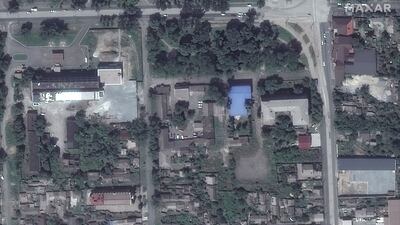
  • A satellite image shows homes and buildings in Mariupol, Ukraine, in February, before Russia's invasion. Maxar Technologies via Reuters
    A satellite image shows homes and buildings in Mariupol, Ukraine, in February, before Russia's invasion. Maxar Technologies via Reuters
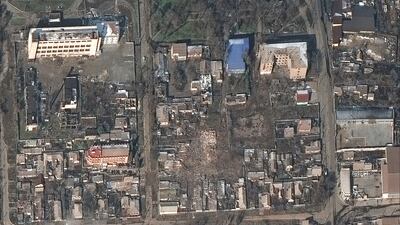
  • A satellite image shows destroyed homes and buildings in Mariupol on March 9. Maxar Technologies via Reuters
    A satellite image shows destroyed homes and buildings in Mariupol on March 9. Maxar Technologies via Reuters
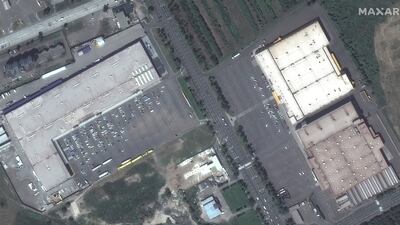
  • Grocery stores and shopping malls in Mariupol in February before Russia's invasion. Maxar Technologies via Reuters
    Grocery stores and shopping malls in Mariupol in February before Russia's invasion. Maxar Technologies via Reuters
  • A satellite image shows destroyed grocery stores and shopping malls in Mariupol on March 9 amid Russia's ongoing invasion of Ukraine. Maxar Technologies via Reuters
    A satellite image shows destroyed grocery stores and shopping malls in Mariupol on March 9 amid Russia's ongoing invasion of Ukraine. Maxar Technologies via Reuters
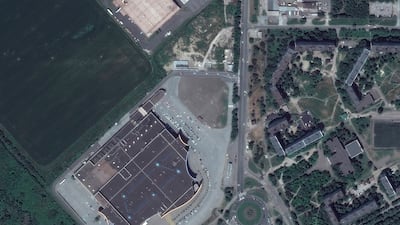
  • The Portcity shopping mall and other stores in Mariupol in February before the Russian invasion. Maxar Technologies via AP
    The Portcity shopping mall and other stores in Mariupol in February before the Russian invasion. Maxar Technologies via AP
  • The heavily damaged Portcity shopping mall and other stores in Mariupol on March 9. Maxar Technologies via AP
    The heavily damaged Portcity shopping mall and other stores in Mariupol on March 9. Maxar Technologies via AP

After about a week of fighting, a first attempt at establishing an evacuation corridor for civilians collapsed. With mobile links down, only the most daring climbed on to rooftops to catch a signal and spread the news. Even the mere mention of a corridor was “like a ray of light to us,” Ivan said.

Towards the end of the second week, he realised that he and his parents would either starve to death, die of thirst, or perish from bombs. Taking to the road was no guarantee of survival, but at least it offered a chance.

On the way out of the city by car along a designated humanitarian corridor, they witnessed two apartment blocks being bombed in front of them.

“So it became clear this was a one-way road,” he said.

The 250 kilometres or so from Mariupol to Zaporizhzhia, normally a couple of hours’ drive, took the convoy of around 100 cars two days.

The convoy spent several hours at a Russian checkpoint trying in vain to persuade the soldiers to let them pass.

Spending the night in a nearby village, residents were welcoming and showed them a way to bypass the closed checkpoint.

By morning light, they drove over fields and on dirt roads, keeping 15 metres between cars in case of explosives.

On reaching the motorway, they found harrowing scenes of corpses and a lorry full of dead soldiers. They knew they had to keep moving.

Eventually, they reached a town where they were stopped by men in sportswear, waving Kalashnikov automatic guns at them. Only yellow bands wrapped around their hands gave away that they were “territorial defence units,” militia organised by Ukraine to protect civilian areas.

They explained that it was best to wait as there was a tank battle under way nearby. When they signalled it was safe, the convoy moved off at top speed. The road was destroyed, asphalt dust hung thick in the air. The drivers focused on the red tail lights ahead while also glancing in the rear mirror at the headlights behind, and that way moved in unison, like links in a chain.

About 400 people were able to get out of Mariupol in the convoy with Ivan, four to each car. He called his friend in Mariupol and described the route, telling him to break into a room in the steel plant’s administrative office where alcohol was stored and use it to bribe Russian soldiers. It worked, and his friend managed to lead another 23 cars to safety.

One work colleague told him that he had been able to leave Mariupol with his mother, but that his father had died, so he buried him near a bench in the garden of their apartment block. Other colleagues told him a lawn in front of the steelworks’ office has been turned into an improvised graveyard where victims of the shelling have been laid to rest.

“People calling me are actively asking for safe routes to leave,” Ivan said. “They didn’t lose hope, they want to survive.”


Mane points for safe home colouring
  • Natural and grey hair takes colour differently than chemically treated hair
  • Taking hair from a dark to a light colour should involve a slow transition through warmer stages of colour
  • When choosing a colour (especially a lighter tone), allow for a natural lift of warmth
  • Most modern hair colours are technique-based, in that they require a confident hand and taught skills
  • If you decide to be brave and go for it, seek professional advice and use a semi-permanent colour
Real estate tokenisation project

Dubai launched the pilot phase of its real estate tokenisation project last month.

The initiative focuses on converting real estate assets into digital tokens recorded on blockchain technology and helps in streamlining the process of buying, selling and investing, the Dubai Land Department said.

Dubai’s real estate tokenisation market is projected to reach Dh60 billion ($16.33 billion) by 2033, representing 7 per cent of the emirate’s total property transactions, according to the DLD.

Planes grounded by coronavirus

British Airways: Cancels all direct flights to and from mainland China 

Hong Kong-based Cathay Pacific: Cutting capacity to/from mainland China by 50 per cent from Jan. 30

Chicago-based United Airlines: Reducing flights to Beijing, Shanghai, and Hong Kong

Ai Seoul:  Suspended all flights to China

Finnair: Suspending flights to Nanjing and Beijing Daxing until the end of March

Indonesia's Lion Air: Suspending all flights to China from February

South Korea's Asiana Airlines,  Jeju Air  and Jin Air: Suspend all flights

Museum of the Future in numbers
  •  78 metres is the height of the museum
  •  30,000 square metres is its total area
  •  17,000 square metres is the length of the stainless steel facade
  •  14 kilometres is the length of LED lights used on the facade
  •  1,024 individual pieces make up the exterior 
  •  7 floors in all, with one for administrative offices
  •  2,400 diagonally intersecting steel members frame the torus shape
  •  100 species of trees and plants dot the gardens
  •  Dh145 is the price of a ticket
The%20specs
%3Cp%3E%3Cstrong%3EEngine%3A%3C%2Fstrong%3E%20Twin%20electric%20motors%20and%20105kWh%20battery%20pack%0D%3Cbr%3E%3Cstrong%3EPower%3A%20%3C%2Fstrong%3E619hp%0D%3Cbr%3E%3Cstrong%3ETorque%3A%20%3C%2Fstrong%3E1%2C015Nm%0D%3Cbr%3E%3Cstrong%3ETransmission%3A%20%3C%2Fstrong%3ESingle-speed%20auto%0D%3Cbr%3E%3Cstrong%3ETouring%20range%3A%20%3C%2Fstrong%3EUp%20to%20561km%0D%3Cbr%3E%3Cstrong%3EOn%20sale%3A%20%3C%2Fstrong%3EQ3%20or%20Q4%202022%0D%3Cbr%3E%3Cstrong%3EPrice%3A%20%3C%2Fstrong%3EFrom%20Dh635%2C000%3C%2Fp%3E%0A

Director: Laxman Utekar

Cast: Vicky Kaushal, Akshaye Khanna, Diana Penty, Vineet Kumar Singh, Rashmika Mandanna

Rating: 1/5

MOUNTAINHEAD REVIEW

Starring: Ramy Youssef, Steve Carell, Jason Schwartzman

Director: Jesse Armstrong

Rating: 3.5/5

Global state-owned investor ranking by size

1.

United States

2.

China

3.

UAE

4.

Japan

5

Norway

6.

Canada

7.

Singapore

8.

Australia

9.

Saudi Arabia

10.

South Korea

Updated: March 18, 2022, 3:25 PM