

Live updates: follow the latest news on Russia-Ukraine
Ukraine came under attack across swathes of the country on Thursday with explosions heard in major cities, assaults on military infrastructure and reports of artillery fire against border guards, airfields and apartment blocks.
Russian missile and air strikes were logged by Ukrainian officials as well as helicopter gunship and tank action deep inside its territory.
Ukrainian border police said tanks had crossed from Russia, from occupied Crimea and from Belarus to the north, opening an assault on several fronts that analysts fear could lead to a swift attack on Kiev.
Ukraine's President Zelenskyy announced the country was under martial law as he directed the armed forces to defend against the Russian assault. “We are working,” he told his people in a video message. “The army is working. Don't panic. We are strong. We are ready for everything. We will defeat everyone. Because we are Ukraine. ”Although the rapidly-changing situation and the possibility of disinformation made it hard to determine exactly what had happened, the scale of the attack proved Western fears correct that Russia would not confine itself to eastern regions of Ukraine but launch an assault across the country.
Late in the day officials said up to 40 people have been killed in the Russian attacks with regional authorities in the southern port city of Odessa claiming 18 people were killed in a Russian missile strike. At least six others were killed in the town of Brovary, near the capital Kiev.
US officials said Russian military columns had crossed on three separate axis. The Ukrainian frontier areas of Chernihiv, Kharkiv, Luhansk, Chernobyl and Hostomel, also near Kiev.
Russia's defence ministry said on Thursday it had taken out military infrastructure at 11 of Ukraine's airbases among 70 targeted facilities and “suppressed” its air defences.
Fears over conflict breaking out had been mounting for weeks after Russia assembled more than 100,000 troops around Ukraine’s borders and carried out drills involving fighter jets, bombers and missile launchers.
Kharkiv
Ukraine's military said there were "fierce fights" with Russian forces in the eastern Kharkiv region, which lies about 40 kilometres from the Russian border but outside the territory previously controlled by pro-Kremlin separatists.
In the industrial city of the same name, Ukraine said four invading tanks had been destroyed, while emergency services said a boy had been killed in an apparent shell attack that hit an apartment building.
The Kharkiv region was one of four in the north where Russian tanks had entered, border guards said, and one of several where Ukraine said missile strikes were targeting airbases, military depots and command facilities.
The invasion was also staged from several positions in Belarus, but the country’s pro-Kremlin President Alexander Lukashenko said his forces were “not taking part in this operation".

Odessa and Mariupol
In the south, Ukraine's military said it had regained control of the port of Mariupol after early reports of Russian attacks there and in Odessa, another coastal city.
To the south of Odessa, Ukraine said attackers were trying to seize an island in the Black Sea and calling on government forces to surrender. It came after Russia strengthened its positions on the Crimean peninsula it annexed in 2014.
“Odessa will be key to the assault because it’s a vital economic artery for the Ukrainian economy through which 70 per cent of the nation's maritime trade flows,” the RUSI think tank expert Sidarth Kaushal told The National.
“The Russians have concentrated their surface combatants presumably to soften up the Ukraine defences either in anticipation of an amphibious assault or in support of a ground offensive.”
There were reports of explosions in both cities, and of people in Mariupol — only 15 kilometres from the front line with eastern separatists — taking suitcases to their cars and fleeing the city.
Regarded as a valuable industrial hub, Mariupol has two major steel plants and some of Ukraine’s grain exports leave from its port. President Volodymyr Zelenskyy’s chief of staff said operations at all of Ukraine’s seaports had been suspended.

Kiev
Ukraine’s military said Boryspil Airport in Kiev was under attack, with the country moving to close its airspace to civilian traffic. Another terminal about 35 kilometres away, Hostomel Airport, was said to be under attack by presidential adviser Mykhaylo Podolyak said.
The alleged attack on the airport could be aimed at bringing in airborne Russian troops and launching an assault on the government administration, Mr Podolyak said.
Large explosions were heard in the capital. Civil defence sirens sounded and some people hastily packed their luggage into cars to try to escape the city, with queues on roads and petrol station forecourts.
Some people huddled underground after the subway system was declared open to all and four metro stations were declared as air raid shelters. Mayor Vitaly Klitschko ordered a curfew after early urfing people in Kiev to stay at home but to prepare for a potential evacuation.
It came as a European aviation agency warned of potential attacks or misidentification of passenger planes. Ukraine said airfields in Ozerne, Kulbakino, Chuhuiv, Kramatorsk and Chornobaivka were under attack.

Separatist regions
Ukraine said it had killed 50 troops in the Luhansk region, part of the contested territory where fighting with pro-Russian forces has been going on for eight years. Explosions were heard in Donetsk, also under separatist control.
Ukraine separately said it had taken down six Russian war planes in the east. Moscow has not issued any reports of military losses. The Russian-backed separatists, in turn, claimed to have downed two Ukrainian planes.
-
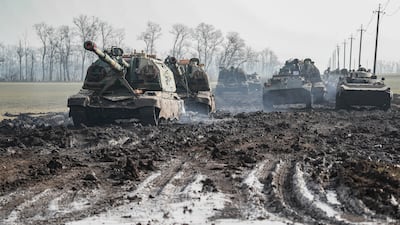
A group of 2S19 Msta vehicles stand on the road in the Rostov region of Russia. EPA -
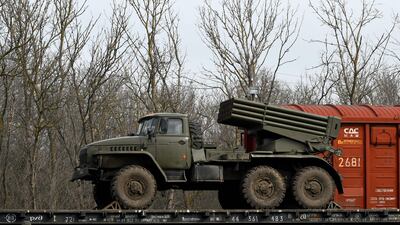
A BM-21 Grad truck is seen loaded on train platforms some 50km from the border with the self-proclaimed Donetsk People's Republic, in Russia's southern Rostov region. AFP -
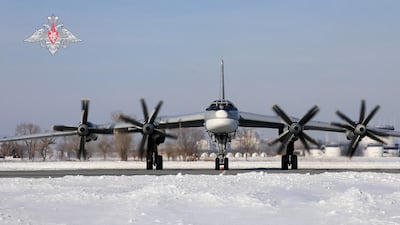
A Russian Tu-95MS bomber aircraft during the Grom-2022 Strategic Deterrence Force exercise at an undefined location in Russia. AFP -
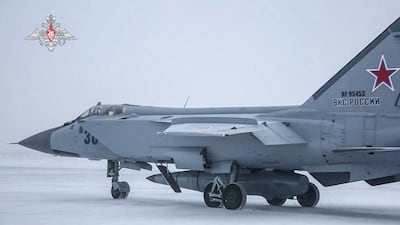
A MiG-31K fighter of the Russian air force carrying a Kinzhal hypersonic cruise missile during the Grom-2022 Strategic Deterrence Force exercise at an undefined location in Russia. AFP -
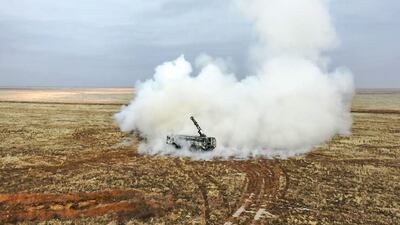
A Russian Iskander-K missile launching during a training launch as part of the Grom-2022 Strategic Deterrence Force exercise at an undefined location in Russia. AFP -
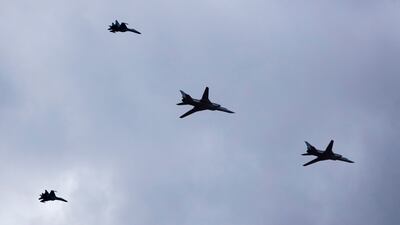
Two Tu-22M3 bombers escorted by Su-35 fighters of the Russian air force during the Union Courage-2022 Russia-Belarus military drills in Belarus. AP Photo -

Russian army tanks are loaded on to railway platforms to move back to their permanent base after drills in Russia. AP Photo -
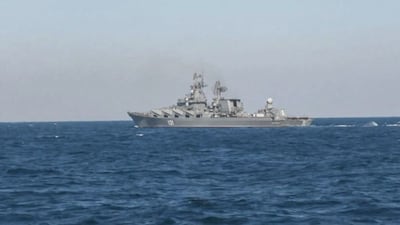
A 'Moskva' Russian cruiser during the Black sea naval exercises outside the Crimean port of Sevastopol. AFP -
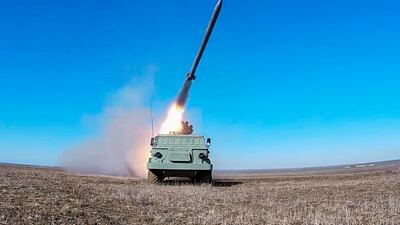
A BM-27 Uragan self-propelled multiple rocket launcher system during a live firing drill at the 'Opuk' interspecific training ground in Crimea. EPA -

Russian tanks leaving for Russia after joint exercises of the armed forces of Russia and Belarus. AFP -
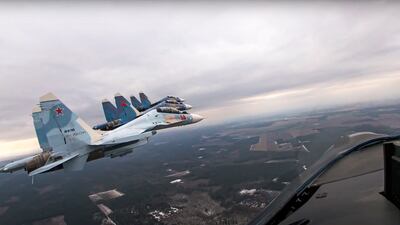
Su-30 fighters of the Russian and Belarusian air forces fly in a joint mission during the Union Courage-2022 Russia-Belarus military drills in Belarus. AP Photo -
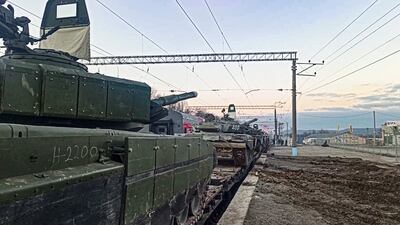
Russian armoured vehicles are loaded on to railway platforms after the end of military drills in southern Russia. AP Photo


Russian military hardware
Western powers had warned of a potential invasion because of what they described as a huge concentration of troops accompanied by infrastructure such as field hospitals.
Russia is also assembling at least six large Ropucha-class tank landing ships off Ukraine’s southern coast for a potential amphibious assault, military analysts have said. There is also an array of warships and submarines are being used to fire cruise missiles at key military and civilian targets.
They were accompanied by military hardware including:
Ropucha landing ship: Soviet-era but would still be effective in getting military hardware ashore in a largely unopposed landing. If Russia wants to have tanks and marine infantry on land at the vital ports of Odessa on the Black Sea and Mariupol, on the Sea of Azov, these ships are capable of each carrying 10 main battle tanks alongside 340 troops. They are also armed with 57mm guns and rocket launchers to target shore resistance.
Kilo-class submarines: Russia has more than 60 of these hunter-killer submarines that would be capable of sinking Ukraine’s small navy, although this was left without serious firepower following the seizure of its fleet in Crimea in 2014. The Kilos are capable of firing the latest Kalibr land-attack cruise missiles that have a range of 1500km and are similar to the US-built Tomahawk missiles. Each has a warhead of about 2,000kg but the boats are only capable of carrying four in total.
Admiral Gorshkov frigate: These are the most modern Russia navy surface ships capable of firing up to 32 Kalibr cruise missiles. The 8,000 ton ships have a speed of nearly 30 knots and are designed to carry out long-range land strikes as well as hunting submarines. There are currently three in service. Its 130mm naval gun can fire up to 40 rounds a minute at a distance of 23km.
BM-27 Uragan rocket launchers sighted during Russian drills in annexed Crimea
Su-30 fighters belonging to Russia and Belarus, known as Flanker aircraft by Nato, and used during their joint drills
The navy cruiser Moskva, the flagship of Russia’s Black Sea fleet, sighted outside the Crimean port of Sevastopol during naval exercises
Tu-22M3 bombers escorted by Su-35 jets at Russia-Belarus drills, both models dating back to the Soviet era
Supersonic MiG-31K fighters used during the so-called Grom-22 exercises, carrying a Kinzhal hypersonic missile
A large fleet of armoured vehicles, with some tanks rolling into Ukraine on Thursday after the Kremlin ordered the invasion

