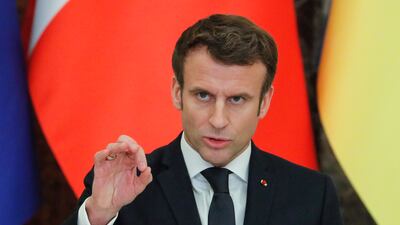
Emmanuel Macron was in Kiev on Tuesday, a day after his Kremlin talks with Vladimir Putin. EPA

Emmanuel Macron says Russia agreed to 'freeze the game' with no Ukraine escalation


Tim Stickings
  • English
  • Arabic

French President Emmanuel Macron claimed a breakthrough on Tuesday in his quest to defuse the Ukraine crisis, saying he had won assurances from Russia not to escalate matters.

Mr Macron said his trip to Moscow had succeeded in its aim of “freezing the game” to allow for Nato and the Kremlin to discuss their future.

“This objective for me is fulfilled,” he said after travelling to Kiev on Tuesday for talks with Ukrainian leaders. “I obtained that there will be neither a worsening nor an escalation.”

Mr Macron did not elaborate on what assurances he had received, and Moscow declined to corroborate his claims.

Russian President Vladimir Putin again warned that Ukraine’s potential membership of Nato could start conflict.

“The potential of the united organisation of Nato is not comparable to Russia’s one," Mr Putin said. "We understand this.

"But we also understand that Russia is one of the leading nuclear powers. It is even ahead of many on some modern components."

Kremlin spokesman Dmitry Peskov said the five-hour talks between Mr Macron and Mr Putin had produced “rational elements on the basis of which work can continue”.

Ukraine's President Volodymyr Zelenskiy also took a cautious tone, saying he was waiting for Russia to match any talk of de-escalation with action.

"I do not really trust words. I believe that every politician can be transparent by taking concrete steps," Mr Zelenskiy said.

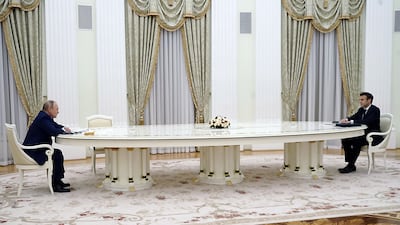
  • Russian President Vladimir Putin, left, and French President Emmanuel Macron meet in the Kremlin in Moscow. EPA
    Russian President Vladimir Putin, left, and French President Emmanuel Macron meet in the Kremlin in Moscow. EPA
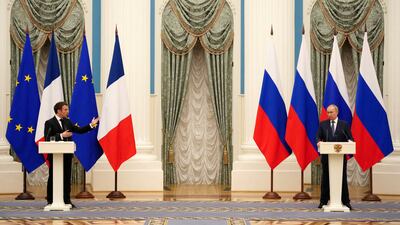
  • Mr Macron at a joint news conference with Mr Putin after five hours of talks. AP
    Mr Macron at a joint news conference with Mr Putin after five hours of talks. AP
  • Mr Putin said proposals put forward by the French leader during their discussion could form a basis for moving forwards. The crisis was sparked by Russia's massing of troops on its border with Ukraine. EPA
    Mr Putin said proposals put forward by the French leader during their discussion could form a basis for moving forwards. The crisis was sparked by Russia's massing of troops on its border with Ukraine. EPA
  • Mr Putin denied that Russia was acting aggressively towards Ukraine or the West. Reuters
    Mr Putin denied that Russia was acting aggressively towards Ukraine or the West. Reuters
  • The Russian leader said Ukrainian authorities were to blame for the conflict in the east of the former Soviet state. Reuters
    The Russian leader said Ukrainian authorities were to blame for the conflict in the east of the former Soviet state. Reuters
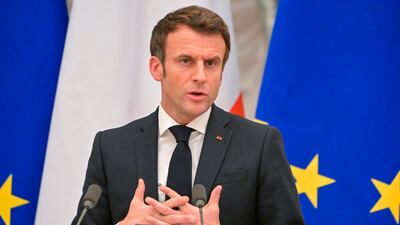
  • Mr Macron said the discussion could "make a start in the direction in which we need to go, which is towards a de-escalation". AFP
    Mr Macron said the discussion could "make a start in the direction in which we need to go, which is towards a de-escalation". AFP
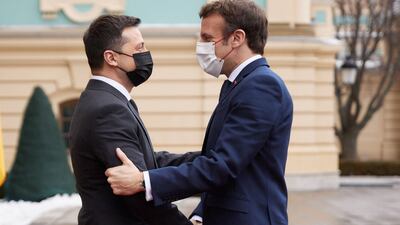
  • Mr Macron also travelled to Kiev to meet Ukrainian President Volodymyr Zelensky, left. AFP
    Mr Macron also travelled to Kiev to meet Ukrainian President Volodymyr Zelensky, left. AFP
  • Mr Macron at a joint press conference with his Ukrainian counterpart following their meeting. EPA
    Mr Macron at a joint press conference with his Ukrainian counterpart following their meeting. EPA

Mr Macron’s trip is the centrepiece of a week of frantic diplomacy as European leaders and foreign ministers try to prevent war in Ukraine.

German Chancellor Olaf Scholz met Mr Macron and Polish President Andrzej Duda in Berlin on Tuesday evening for talks in a group of three known as the Weimar Triangle.

"We are united by the goal of maintaining peace in Europe through diplomacy and clear messages and the shared will to act in unison," Mr Scholz said.

Annalena Baerbock, Germany's Foreign Minister, was on the frontline of Ukraine's conflict with pro-Russian separatists, where she said the crisis could only be solved with diplomacy.

"We will not be able to solve this aggression from the Russian side militarily," she said, after Germany was criticised in some quarters for refusing to export weapons to Ukraine.

It follows a trip by Mr Scholz to Washington in which he sought to reassure allies that Germany was on the same page as the US and Nato.

German Foreign Minister Annalena Baerbock visits Shyrokyne in the Donetsk region of Ukraine. Reuters

US President Joe Biden said Mr Scholz had "the complete trust of the United States" and described Germany as "completely, totally, thoroughly reliable".

While trumpeting the success of his Russian trip, Mr Macron said it would take weeks or months before any concrete progress was made.

Russia continues to press for guarantees that former Soviet countries such as Ukraine and Georgia will not be admitted to Nato.

The alliance rejects this and says Moscow should tone down its aggressive posture if it wants fewer western troops in its orbit.

Ann Linde, the Foreign Minister of non-aligned Sweden, said on Tuesday that there could be no return to a Cold War situation where countries such as Ukraine are "relegated to satellite status" rather than being free to choose their own alliances.

But Ms Linde told an event at the London School of Economics that Sweden had no plans to join Nato at the moment.

Ukrainian servicemen near the front line of a separatist-held region in the east of the country. Getty Images

Meanwhile, UK Prime Minister Boris Johnson told Russia that any invasion of Ukraine would backfire because it would only make Nato stronger.

After meeting Lithuanian Prime Minister Ingrida Simonyte, Mr Johnson said the UK stood by Nato and eastern European allies.

"We're shoulder to shoulder with you and all our Nato allies and we want to make clear that we support you," he said.

"We support you when it comes to the immigration issues in Belarus and all the questions that we're now facing."

The talks are taking place against the backdrop of military drills under way in Russia and about to start on the territory of its ally, Belarus.

On Tuesday, Russia's Defence Ministry said six large landing ships were moving from the Mediterranean to the Black Sea, where they will take part in the exercises.

Mr Putin’s remarks on his summit with Mr Macron praised France’s diplomatic efforts and indicated that he was ready to continue negotiations.

But he also criticised Nato after it insisted that Ukraine, Georgia and other countries near Russia could join the alliance if they chose to.

Mr Putin described the military build-up near Ukraine as troop movements on Russian territory that should be of no concern to Nato.

“Nato and its member states believe that they have a right to teach us where and how we can deploy our armed forces,” he said.


UAE currency: the story behind the money in your pockets
How to protect yourself when air quality drops

Install an air filter in your home.

Close your windows and turn on the AC.

Shower or bath after being outside.

Wear a face mask.

Stay indoors when conditions are particularly poor.

If driving, turn your engine off when stationary.

Top investing tips for UAE residents in 2021

Build an emergency fund: Make sure you have enough cash to cover six months of expenses as a buffer against unexpected problems before you begin investing, advises Steve Cronin, the founder of DeadSimpleSaving.com.

Think long-term: When you invest, you need to have a long-term mindset, so don’t worry about momentary ups and downs in the stock market.

Invest worldwide: Diversify your investments globally, ideally by way of a global stock index fund.

Is your money tied up: Avoid anything where you cannot get your money back in full within a month at any time without any penalty.

Skip past the promises: “If an investment product is offering more than 10 per cent return per year, it is either extremely risky or a scam,” Mr Cronin says.

Choose plans with low fees: Make sure that any funds you buy do not charge more than 1 per cent in fees, Mr Cronin says. “If you invest by yourself, you can easily stay below this figure.” Managed funds and commissionable investments often come with higher fees.

Be sceptical about recommendations: If someone suggests an investment to you, ask if they stand to gain, advises Mr Cronin. “If they are receiving commission, they are unlikely to recommend an investment that’s best for you.”

Get financially independent: Mr Cronin advises UAE residents to pursue financial independence. Start with a Google search and improve your knowledge via expat investing websites or Facebook groups such as SimplyFI. 

Ten tax points to be aware of in 2026

1. Domestic VAT refund amendments: request your refund within five years

If a business does not apply for the refund on time, they lose their credit.

2. E-invoicing in the UAE

Businesses should continue preparing for the implementation of e-invoicing in the UAE, with 2026 a preparation and transition period ahead of phased mandatory adoption. 

3. More tax audits

Tax authorities are increasingly using data already available across multiple filings to identify audit risks. 

4. More beneficial VAT and excise tax penalty regime

Tax disputes are expected to become more frequent and more structured, with clearer administrative objection and appeal processes. The UAE has adopted a new penalty regime for VAT and excise disputes, which now mirrors the penalty regime for corporate tax.

5. Greater emphasis on statutory audit

There is a greater need for the accuracy of financial statements. The International Financial Reporting Standards standards need to be strictly adhered to and, as a result, the quality of the audits will need to increase.

6. Further transfer pricing enforcement

Transfer pricing enforcement, which refers to the practice of establishing prices for internal transactions between related entities, is expected to broaden in scope. The UAE will shortly open the possibility to negotiate advance pricing agreements, or essentially rulings for transfer pricing purposes. 

7. Limited time periods for audits

Recent amendments also introduce a default five-year limitation period for tax audits and assessments, subject to specific statutory exceptions. While the standard audit and assessment period is five years, this may be extended to up to 15 years in cases involving fraud or tax evasion. 

8. Pillar 2 implementation 

Many multinational groups will begin to feel the practical effect of the Domestic Minimum Top-Up Tax (DMTT), the UAE's implementation of the OECD’s global minimum tax under Pillar 2. While the rules apply for financial years starting on or after January 1, 2025, it is 2026 that marks the transition to an operational phase.

9. Reduced compliance obligations for imported goods and services

Businesses that apply the reverse-charge mechanism for VAT purposes in the UAE may benefit from reduced compliance obligations. 

10. Substance and CbC reporting focus

Tax authorities are expected to continue strengthening the enforcement of economic substance and Country-by-Country (CbC) reporting frameworks. In the UAE, these regimes are increasingly being used as risk-assessment tools, providing tax authorities with a comprehensive view of multinational groups’ global footprints and enabling them to assess whether profits are aligned with real economic activity. 

Contributed by Thomas Vanhee and Hend Rashwan, Aurifer

Conflict, drought, famine

Estimates of the number of deaths caused by the famine range from 400,000 to 1 million, according to a document prepared for the UK House of Lords in 2024.
It has been claimed that the policies of the Ethiopian government, which took control after deposing Emperor Haile Selassie in a military-led revolution in 1974, contributed to the scale of the famine.
Dr Miriam Bradley, senior lecturer in humanitarian studies at the University of Manchester, has argued that, by the early 1980s, “several government policies combined to cause, rather than prevent, a famine which lasted from 1983 to 1985. Mengistu’s government imposed Stalinist-model agricultural policies involving forced collectivisation and villagisation [relocation of communities into planned villages].
The West became aware of the catastrophe through a series of BBC News reports by journalist Michael Buerk in October 1984 describing a “biblical famine” and containing graphic images of thousands of people, including children, facing starvation.

Band Aid

Bob Geldof, singer with the Irish rock group The Boomtown Rats, formed Band Aid in response to the horrific images shown in the news broadcasts.
With Midge Ure of the band Ultravox, he wrote the hit charity single Do They Know it’s Christmas in December 1984, featuring a string of high-profile musicians.
Following the single’s success, the idea to stage a rock concert evolved.
Live Aid was a series of simultaneous concerts that took place at Wembley Stadium in London, John F Kennedy Stadium in Philadelphia, the US, and at various other venues across the world.
The combined event was broadcast to an estimated worldwide audience of 1.5 billion.

Updated: February 09, 2022, 6:06 AM