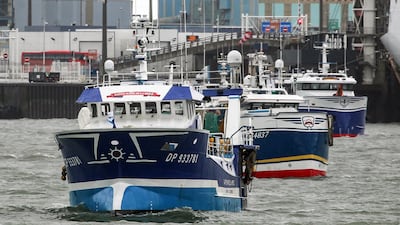
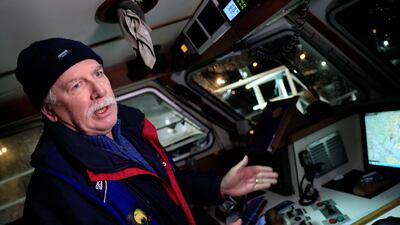
French fishermen blockaded traffic in the English Channel on Friday in a protest over post-Brexit rights that comes amid worsening tensions between the UK and France.
The protest began before dawn, with fishermen holding red flares aloft as they circled their boats off the coast of Saint Malo, a port in northern France, and stopped a British cargo vessel from docking.
Later on Friday, the relay passed to Calais and Ouistreham further along the coast, with six fishing boats from the port of Boulogne blocking access to the Calais port.
Other protesters used motor vehicles to block access to the Channel Tunnel for goods lorries, preventing them from boarding the rail shuttle to England.
Cars and trucks tailed back towards the motorway after fishermen put up barricades and lit smoke canisters at the Channel Tunnel terminal in Coquelles.
The UK government said it was hoping to keep any disruption to a minimum. "We're closely monitoring the situation and the actions of the French fishermen," a Downing Street spokesman said. "We look to the French authorities to ensure the free flow of traffic and trade to ensure the trade is not disrupted."
It coincides with the bitter fallout from the tragedy in the Channel on Wednesday, when 27 migrants died after attempting to reach Britain in an inflatable boat.
Paris reacted angrily to a letter made public by UK Prime Minister Boris Johnson on Thursday, in which he proposed returning migrants to France and conducting joint patrols of the French coast.
The response from the French government was to cancel an invitation UK Home Secretary Priti Patel to attend an emergency migration summit on Sunday.
It adds to months of tensions linked to Britain’s departure from the EU, which were worsened by a submarine deal between the UK, US and Australia.
The fishermen are angered by the UK’s failure, as they see it, to grant the access to British waters that was promised under a post-Brexit agreement.
Their grievances are shared by the French government, which says dozens of licenses are owed to its fishing industry, but Britain says it is honouring the agreement.
Gerard Romiti, chairman of the French national fisheries committee, described the protests as a warning shot against the “derisive and humiliating attitude of the English”.
“The UK must abide by the post-Brexit deal. Too many fishermen are still in the dark,” he said.
“We don't want handouts, we just want our licenses back,” he said, after the French government suggested compensation for the fishermen — a move which sparked fears it was backing down.
Dozens of French fishing boats are expected to block ferries from the UK at the ports of Saint-Malo, Calais and Ouistreham from midday.
Fishermen will try to use their cars to block the motorway leading to the Channel Tunnel, where goods lorries are carried on a railway shuttle.
The EU, which is locked in separate talks with Britain over special trading arrangements in Northern Ireland, has set a December 10 deadline to resolve the fishing dispute.
A spokesman for Mr Johnson said the UK was disappointed by the planned protests. He said Britain had issued almost 1,700 licenses to EU boats and invited fishermen to submit further evidence of their past ventures.
“It is obviously a matter for the French to ensure there are no illegal actions and that trade is not affected but we continue to monitor the situation closely,” he said.
Under the post-Brexit licensing agreement, Britain agreed to grant access to trawlers with an established record of fishing deep in its waters.
But France was outraged when the UK announced in September that only 12 out of a batch of 47 applications had been granted.
French authorities briefly seized a British trawler last month, and both sides have sent patrol vessels to waters off Jersey, a UK-controlled Channel Island.
The fishing industry is economically small but politically symbolic in both countries, and French President Emmanuel Macron is up for re-election next year.

UAE currency: the story behind the money in your pockets
The years Ramadan fell in May
TECH%20SPECS%3A%20APPLE%20WATCH%20SERIES%209
%3Cp%3E%3Cstrong%3EDisplay%3A%3C%2Fstrong%3E%2041mm%20%E2%80%93%20352%20x%20430%3B%2045mm%20%E2%80%93%20396%20x%20484%3B%20always-on%20Retina%20LTPO%20OLED%2C%202000%20nits%20max%3B%20Ion-X%20glass%20(aluminium%20cases)%2C%20sapphire%20crystal%20(stainless%20steel%20cases)%3C%2Fp%3E%0A%3Cp%3E%3Cstrong%3EProcessor%3A%3C%2Fstrong%3E%20Apple%20S9%2064-bit%2C%20W3%20wireless%2C%202nd-gen%20Ultra%20Wideband%3C%2Fp%3E%0A%3Cp%3E%3Cstrong%3ECapacity%3A%3C%2Fstrong%3E%2064GB%3C%2Fp%3E%0A%3Cp%3E%3Cstrong%3EMemory%3A%3C%2Fstrong%3E%201GB%3C%2Fp%3E%0A%3Cp%3E%3Cstrong%3EPlatform%3A%3C%2Fstrong%3E%20watchOS%2010%3C%2Fp%3E%0A%3Cp%3E%3Cstrong%3EHealth%20metrics%3A%3C%2Fstrong%3E%20Blood%20oxygen%20sensor%2C%20electrical%20heart%20sensor%20and%20ECG%2C%203rd-gen%20optical%20heart%20sensor%2C%20high%20and%20low%20heart%20rate%20notifications%2C%20irregular%20rhythm%20notifications%2C%20sleep%20stages%2C%20temperature%20sensing%3C%2Fp%3E%0A%3Cp%3E%3Cstrong%3EEmergency%20services%3A%3C%2Fstrong%3E%20Emergency%20SOS%2C%20international%20emergency%20calling%2C%20crash%20detection%2C%20fall%20detection%3C%2Fp%3E%0A%3Cp%3E%3Cstrong%3EConnectivity%3A%3C%2Fstrong%3E%20GPS%2FGPS%20%2B%20cellular%3B%20Wi-Fi%2C%20LTE%2C%20Bluetooth%205.3%2C%20NFC%20(Apple%20Pay)%3C%2Fp%3E%0A%3Cp%3E%3Cstrong%3EDurability%3A%3C%2Fstrong%3E%20IP6X%2C%20water%20resistant%20up%20to%2050m%2C%20dust%20resistant%3C%2Fp%3E%0A%3Cp%3E%3Cstrong%3EBattery%3A%3C%2Fstrong%3E%20308mAh%20Li-ion%2C%20up%20to%2018h%20regular%2F36h%20low%20power%3B%20wireless%20charging%3C%2Fp%3E%0A%3Cp%3E%3Cstrong%3ECards%3A%3C%2Fstrong%3E%20eSIM%3C%2Fp%3E%0A%3Cp%3E%3Cstrong%3EFinishes%3A%3C%2Fstrong%3E%20Aluminium%20%E2%80%93%20midnight%2C%20pink%2C%20Product%20Red%2C%20silver%2C%20starlight%3B%20stainless%20steel%20%E2%80%93%20gold%2C%20graphite%2C%20silver%3C%2Fp%3E%0A%3Cp%3E%3Cstrong%3EIn%20the%20box%3A%3C%2Fstrong%3E%20Watch%20Series%209%2C%20woven%20magnetic-to-USB-C%20charging%20cable%2C%20band%2Floop%3C%2Fp%3E%0A%3Cp%3E%3Cstrong%3EPrice%3A%3C%2Fstrong%3E%20Starts%20at%20Dh1%2C599%20(41mm)%20%2F%20Dh1%2C719%20(45mm)%3C%2Fp%3E%0A
Dengue%20fever%20symptoms
%3Cp%3EHigh%20fever%20(40%C2%B0C%2F104%C2%B0F)%3Cbr%3ESevere%20headache%3Cbr%3EPain%20behind%20the%20eyes%3Cbr%3EMuscle%20and%20joint%20pains%3Cbr%3ENausea%3Cbr%3EVomiting%3Cbr%3ESwollen%20glands%3Cbr%3ERash%26nbsp%3B%3C%2Fp%3E%0A
Labour dispute
The insured employee may still file an ILOE claim even if a labour dispute is ongoing post termination, but the insurer may suspend or reject payment, until the courts resolve the dispute, especially if the reason for termination is contested. The outcome of the labour court proceedings can directly affect eligibility.
- Abdullah Ishnaneh, Partner, BSA Law
McLaren GT specs
Engine: 4-litre twin-turbo V8
Transmission: seven-speed
Power: 620bhp
Torque: 630Nm
Price: Dh875,000
On sale: now
Results
4pm: Al Bastakiya – Listed (TB) $150,000 (Dirt) 1,900m; Winner: Panadol, Mickael Barzalona (jockey), Salem bin Ghadayer (trainer)
4.35pm: Dubai City Of Gold – Group 2 (TB) $228,000 (Turf) 2,410m; Winner: Walton Street, William Buick, Charlie Appleby
5.10pm: Mahab Al Shimaal – Group 3 (TB) $228,000 (D) 1,200m; Winner: Canvassed, Pat Dobbs, Doug Watson
5.45pm: Burj Nahaar – Group 3 (TB) $228,000 (D) 1,600m; Winner: Midnight Sands, Pat Dobbs, Doug Watson
6.20pm: Jebel Hatta – Group 1 (TB) $260,000 (T) 1,800m; Winner: Lord Glitters, Daniel Tudhope, David O’Meara
6.55pm: Al Maktoum Challenge Round-1 – Group 1 (TB) $390,000 (D) 2,000m; Winner: Salute The Soldier, Adrie de Vries, Fawzi Nass
7.30pm: Nad Al Sheba – Group 3 (TB) $228,000 (T) 1,200m; Winner: Final Song, Frankie Dettori, Saeed bin Suroor
Results
1. Lewis Hamilton (Mercedes) 1hr 32mins 03.897sec
2. Max Verstappen (Red Bull-Honda) at 0.745s
3. Valtteri Bottas (Mercedes) 37.383s
4. Lando Norris (McLaren) 46.466s
5.Sergio Perez (Red Bull-Honda) 52.047s
6. Charles Leclerc (Ferrari) 59.090s
7. Daniel Ricciardo (McLaren) 1:06.004
8. Carlos Sainz Jr (Ferrari) 1:07.100
9. Yuki Tsunoda (AlphaTauri-Honda) 1:25.692
10. Lance Stroll (Aston Martin-Mercedes) 1:26.713,
Favourite book: ‘The Art of Learning’ by Josh Waitzkin
Favourite film: Marvel movies
Favourite parkour spot in Dubai: Residence towers in Jumeirah Beach Residence
Tips for SMEs to cope
- Adapt your business model. Make changes that are future-proof to the new normal
- Make sure you have an online presence
- Open communication with suppliers, especially if they are international. Look for local suppliers to avoid delivery delays
- Open communication with customers to see how they are coping and be flexible about extending terms, etc
Courtesy: Craig Moore, founder and CEO of Beehive, which provides term finance and working capital finance to SMEs. Only SMEs that have been trading for two years are eligible for funding from Beehive.
Ten tax points to be aware of in 2026
1. Domestic VAT refund amendments: request your refund within five years
If a business does not apply for the refund on time, they lose their credit.
2. E-invoicing in the UAE
Businesses should continue preparing for the implementation of e-invoicing in the UAE, with 2026 a preparation and transition period ahead of phased mandatory adoption.
3. More tax audits
Tax authorities are increasingly using data already available across multiple filings to identify audit risks.
4. More beneficial VAT and excise tax penalty regime
Tax disputes are expected to become more frequent and more structured, with clearer administrative objection and appeal processes. The UAE has adopted a new penalty regime for VAT and excise disputes, which now mirrors the penalty regime for corporate tax.
5. Greater emphasis on statutory audit
There is a greater need for the accuracy of financial statements. The International Financial Reporting Standards standards need to be strictly adhered to and, as a result, the quality of the audits will need to increase.
6. Further transfer pricing enforcement
Transfer pricing enforcement, which refers to the practice of establishing prices for internal transactions between related entities, is expected to broaden in scope. The UAE will shortly open the possibility to negotiate advance pricing agreements, or essentially rulings for transfer pricing purposes.
7. Limited time periods for audits
Recent amendments also introduce a default five-year limitation period for tax audits and assessments, subject to specific statutory exceptions. While the standard audit and assessment period is five years, this may be extended to up to 15 years in cases involving fraud or tax evasion.
8. Pillar 2 implementation
Many multinational groups will begin to feel the practical effect of the Domestic Minimum Top-Up Tax (DMTT), the UAE's implementation of the OECD’s global minimum tax under Pillar 2. While the rules apply for financial years starting on or after January 1, 2025, it is 2026 that marks the transition to an operational phase.
9. Reduced compliance obligations for imported goods and services
Businesses that apply the reverse-charge mechanism for VAT purposes in the UAE may benefit from reduced compliance obligations.
10. Substance and CbC reporting focus
Tax authorities are expected to continue strengthening the enforcement of economic substance and Country-by-Country (CbC) reporting frameworks. In the UAE, these regimes are increasingly being used as risk-assessment tools, providing tax authorities with a comprehensive view of multinational groups’ global footprints and enabling them to assess whether profits are aligned with real economic activity.
Contributed by Thomas Vanhee and Hend Rashwan, Aurifer