

Hundreds of migrants caught in a stand-off between Poland and Belarus were sheltering on the floor of a warehouse on Friday after they were moved from the freezing border zone.
But Poland said the crisis at the EU border had not ended, with 255 people attempting to cross even after makeshift camps were cleared.
President Alexander Lukashenko denied once again that Belarus had lured the migrants to the border to undermine the EU.
But he said in an interview with the BBC that Belarusian troops may have helped people cross into Poland once they were there.
“I think that’s absolutely possible. We’re Slavs. We have hearts,” he said. “Maybe someone helped them. I won't even look into this.
“But I didn't invite them here. And to be honest, I don't want them to go through Belarus.”
The EU and its allies have rejected Mr Lukashenko’s denials and accused him of engineering the crisis to exact vengeance for sanctions the bloc has enacted on Belarus.
Thousands of migrants are thought to still be in Belarus, where state media boasted that 2,000 people were provided with hot meals and drinking water at a warehouse on the Belarusian side of the border.
After they were moved from tents to the warehouse, Poland said it would halt railway freight traffic at a nearby border crossing.
-
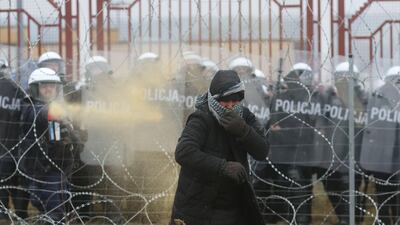
A Polish law enforcement officer uses tear gas, as migrants attempt to cross the border at a checkpoint in the Grodno region of Belarus. Reuters -
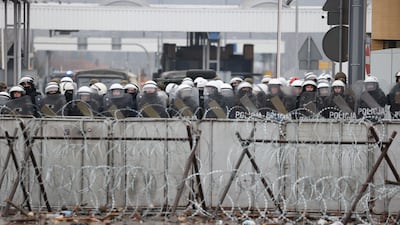
Polish law enforcement officers line up at the Bruzgi-Kuznica border crossing. AFP -
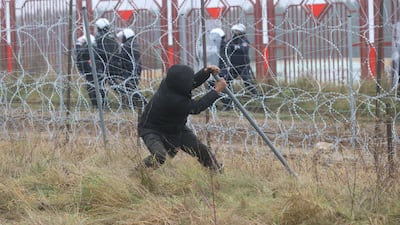
A man breaks a fence at the border. Reuters -

A drone view as Polish servicemen use a water cannon during clashes between migrants and Polish border guards. AP -
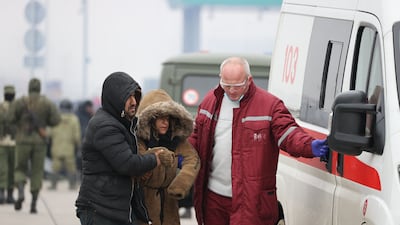
A woman receives medical attention at the Bruzgi-Kuznica border crossing. AFP -
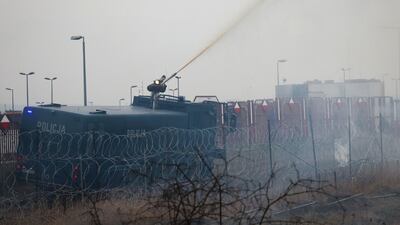
Polish servicemen use a water cannon at the border. Polish border forces said they were attacked with stones by migrants. AP -
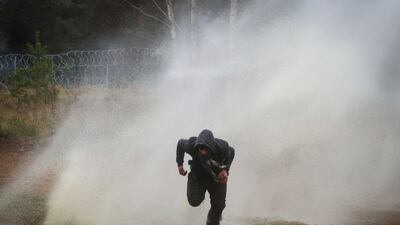
A man runs away from a water cannon during the clashes. AP Photo -
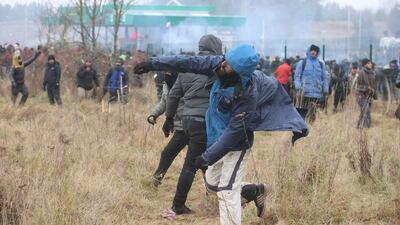
A man throws a stone in the direction of a border fence and Polish law enforcement officers. Reuters -
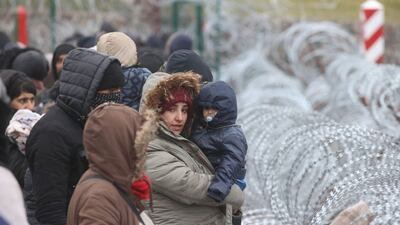
Migrants gather at the Bruzgi-Kuznica border crossing. AFP


Aid workers remained concerned for the welfare of the migrants, at least 11 of whom are believed to have died due to the freezing temperatures.
“Urgent action is needed to protect the lives of people stranded in the border regions,” said Dunja Mijatovic, a human rights commissioner for the Council of Europe.
Although Belarus is suspected of engineering the crisis, Poland is considered to be at fault for restricting humanitarian access to the border and pushing migrants out of its territory, she said.
“Every night and every hour spent in the borderland means real danger to their lives,” she said.
The EU resumed its efforts to stop the flow of migrants to Belarus on Friday, with commissioner Margaritis Schinas visiting Turkey to seek co-operation.
Brussels has leant on countries including Iraq to stop people leaving for Minsk. Some people flew back to Baghdad from the Belarusian capital this week.
Others are still holding out hope of being admitted to the EU. But Germany dismissed suggestions that it could take in some of the migrants.
“The aim must be to save people from need and suffering and bring them safely back to their home countries,” said German Interior Minister Horst Seehofer.

Mr Lukashenko spoke to his main political backer, Russian President Vladimir Putin, on Friday about what the Kremlin described as Belarus’s steps to de-escalate the crisis.
Poland rejected the idea that the crisis was easing, claiming that hundreds of migrants were driven back to the border after darkness fell.
Four Polish guards were injured and others blinded with lasers as people tried to force their way over the border, said border guard spokeswoman Anna Michalska.
Secretary General of Nato Jens Stoltenberg said the start of return flights to Baghdad was a step in the right direction.
But the situation was serious and Nato would “remain vigilant and stand ready to further help our allies”, he said.
“The Lukashenko regime’s use of vulnerable people as a means to put pressure on other countries is cynical and inhumane,” he said.

