


A Russian test of an anti-satellite missile that created a cloud of debris and endangered humans living aboard the International Space Station has reignited concerns over space junk.
Thanks to a sharp rise in the number of private companies capable of putting satellites in orbit at a greatly reduced cost, the number of objects in space has soared in recent years.
Private companies like Elon Musk’s SpaceX and Jeff Bezos’s Blue Origin are opening up a new era in space flight and small satellites, but experts have for years given warning of the perils of ignoring the problem of space junk before taking the next small steps into the cosmos.
What experts are saying about space junk
“Space junk rises to the level of our national consciousness only when something – an inactive satellite, busted-up rocket boosters, fragments of manned spacecraft – threatens us back on Earth,” US futurist Amy Webb wrote in 2018.
“Space junk is a problem that continues to orbit our collective attention, and within days it will once again circle out of view. We’ll ignore the problem to our own detriment.”
Russia’s missile test last week destroyed an old satellite in low Earth orbit and created a cloud of hundreds of thousands of pieces of debris, 1,500 of which are large enough to track from the ground, prompting US officials to accuse the Russians of “dangerous and irresponsible behaviour”.
After several officials at first denied that Russia was behind the test, Defence Minister Sergei Shoigu eventually defended the action and said the debris did “not pose any threat to space activity”.
But this view was not shared by space officials and experts.
Nasa administrator Bill Nelson said he was “outraged by this irresponsible and destabilising action. With its long and storied history in human spaceflight, it is unthinkable that Russia would endanger not only the American and international partner astronauts on the ISS but also their own cosmonauts.
“All nations have a responsibility to prevent the purposeful creation of space debris from Asats (anti-satellite weapons) and to foster a safe, sustainable space environment,” he said.

The crew of astronauts on board the International Space Station – including two Russian cosmonauts – were forced to take shelter in their re-entry capsules while they passed near the debris cloud, Nasa said.
The US space agency was already tracking more than 100 million pieces of space junk orbiting the Earth.
Even the smallest objects can pose a threat to fragile satellites and orbiting laboratories like the ISS because of the incredibly high speeds at which they are travelling – often in excess of 28,000kph.
Though the near-term threat posed by space junk is largely confined to satellites in low Earth orbit, experts want action now before any unforeseen consequences arise.
“As the number of rocket launches increases, the more space junk there will be – and it's unclear what the long-term effects on the atmosphere may be,” wrote Alice Gorman, a pioneering “space archaeologist”, whose research focuses on space debris.
“The quantity of human materials in orbit is only increasing more rapidly with the launch of "mega-constellations" of communication satellites, like Starlink, SpaceX's plan to provide low-cost satellite internet access,” she wrote.
Calls for better regulation
After the Russian Asat test, Pentagon spokesman John Kirby said the event showed the need for international regulation governing activity in space.
"We've been very clear, we would like to see norms for space so that it can be used responsibly by all spacefaring nations," he said.
While there are international agreements that govern the use of weapons in space – in 1963, the UN General Assembly unanimously adopted a resolution prohibiting the introduction of weapons of mass destruction in outer space – Asat tests such as the one carried out by Russia this week are not illegal.
After a similar Russian test destroyed a satellite in July last year, international space agencies and former astronauts signed an open letter from the Outer Space Institute, calling for a halt to Asat testing.
“The development of mega-constellations along with the expected growth of crewed space missions make debris-generating Asat tests significantly more perilous than before,” the letter said.
The institute said Asat tests could create a domino effect, leading to a cascading series of incidents and creating more and more orbital debris, similar to the disaster depicted in the 2013 film Gravity.
Regulation regarding space junk, the institute said, has “lapsed”.
But a host of space companies and organisations this week committed to redoubling their efforts to find ways of reducing the amount of junk in orbit by 2030.
The Net Zero Space charter, launched on November 12 during the Paris Peace Forum in France, was signed by high-profile space companies including Arianespace and Eutelsat.
“There are about 4,700 operational satellites currently in orbit, and this number could rise to more than 25,000 by the end of the decade," Arianespace chief executive Stephan Israel said.
“We must therefore urgently address the question of our responsibility in relation to the increased use of space, so we can safeguard the benefits for humanity over the long haul.”
Anti-satellite weapons - in pictures
-

The ASM-135 ASAT anti-satellite missile is part of the US F15 Eagle aircraft's arsenal. Photo: Lorax -
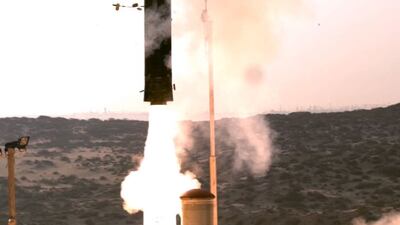
The Israel Missile Defence Organisation and the US Missile Defence Agency jointly developed the Arrow-3 interceptor. Photo: Public Domain -
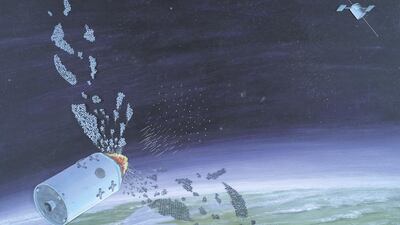
An artist's impression of a Russian anti-satellite weapon. Photo: Public Domain -
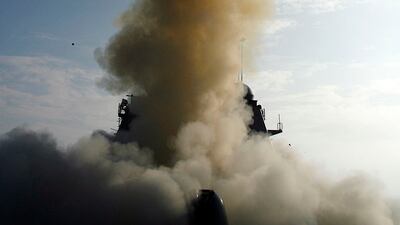
The US fired a modified SM-3 missile to destroy the failing NRO-L 21 satellite. Photo: Public Domain -
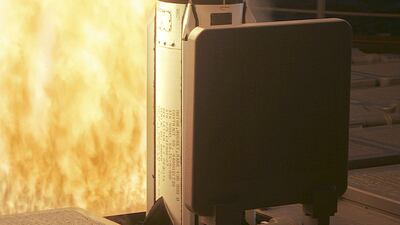
An SM-3 being launched from the Pearl Harbor-based Aegis cruiser 'USS Lake Erie' during a ballistic missile flight test. The missile intercepted a separating ballistic missile threat target, launched from the Pacific Missile Range Facility in Barking Sands, Hawaii. The test was the sixth intercept, in seven flight tests, by Aegis Ballistic Missile Defence. Photo: Public Domain -

The Soviet Strategic Defence Programme involved extensive research on advanced technologies in the 1980s. The USSR already had ground-based lasers, conceptually illustrated here, capable of interfering with some US satellites. Photo: Public Domain -
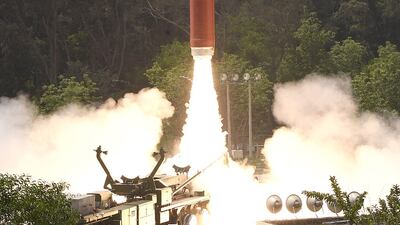
The Defence Research and Development Organisation launched a ballistic missile defence interceptor missile in a test – Mission Shakti – engaging an Indian orbiting target satellite in low Earth orbit on March 27, 2019. Photo: Ministry of Defence India -
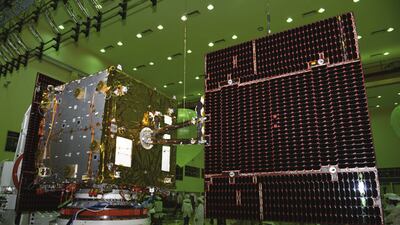
A Microsat-R satellite was launched by India on January 24, 2019 and served as a target for the Mission Shakti test on March 27, 2019. Photo: Ministry of Defence India -
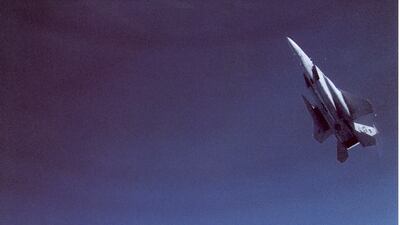
The airborne launch of an ASAT missile in September 1985, which destroyed an orbiting satellite. Photo: Public Domain



