


Survivors of the November 2015 Paris attacks began testifying at a trial on Tuesday, reliving the night of horror in the presence of more than a dozen accused in court.
One by one over the coming weeks, 300 survivors and family members of the victims of the attacks on November 13, which killed 130 people, are to take the stand.
The suicide bomb and gun assaults by three teams of terrorists on bars, restaurants, the Bataclan concert hall and the national stadium, planned in Syria and later claimed by ISIS, also wounded about 350 people.
"A suicide bomber blew himself up in front of us. I can still feel the explosion in my body, as well as the noise and the smell," Pierre, a now-retired gendarme officer, told the court on Tuesday.
Pierre, who was part of a Republican Guard patrol at the Stade de France the night of the attacks, said in a trembling voice: "It was shocking to see a human torso cut in half, and bits of flesh everywhere".
In his 33-year career, he had never seen anything like it.
"No training prepares you for a suicide bombing," Pierre said.
"I felt a shockwave go through my body," said Gregory, another member of that day's patrol. "I wasn't scared and I felt no pain. But that made it worse because I'd never felt like that before."

Gregory, who like his colleagues testified in uniform, remembered one other thing: "When I got home I realised I had bits of flesh stuck in my hair."
Some of the survivors told AFP that, as daunting as it was to tell their stories in a packed courtroom with the accused present, they felt it had to be done.
"I want to go through with this. It's part of my reconstruction effort," said Marko, 31, who sat on a terrace at the Belle Equipe cafe in central Paris with a group of friends when the gunmen attacked, killing one of them.
"I want to face these people, I want them to see who their victims were – what happened to us and to those who are gone," Marko said before Tuesday's proceedings.
That night, 39 people were killed on terraces of bars and cafes.
Fourteen defendants are being tried in person at the biggest trial in modern French history, and six others will be judged in their absence, with most facing life sentences.
Among them is the only surviving gunman, Salah Abdeslam, a French-Moroccan national who sought to upstage the first weeks of proceedings with repeated unscheduled interventions that have angered survivors.
The presiding judge has scheduled 15 witness statements by survivors for each day, starting with those who were at the Stade de France, followed by those in cafes and finally the survivors of the Bataclan concert hall massacre.
"I'm completely petrified," said Edith Seurat, 43, who made it out of the Bataclan alive.
At first, she said, she didn't see the point of going over the events again because "everything has been said a thousand times".
Instead, Ms Seurat said, she wanted to talk about her life since those events.
-

A person is being evacuated after a shooting, outside the Bataclan theater in Paris. A series of attacks targeting young concert-goers, soccer fans and Parisians enjoying a Friday night out at popular nightspots killed over 100 people in the deadliest violence to strike France since the Second World War. Thibault Camus/ AP Photo -

Spectators spill onto the pitch of the Stade de France stadium after three suicide bombers blew themselves up outside the stadium where France were playing Germany in an international football match. Michel Euler/AP Photo -

Spectators running onto the pitch of the Stade de France stadium amid the chaos and aftermath of suicide bombings outside the venue. Christophe Ena/AP Photo -

A victim under a blanket lays dead outside the Bataclan theatre in Paris on Nov 13, 2015, as more than 120 people were killed in a series of shooting and explosions across the French capital. Jerome Delay/AP Photo -
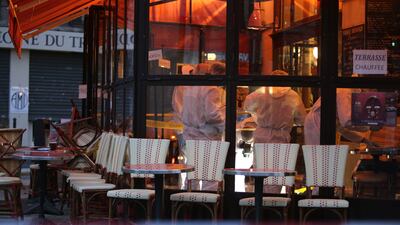
Forensic police searching for evidence inside the Comptoir Voltaire cafe at the site of an attack on November 14, 2015 in Paris, the morning after a series of gun attacks occurred across the city. Kenzo Tribouillard/AFP Photo -
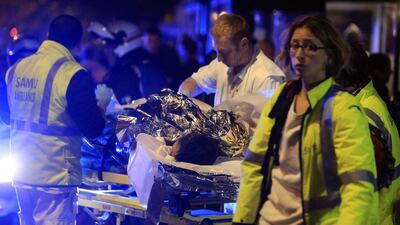
Emergency workers tending to the injured outside the Bataclan theatre. Thibault Camus/AP Photo -
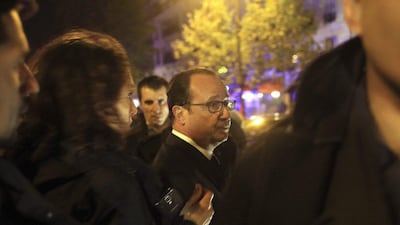
French president Francois Hollande, who declared a state of emergency and announced that he was closing the country's borders, arrives to visit the site of the the Bataclan theatre after the maasacre. Thibault Camus/AP Photo -

Investigators search for clues outside the Stade de France stadium after an explosion and after a friendly soccer match between France and Germany, in Saint Denis, outside Paris, early Saturday Nov 14, 2015. Michel Spingler/ AP Photo -
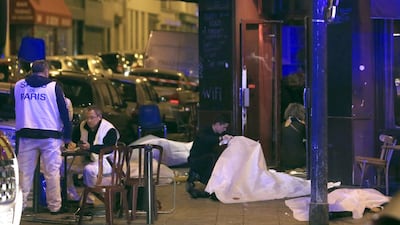
Victims lay on the pavement outside a Paris restaurant. Thibault Camus/AP Photo -
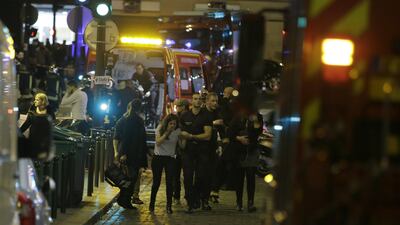
French security moving people in the area of Rue Bichat in the 10th arrondissement of the French capital Paris following a string of attacks on November 13, 2015. At least 18 people were killed as multiple shootings and explosions hit Paris, police said. Police also said there was an ongoing hostage crisis in the Bataclan a concert hall in the French capital.Kenzo Tribouillard/AFP Photo -
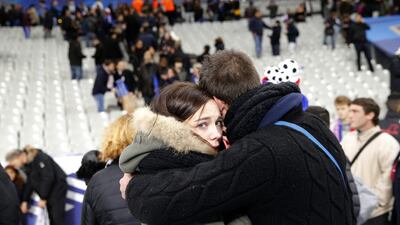
A man comforts a woman after spectators poured onto the pitch of the Stade de France stadium after multiple explosions outside. Christophe Ena/AP Photo


But when she went to listen in the trial's opening phase, she realised that each investigator had a different version of what happened that night.
"Perhaps I underestimated the importance of bearing witness, and maybe I will now focus on what I saw and heard," Ms Seurat said.
Many witnesses needed help to overcome their unease about addressing the court, said Gerard Chemla, a lawyer representing 15 of the survivors .
Several battled survivor's guilt, and the fears of having nothing to say and of breaking down, Mr Chemla said.
"To be overwhelmed by emotion or to cry in public is not a sign of failure," he told his clients.
The witnesses face the court as they testify, with the bench of the accused placed behind them.
But many of the survivors wondered whether they should turn around to address the accused, especially Mr Abdeslam.
When he last week told the court the attacks had been "inevitable", Marko, who was in the audience, jumped to his feet.
"I started to shout abuse at him," he said. "An injured friend talked me down but I still remained standing until the end, staring at him."
The trial is scheduled to continue until May 2022.

