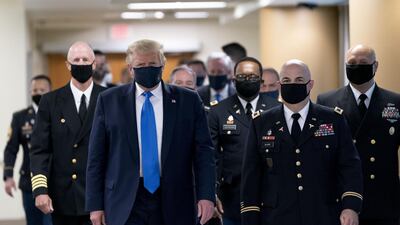
President Donald Trump, with two months left in office, asked for options for attacking Iran's main nuclear site last week before ultimately deciding against taking the escalatory step, a US official said on Monday.
Mr Trump made the request during an Oval Office meeting on Thursday with his top national security aides, including Vice President Mike Pence, Secretary of State Mike Pompeo, new acting Defence Secretary Christopher Miller and General Mark Milley, chairman of the Joint Chiefs of Staff, the official said.
Mr Trump, who has refused to concede and is challenging the results of the November 3 presidential election, is to hand over power to Democratic President-elect Joe Biden on January 20.
The official confirmed the account of the meeting in The New York Times, which reported how the advisers persuaded Mr Trump not to go ahead with a strike because of the risk of a broader conflict.
"He asked for options. They gave him the scenarios and he ultimately decided not to go forward," the official said.
The White House declined to comment.
-
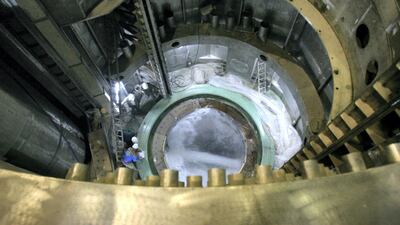
Russian contractors work at the Bushehr nuclear reactor site in 2007. The plant opened four years later. Bloomberg -
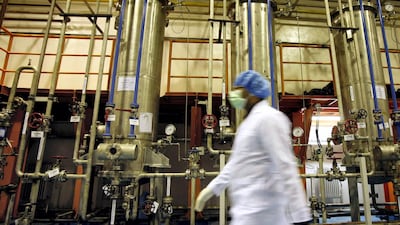
An Iranian technician at the International Atomic Energy Agency inspects the country's Isfahan plant in 2007. Tehran is no longer co-operating with the agency at nuclear sites across the country. EPA -

Workers wait to begin constructing a second reactor at the Bushehr nuclear power plant in 2019. AFP -
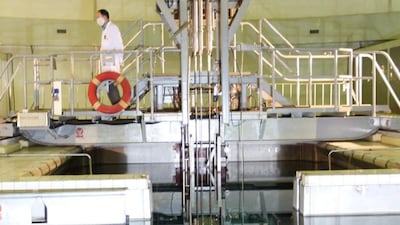
A metal-encased rod with 20 per cent enriched nuclear fuel is inserted into a reactor in Tehran in 2012. AFP -
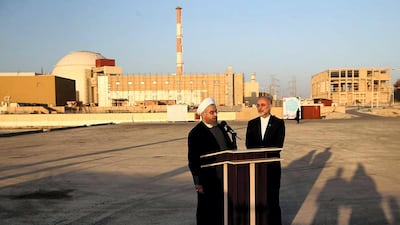
Fomer Iranian President Hassan Rouhani and the country's Atomic Energy Organisation chief Ali Akbar Salehi speak at the Bushehr nuclear site in 2015. AFP -
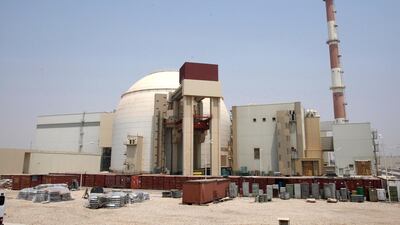
Iran's Bushehr nuclear plant has been restarted. EPA -
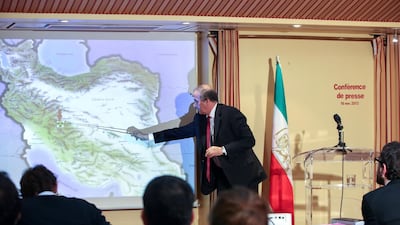
Mehdi Abrichamtchi, chairman of the Peace and Security Committee at the National Council of Resistance of Iran, shows journalists the location of a secret nuclear site in Iran in 2013. AFP -
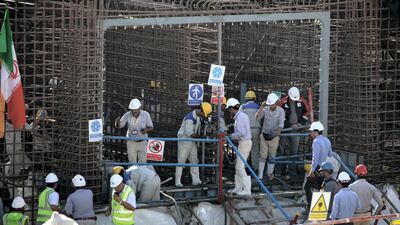
Workers prepare to begin the construction of a second reactor at the Bushehr site. AFP


Mr Trump has spent all four years of his presidency engaging in an aggressive policy against Iran, withdrawing in 2018 from the Iran nuclear deal negotiated by his Democratic predecessor, Barack Obama, and imposing economic sanctions against a wide variety of Iranian targets.
Mr Trump's request for options came a day after a UN watchdog report showed Iran had finished moving a first cascade of advanced centrifuges from an aboveground plant at its main uranium enrichment site to an underground one, in a fresh breach of its 2015 nuclear deal with major powers.
Alireza Miryousefi, a spokesman for Iran’s mission to the United Nations in New York, said Iran's nuclear programme is purely for peaceful purposes and civilian use and Mr Trump's policies have not changed that. "However, Iran has proven to be capable of using its legitimate military might to prevent or respond to any melancholy adventure from any aggressor," he added.
Iran's 2.4 tonne stock of low-enriched uranium is now far above the deal's 202.8kg limit. It produced 337.5kg in the quarter, less than the more than 500kg recorded in the previous two quarters by the International Atomic Energy Agency.
In January, Mr Trump ordered a US drone strike that killed Iranian General Qassem Suleimani at Baghdad's airport. But he has shied away from broader military conflicts and sought to withdraw US troops from global hotspots in keeping with a promise to stop what he calls "endless wars."
A strike on Iran's main nuclear site at Natanz could flare into a regional conflict and pose a serious foreign policy challenge for Mr Biden.
Mr Biden's transition team, which has not had access to national security intelligence due to the Trump administration's refusal to begin the transition, declined to comment.

