
India's Taj Mahal and some schools reopened on Monday as authorities pressed ahead with kick-starting the country's economy despite soaring infection numbers.
India, home to 1.3 billion people and some of the world's most crowded cities, has recorded more than 5.4 million Covid-19 cases, second only to the US.
But after a lockdown in March that affected the livelihoods of tens of millions of people, Prime Minister Narendra Modi is reluctant to copy some other nations and tighten restrictions again.
Instead, in recent months his government eased more and more restrictions, including on many train routes, domestic flights, markets, restaurants – and now visiting the Taj Mahal.
"So many people lost their job during the lockdown. People have suffered a lot and it is time the country opens up fully," said bank official Ayub Sheikh, 35, who was visiting the tourist site with his wife and baby daughter.
"We are not afraid of the virus. If it has to infect us, it will. Not many people are dying now. I don't think it is going to go away soon. We have to get used to it now."
The white-marble mausoleum in Agra, south of New Delhi, is India's most popular tourist site. It usually draws seven million visitors a year, but was closed in March.
Officials said strict social distancing rules were in place and visitors were not allowed to touch the marble.
The famous bench where visitors sit for a picture, including Princess Diana in 1992, has been laminated so that it can be regularly sanitised without damage.
-
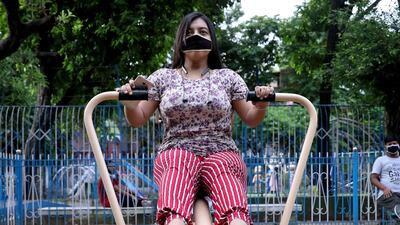
A woman wearing a protective face mask exercises at an open-air gym in a municipal park amidst the coronavirus disease (COVID-19) outbreak in Kolkata, India, September 21, 2020. REUTERS/Rupak De Chowdhuri -
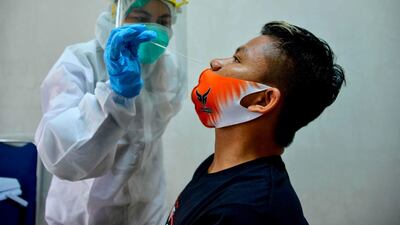
A local football player takes a swab test for the COVID-19 coronavirus at the Syiah Kuala university laboratory in Banda Aceh on September 21, 2020. / AFP / CHAIDEER MAHYUDDIN -
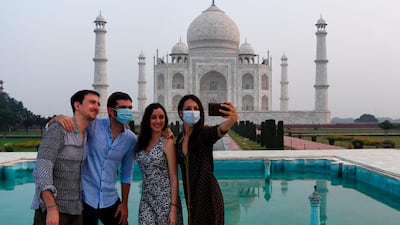
Tourists have their pictures taken at the Taj Mahal in Agra on September 21, 2020. The Taj Mahal reopens to visitors on September 21 in a symbolic business-as-usual gesture, even as India looks set to overtake the US as the global leader in coronavirus infections. / AFP / Sajjad HUSSAIN -

Fans of Atletico de San Luis play the drum as they cheer for their team before a Mexican Aperturna tournament football match against Monterrey, outside the Alfonso Lastras stadium in San Luis Potosi, Mexico, on September 20, 2020, amid the COVID-19 coronavirus pandemic. The tournament is played without spectators as a preventive measure against the spread of COVID-19. / AFP / VICTOR CRUZ -

A sign displays a QR code for the NZ Covid Tracer app outside a store in Queenstown, New Zealand. Bloomberg -
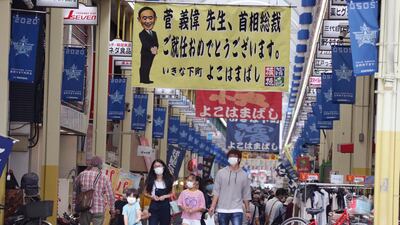
People walk at a shopping mall in Yokohama near Tokyo. AP Photo -

Jimmy Kimmel stands in front of a wall of nominees watching remotely at the Staples Center during the 72nd Primetime Emmy Awards ceremony held. AFP -
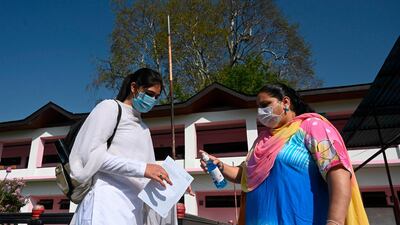
A teacher sprays sanitiser on the hands of student entering a school in Srinagar. AFP -
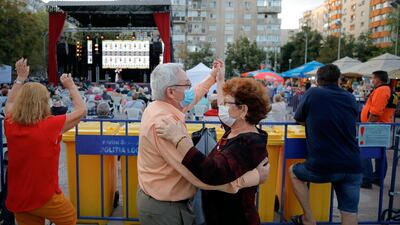
People attends a folk music concert in a park in Bucharest, Romania. AP Photo -
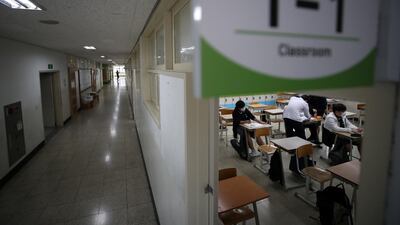
High school students prepare for a class at a high school in Seoul, South Korea. Reuters -
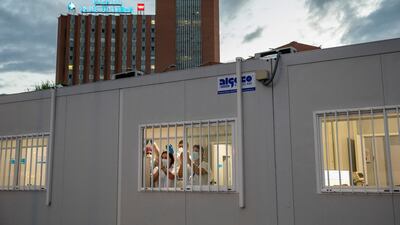
Health care workers applaud protesters during a demonstration outside 12 October Hospital, in the Usera neighborhood in Madrid, Spain. Getty Images -

A man takes part in a procession as part of the Sao Goncalo Festival, in Amarantina, district of Ouro Preto, Minas Gerais State, Brazil. AFP -
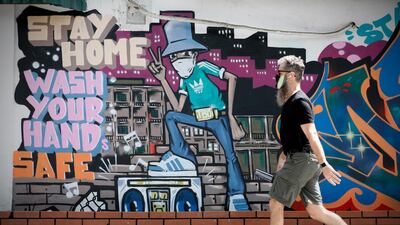
A man walks past graffiti painted on a wall in Hanoi, Vietnam. EPA


Early on Monday a couple of hundred of visitors were inside the site. Security personnel reminded everyone to wear masks once photos were taken. Daily visitor numbers have been capped at 5,000 – a quarter of the normal rate.
"Coronavirus is there in every country," Spanish visitor Ainhoa Parra told AFP.
"We are taking all the safety measures that we can. We have to be careful but if we have to get infected we will."
Local official said he was pleased the Taj Mahal reopened because so many livelihoods depended on the site.
Elsewhere in India, particularly in rural areas where infections are soaring, anecdotal evidence suggests that government guidelines on avoiding the virus are more often ignored than adhered to.
"I think, not just in India but all over the world, fatigue with extreme measures that were taken to restrict the growth of the coronavirus is setting in," said Gautam Menon, a professor of physics and biology at Ashoka University.
Many experts say that even though India is testing more than a million people every day, that is still not enough and the true number of cases may be much higher than officially reported.
The same goes for deaths, which currently stand at more than 87,000, with many fatalities not properly recorded even in normal times in one of the world's worst-funded healthcare systems.
But there is some resistance to the push from the authorities to open up the world's second-most populated country, where the economy contracted by almost a quarter between April and June.
Schools were allowed to resume on Monday on a voluntary basis for pupils aged 14 to 17, but most Indian states said it was still too soon.
In those states where they can open, school officials refused to open them and parents are wary of sending their children back to class.
In one rural school in the north-eastern state of Assam, for example, out of 400 pupils only eight showed up on Monday morning.
"I am prepared for my son to lose an academic year by not going to school rather than risk sending him," said Nupur Bhattacharya, the mother of a nine-year-old boy in the southern city of Bangalore.

