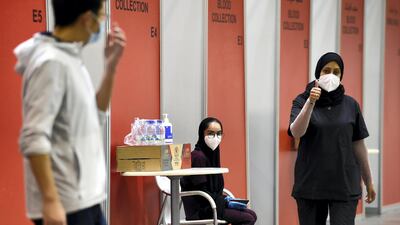
Manama’s convention centre was turned into a field hospital. AFP

Bahrain approves use of Pfizer-BioNTech Covid vaccine


  • English
  • Arabic

Bahrain said it has granted emergency use authorisation for the Pfizer-BioNTech Covid-19 vaccine, becoming the second country after Britain to approve it.

“The approval of the Pfizer-BioNTech vaccine will add a further important layer to the kingdom’s national Covid-19 response,” Dr Mariam Al Jalahma, chief executive of Bahrain’s National Health Regulatory Authority, said on Friday.

The Pfizer-BioNTech vaccine was first approved for use in the UK this week. It is currently being reviewed by the Food and Drug Administration in the US for approval as early as December 10.

The state had also approved Sinopharm's Covid-19 vaccine in November for use by frontline workers.

Since the pandemic started, Bahrain recorded at least 87,600 known coronavirus cases and 341 deaths due to Covid-19.

Six tips to secure your smart home

Most smart home devices are controlled via the owner's smartphone. Therefore, if you are using public wi-fi on your phone, always use a VPN (virtual private network) that offers strong security features and anonymises your internet connection.

Keep your smart home devices’ software up-to-date. Device makers often send regular updates - follow them without fail as they could provide protection from a new security risk.

Use two-factor authentication so that in addition to a password, your identity is authenticated by a second sign-in step like a code sent to your mobile number.

Set up a separate guest network for acquaintances and visitors to ensure the privacy of your IoT devices’ network.

Change the default privacy and security settings of your IoT devices to take extra steps to secure yourself and your home.

Always give your router a unique name, replacing the one generated by the manufacturer, to ensure a hacker cannot ascertain its make or model number.

The biog

Favourite books: 'Ruth Bader Ginsburg: A Life' by Jane D. Mathews and ‘The Moment of Lift’ by Melinda Gates

Favourite travel destination: Greece, a blend of ancient history and captivating nature. It always has given me a sense of joy, endless possibilities, positive energy and wonderful people that make you feel at home.

Favourite pastime: travelling and experiencing different cultures across the globe.

Favourite quote: “In the future, there will be no female leaders. There will just be leaders” - Sheryl Sandberg, COO of Facebook.

Favourite Movie: Mona Lisa Smile 

Favourite Author: Kahlil Gibran

Favourite Artist: Meryl Streep

Mercer, the investment consulting arm of US services company Marsh & McLennan, expects its wealth division to at least double its assets under management (AUM) in the Middle East as wealth in the region continues to grow despite economic headwinds, a company official said.

Mercer Wealth, which globally has $160 billion in AUM, plans to boost its AUM in the region to $2-$3bn in the next 2-3 years from the present $1bn, said Yasir AbuShaban, a Dubai-based principal with Mercer Wealth.

Within the next two to three years, we are looking at reaching $2 to $3 billion as a conservative estimate and we do see an opportunity to do so,” said Mr AbuShaban.

Mercer does not directly make investments, but allocates clients’ money they have discretion to, to professional asset managers. They also provide advice to clients.

“We have buying power. We can negotiate on their (client’s) behalf with asset managers to provide them lower fees than they otherwise would have to get on their own,” he added.

Mercer Wealth’s clients include sovereign wealth funds, family offices, and insurance companies among others.

From its office in Dubai, Mercer also looks after Africa, India and Turkey, where they also see opportunity for growth.

Wealth creation in Middle East and Africa (MEA) grew 8.5 per cent to $8.1 trillion last year from $7.5tn in 2015, higher than last year’s global average of 6 per cent and the second-highest growth in a region after Asia-Pacific which grew 9.9 per cent, according to consultancy Boston Consulting Group (BCG). In the region, where wealth grew just 1.9 per cent in 2015 compared with 2014, a pickup in oil prices has helped in wealth generation.

BCG is forecasting MEA wealth will rise to $12tn by 2021, growing at an annual average of 8 per cent.

Drivers of wealth generation in the region will be split evenly between new wealth creation and growth of performance of existing assets, according to BCG.

Another general trend in the region is clients’ looking for a comprehensive approach to investing, according to Mr AbuShaban.

“Institutional investors or some of the families are seeing a slowdown in the available capital they have to invest and in that sense they are looking at optimizing the way they manage their portfolios and making sure they are not investing haphazardly and different parts of their investment are working together,” said Mr AbuShaban.

Some clients also have a higher appetite for risk, given the low interest-rate environment that does not provide enough yield for some institutional investors. These clients are keen to invest in illiquid assets, such as private equity and infrastructure.

“What we have seen is a desire for higher returns in what has been a low-return environment specifically in various fixed income or bonds,” he said.

“In this environment, we have seen a de facto increase in the risk that clients are taking in things like illiquid investments, private equity investments, infrastructure and private debt, those kind of investments were higher illiquidity results in incrementally higher returns.”

The Abu Dhabi Investment Authority, one of the largest sovereign wealth funds, said in its 2016 report that has gradually increased its exposure in direct private equity and private credit transactions, mainly in Asian markets and especially in China and India. The authority’s private equity department focused on structured equities owing to “their defensive characteristics.”

Tiger%20Stripes%20
%3Cp%3E%3Cstrong%3EDirector%3A%3C%2Fstrong%3E%20Amanda%20Nell%20Eu%C2%A0%3C%2Fp%3E%0A%3Cp%3E%3Cstrong%3EStars%3A%3C%2Fstrong%3E%20Zafreen%20Zairizal%2C%20Deena%20Ezral%20and%20Piqa%3C%2Fp%3E%0A%3Cp%3E%3Cstrong%3ERating%3A%3C%2Fstrong%3E%204.5%3C%2Fp%3E%0A
Indoor cricket in a nutshell

Indoor Cricket World Cup - Sep 16-20, Insportz, Dubai

16 Indoor cricket matches are 16 overs per side

8 There are eight players per team

There have been nine Indoor Cricket World Cups for men. Australia have won every one.

5 Five runs are deducted from the score when a wickets falls

Batsmen bat in pairs, facing four overs per partnership

Scoring In indoor cricket, runs are scored by way of both physical and bonus runs. Physical runs are scored by both batsmen completing a run from one crease to the other. Bonus runs are scored when the ball hits a net in different zones, but only when at least one physical run is score.

Zones

A Front net, behind the striker and wicketkeeper: 0 runs

B Side nets, between the striker and halfway down the pitch: 1 run

Side nets between halfway and the bowlers end: 2 runs

Back net: 4 runs on the bounce, 6 runs on the full

Results

2.15pm: Maiden (PA) Dh40,000 1,700m; Winner: AF Arrab, Antonio Fresu (jockey), Ernst Oertel (trainer).

2.45pm: Maiden (PA) Dh40,000 1,700m; Winner: AF Mahaleel, Antonio Fresu, Ernst Oertel.

3.15pm: Sheikh Ahmed bin Rashid Al Maktoum handicap (TB) Dh200,000 2,000m; Winner: Dolmen, Richard Mullen, Satish Seemar.

3.45pm: Handicap (PA) Dh40,000 1,200m; Winner: Amang Alawda, Sandro Paiva, Bakhit Al Ketbi.

4.15pm: The Crown Prince of Sharjah Cup Prestige (PA) Dh200,000 1,200m; Winner: AF Alwajel, Tadhg O’Shea, Ernst Oertel.

4.45pm: Handicap (PA) Dh40,000 2,000m; Winner: Al Jazi, Jesus Rosales, Eric Lemartinel.
