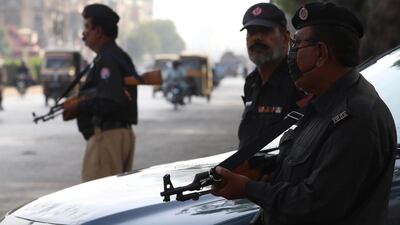
Pakistan's government banned the TLP after it organised deadly protests. EPA

Pakistan radicals release 11 police hostages after anti-France protests


  • English
  • Arabic

Eleven Pakistani police officers seized by supporters of a radical group campaigning to get the French ambassador expelled have been released, officials said on Monday.

The officers were taken hostage during the latest violent clashes between police and Tehrik-i-Labaik Pakistan (TLP) protesters in Lahore.

A video circulating on social media, confirmed by a police source, showed some of the hostages bloodied and bruised, with bandages around their heads.

Interior Minister Sheikh Rashid Ahmed said on Monday that "11 policemen who were made hostages" had been released after talks with the TLP, which the government banned last week after effectively labelling it a terrorist organisation.

"Negotiations have been started with TLP; the first round completed successfully," Mr Rashid said in a video on Twitter.

Police in Lahore confirmed the release of the hostages, and added that one of the group was a ranger from the country's paramilitary forces.

The officers had been held at a TLP mosque stronghold in Lahore, which remained packed with supporters and surrounded by police.

The group has waged a vocal campaign against France for months since President Emmanuel Macron defended the right of Charlie Hebdo magazine to republish cartoons depicting the Prophet Mohammed, an act deemed blasphemous by many Muslims.

Rioting has rocked the country for the past week since the leader of the TLP was detained in Lahore after calling for a march on the capital to evict the French ambassador.

The protests have paralysed cities and led to the deaths of at least six policemen.

TLP leaders say several of the party's supporters have also been killed and many wounded in clashes.

Calls for a nationwide strike in solidarity with the TLP has been widely supported by mainstream religious groups.

On Monday, shops and markets in Lahore and Karachi were closed and some transport services halted.

Few issues are as galvanising in Pakistan as blasphemy, and even the slightest suggestion of an insult to Islam can supercharge protests, incite lynchings, and unite the country's warring political parties.

"The government has resorted to shedding blood of innocent people. The [protesters] are raising their voice rightfully and we support that," said Sharjeel Goplani, the head of a business association in Karachi, who supports the expulsion of the French ambassador.

TLP supporters are calling on the Pakistani government to expel the French ambassador and cut ties with France. EPA

Prime Minister Imran Khan's government has struggled to bring TLP to heel over the years, but last week announced an outright ban against the group.

On Monday he called for an end to the violence.

"We all have the same objective – to safeguard the honour of our Prophet – but we must remember that we cannot make the West realise how it hurts us when they disgrace our Prophet by causing damage to our national property, life and honour," he said at an event in the capital Islamabad, where security has been stepped up.

Last week the French embassy in Pakistan advised its nationals to leave the country, a call that appears to have gone largely unheeded.

The TLP had previously set an April 20 deadline for the ambassador's expulsion.

Interior minister Rashid said a second round of negotiations would take place later on Monday.

Lahore police said on Monday that TLP supporters were refusing to bury the dead bodies of supporters being held at the mosque.

Also at the site was an oil tanker seized by crowds on Sunday.

The National Archives, Abu Dhabi

Founded over 50 years ago, the National Archives collects valuable historical material relating to the UAE, and is the oldest and richest archive relating to the Arabian Gulf.

Much of the material can be viewed on line at the Arabian Gulf Digital Archive - https://www.agda.ae/en

Some of Darwish's last words

"They see their tomorrows slipping out of their reach. And though it seems to them that everything outside this reality is heaven, yet they do not want to go to that heaven. They stay, because they are afflicted with hope." - Mahmoud Darwish, to attendees of the Palestine Festival of Literature, 2008

His life in brief: Born in a village near Galilee, he lived in exile for most of his life and started writing poetry after high school. He was arrested several times by Israel for what were deemed to be inciteful poems. Most of his work focused on the love and yearning for his homeland, and he was regarded the Palestinian poet of resistance. Over the course of his life, he published more than 30 poetry collections and books of prose, with his work translated into more than 20 languages. Many of his poems were set to music by Arab composers, most significantly Marcel Khalife. Darwish died on August 9, 2008 after undergoing heart surgery in the United States. He was later buried in Ramallah where a shrine was erected in his honour.

THE BIO

Favourite place to go to in the UAE: The desert sand dunes, just after some rain

Who inspires you: Anybody with new and smart ideas, challenging questions, an open mind and a positive attitude

Where would you like to retire: Most probably in my home country, Hungary, but with frequent returns to the UAE

Favorite book: A book by Transilvanian author, Albert Wass, entitled ‘Sword and Reap’ (Kard es Kasza) - not really known internationally

Favourite subjects in school: Mathematics and science

COMPANY%20PROFILE
%3Cp%3E%3Cstrong%3EName%3A%20%3C%2Fstrong%3EEjari%3Cbr%3E%3Cstrong%3EBased%3A%20%3C%2Fstrong%3ERiyadh%2C%20Saudi%20Arabia%3Cbr%3E%3Cstrong%3EFounders%3A%20%3C%2Fstrong%3EYazeed%20Al%20Shamsi%2C%20Fahad%20Albedah%2C%20Mohammed%20Alkhelewy%20and%20Khalid%20Almunif%3Cbr%3E%3Cstrong%3ESector%3A%20%3C%2Fstrong%3EPropTech%3Cbr%3E%3Cstrong%3ETotal%20funding%3A%20%3C%2Fstrong%3E%241%20million%3Cbr%3E%3Cstrong%3EInvestors%3A%20%3C%2Fstrong%3ESanabil%20500%20Mena%2C%20Hambro%20Perks'%20Oryx%20Fund%20and%20angel%20investors%3Cbr%3E%3Cstrong%3ENumber%20of%20employees%3A%20%3C%2Fstrong%3E8%3C%2Fp%3E%0A
SPECS
%3Cp%3E%3Cstrong%3EEngine%3A%3C%2Fstrong%3E%206-cylinder%203-litre%2C%20with%20petrol%20and%20diesel%20variants%3Cbr%3E%3Cstrong%3ETransmission%3A%20%3C%2Fstrong%3E8-speed%20automatic%3Cbr%3E%3Cstrong%3EPower%3A%3C%2Fstrong%3E%20286hp%20(petrol)%2C%20249hp%20(diesel)%3Cbr%3E%3Cstrong%3ETorque%3A%20%3C%2Fstrong%3E450Nm%20(petrol)%2C%20550Nm%20(diesel)%3Cbr%3E%3Cstrong%3EPrice%3A%20%3C%2Fstrong%3EStarting%20at%20%2469%2C800%3Cbr%3E%3Cstrong%3EOn%20sale%3A%20%3C%2Fstrong%3ENow%3C%2Fp%3E%0A
UAE currency: the story behind the money in your pockets
ANATOMY%20OF%20A%20FALL
%3Cp%3E%3Cstrong%3EDirector%3A%20%3C%2Fstrong%3EJustine%20Triet%3C%2Fp%3E%0A%3Cp%3E%3Cstrong%3EStarring%3A%20%3C%2Fstrong%3ESandra%20Huller%2C%20Swann%20Arlaud%2C%20Milo%20Machado-Graner%3C%2Fp%3E%0A%3Cp%3E%3Cstrong%3ERating%3A%3C%2Fstrong%3E%205%2F5%3C%2Fp%3E%0A
Company profile

Date started: 2015

Founder: John Tsioris and Ioanna Angelidaki

Based: Dubai

Sector: Online grocery delivery

Staff: 200

Funding: Undisclosed, but investors include the Jabbar Internet Group and Venture Friends

The specs: 2017 Dodge Viper SRT

Price, base / as tested Dh460,000

Engine 8.4L V10

Transmission Six-speed manual

Power 645hp @ 6,200rpm

Torque 813Nm @ 5,000rpm

Fuel economy, combined 16.8L / 100km

Karwaan

Producer: Ronnie Screwvala

Director: Akarsh Khurana

Starring: Irrfan Khan, Dulquer Salmaan, Mithila Palkar

Rating: 4/5

Mercer, the investment consulting arm of US services company Marsh & McLennan, expects its wealth division to at least double its assets under management (AUM) in the Middle East as wealth in the region continues to grow despite economic headwinds, a company official said.

Mercer Wealth, which globally has $160 billion in AUM, plans to boost its AUM in the region to $2-$3bn in the next 2-3 years from the present $1bn, said Yasir AbuShaban, a Dubai-based principal with Mercer Wealth.

Within the next two to three years, we are looking at reaching $2 to $3 billion as a conservative estimate and we do see an opportunity to do so,” said Mr AbuShaban.

Mercer does not directly make investments, but allocates clients’ money they have discretion to, to professional asset managers. They also provide advice to clients.

“We have buying power. We can negotiate on their (client’s) behalf with asset managers to provide them lower fees than they otherwise would have to get on their own,” he added.

Mercer Wealth’s clients include sovereign wealth funds, family offices, and insurance companies among others.

From its office in Dubai, Mercer also looks after Africa, India and Turkey, where they also see opportunity for growth.

Wealth creation in Middle East and Africa (MEA) grew 8.5 per cent to $8.1 trillion last year from $7.5tn in 2015, higher than last year’s global average of 6 per cent and the second-highest growth in a region after Asia-Pacific which grew 9.9 per cent, according to consultancy Boston Consulting Group (BCG). In the region, where wealth grew just 1.9 per cent in 2015 compared with 2014, a pickup in oil prices has helped in wealth generation.

BCG is forecasting MEA wealth will rise to $12tn by 2021, growing at an annual average of 8 per cent.

Drivers of wealth generation in the region will be split evenly between new wealth creation and growth of performance of existing assets, according to BCG.

Another general trend in the region is clients’ looking for a comprehensive approach to investing, according to Mr AbuShaban.

“Institutional investors or some of the families are seeing a slowdown in the available capital they have to invest and in that sense they are looking at optimizing the way they manage their portfolios and making sure they are not investing haphazardly and different parts of their investment are working together,” said Mr AbuShaban.

Some clients also have a higher appetite for risk, given the low interest-rate environment that does not provide enough yield for some institutional investors. These clients are keen to invest in illiquid assets, such as private equity and infrastructure.

“What we have seen is a desire for higher returns in what has been a low-return environment specifically in various fixed income or bonds,” he said.

“In this environment, we have seen a de facto increase in the risk that clients are taking in things like illiquid investments, private equity investments, infrastructure and private debt, those kind of investments were higher illiquidity results in incrementally higher returns.”

The Abu Dhabi Investment Authority, one of the largest sovereign wealth funds, said in its 2016 report that has gradually increased its exposure in direct private equity and private credit transactions, mainly in Asian markets and especially in China and India. The authority’s private equity department focused on structured equities owing to “their defensive characteristics.”

Director: Laxman Utekar

Cast: Vicky Kaushal, Akshaye Khanna, Diana Penty, Vineet Kumar Singh, Rashmika Mandanna

Rating: 1/5
