Tens of millions battle floods in Pakistan as death toll surpasses 1,000


  • English
  • Arabic

International aid began arriving and a relief operation was under way on Monday as tens of millions of Pakistanis struggled to cope with monsoon floods that have killed more than 1,061 people.

The death toll could rise as hundreds of villages in the mountainous north have been cut off by flood-swollen rivers that have washed roads and bridges away.

More than 33 million people — or one in seven Pakistanis — have been affected by the floods, and about a million homes have been damaged, officials said.

The annual monsoon is essential for irrigating crops and replenishing lakes and dams across the Indian subcontinent, but it can also bring destruction.

The UAE began operating an air bridge for humanitarian aid to the country, where a state of emergency has been declared and armed forces mobilised to help with relief efforts.

Climate Change Minister Sherry Rehman called it “the monster monsoon of the decade”.

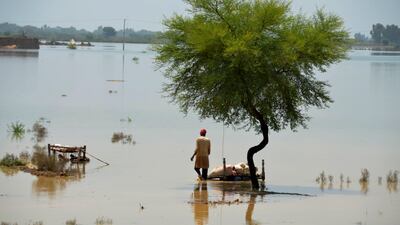
“Many districts are beginning to look like they’re part of the ocean,” the official told German broadcaster DW News.

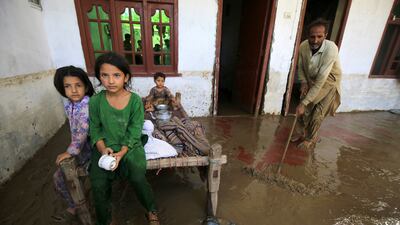
  • A man clears mud off his property in the aftermath of floods in Charsadda District, Pakistan. EPA
    A man clears mud off his property in the aftermath of floods in Charsadda District, Pakistan. EPA
  • A man wades through floodwater carrying his granddaughter on his back in Charsadda. Reuters
    A man wades through floodwater carrying his granddaughter on his back in Charsadda. Reuters
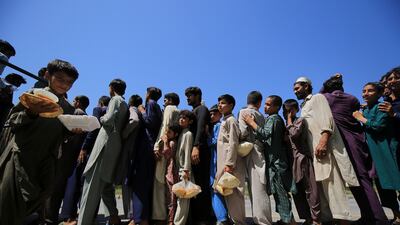
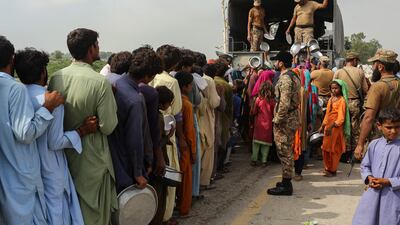
  • People affected by floods wait to receive food in Charsadda District. EPA
    People affected by floods wait to receive food in Charsadda District. EPA
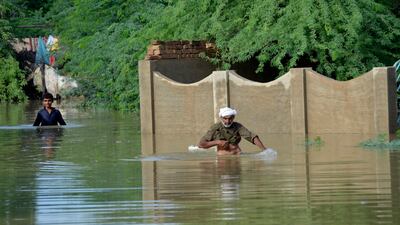
  • A man holding a baby wades through a flooded area in Khyber Pakhtunkhwa province. EPA
    A man holding a baby wades through a flooded area in Khyber Pakhtunkhwa province. EPA
  • People wade through water in Sanghar District. EPA
    People wade through water in Sanghar District. EPA
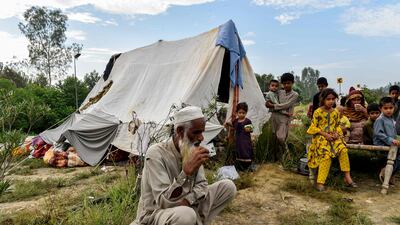
  • A displaced boy peeks through a hole in a plastic shelter after fleeing his flood-hit home on the outskirts of Peshawar. AP Photo
    A displaced boy peeks through a hole in a plastic shelter after fleeing his flood-hit home on the outskirts of Peshawar. AP Photo
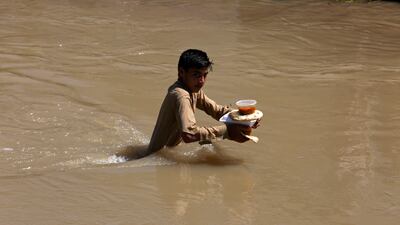
  • A displaced boy who fled his flood-hit home carries food rations as he wades through water. AP Photo
    A displaced boy who fled his flood-hit home carries food rations as he wades through water. AP Photo
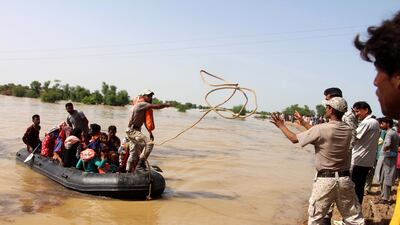
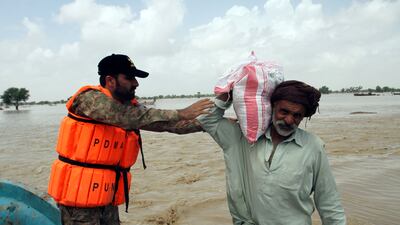
  • Personnel from the Pakistan Navy rescue people from the floods in the Dadu district of Farid Abad village in Sindh province. EPA
    Personnel from the Pakistan Navy rescue people from the floods in the Dadu district of Farid Abad village in Sindh province. EPA
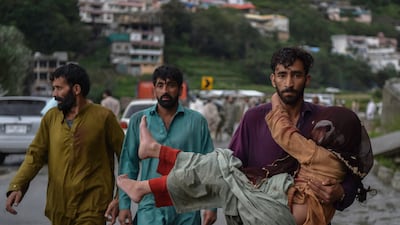
  • A man carries his sick daughter along a road damaged by flood waters following heavy monsoon rains in the Madian area of Pakistan's northern Swat Valley. AFP
    A man carries his sick daughter along a road damaged by flood waters following heavy monsoon rains in the Madian area of Pakistan's northern Swat Valley. AFP
  • People forced from their homes gather at a road damaged by flood waters following monsoon rains in the Madian area of Pakistan's northern Swat Valley. AFP
    People forced from their homes gather at a road damaged by flood waters following monsoon rains in the Madian area of Pakistan's northern Swat Valley. AFP
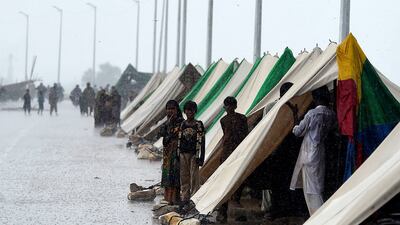
  • Tents set along a road provide temporary shelter during monsoon rains in Sukkur, Sindh province. AFP
    Tents set along a road provide temporary shelter during monsoon rains in Sukkur, Sindh province. AFP
  • A man is given food by the Pakistan Army during relief operations in the Rajanpur district of Punjab. AP
    A man is given food by the Pakistan Army during relief operations in the Rajanpur district of Punjab. AP
  • People are moved away from a flood-hit area of the Rajanpur district of Punjab by soliders. AP
    People are moved away from a flood-hit area of the Rajanpur district of Punjab by soliders. AP
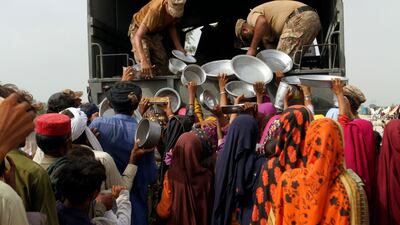
  • Troops distribute food and other essentials to the displaced people of flood-hit Rajanpur district in Punjab. AP
    Troops distribute food and other essentials to the displaced people of flood-hit Rajanpur district in Punjab. AP
  • People affected by floods triggered by heavy rains survey their damaged houses on the outskirts of Quetta, Balochistan province, Pakistan. EPA
    People affected by floods triggered by heavy rains survey their damaged houses on the outskirts of Quetta, Balochistan province, Pakistan. EPA
  • Thousands of people living near flood-swollen rivers in Pakistan's north have been ordered to leave their homes as the death toll from devastating monsoon rains approaches 1,000. AFP
    Thousands of people living near flood-swollen rivers in Pakistan's north have been ordered to leave their homes as the death toll from devastating monsoon rains approaches 1,000. AFP
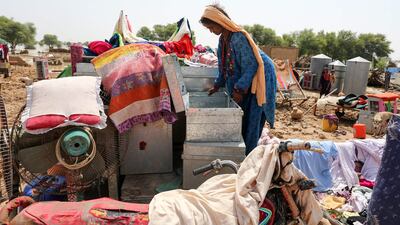
  • A woman goes through her belongings next to the ruins of her house after heavy monsoon rains in Rajanpur district, Punjab province. AFP
    A woman goes through her belongings next to the ruins of her house after heavy monsoon rains in Rajanpur district, Punjab province. AFP
  • Soldiers distribute food to people affected by floods, near a makeshift camp in Rajanpur. AFP
    Soldiers distribute food to people affected by floods, near a makeshift camp in Rajanpur. AFP
  • Rescue workers evacuate people from flood-hit homes in the district. AFP
    Rescue workers evacuate people from flood-hit homes in the district. AFP
  • A doctor checks a child at a makeshift medical camp in Sanghar District, Sindh Province. EPA
    A doctor checks a child at a makeshift medical camp in Sanghar District, Sindh Province. EPA
  • A villager uses cots to save usable items salvaged from his flood-hit home, in Jaffarabad district, Balochistan province. AP
    A villager uses cots to save usable items salvaged from his flood-hit home, in Jaffarabad district, Balochistan province. AP
  • People take refuge by a highway after fleeing from their homes in Charsadda district, Khyber Pakhtunkhwa province. AFP
    People take refuge by a highway after fleeing from their homes in Charsadda district, Khyber Pakhtunkhwa province. AFP
  • The heavy rains are expected to continue, bringing more hardship for those displaced. AFP
    The heavy rains are expected to continue, bringing more hardship for those displaced. AFP
  • Partially submerged houses in Charsadda district. AFP
    Partially submerged houses in Charsadda district. AFP
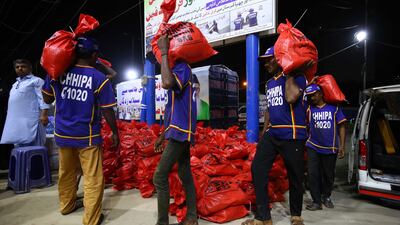
  • Volunteers from the Chhipa Welfare Association carry goods for distribution to flood victims following heavy rains, in Karachi. EPA
    Volunteers from the Chhipa Welfare Association carry goods for distribution to flood victims following heavy rains, in Karachi. EPA
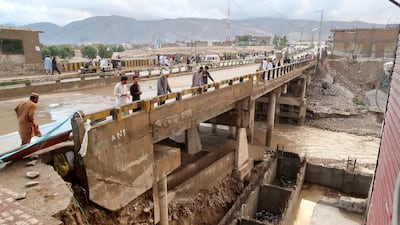
  • A damaged bridge in Quetta. EPA
    A damaged bridge in Quetta. EPA
  • A partially damaged homestead in Jaffarabad. AP
    A partially damaged homestead in Jaffarabad. AP
  • Pakistan's government has appealed for relief assistance from the international community. AP
    Pakistan's government has appealed for relief assistance from the international community. AP
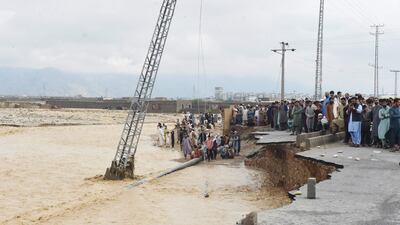
  • A damaged road in Quetta. AFP
    A damaged road in Quetta. AFP
  • A satellite dish is used to move children across a flooded area in Jaffarabad district. AFP
    A satellite dish is used to move children across a flooded area in Jaffarabad district. AFP

“Our helicopter sorties are not finding dry land to drop rations.”

The navy is being deployed for the first time, she said.

This year's floods are comparable to 2010, the worst on record, when more than 2,000 people died and nearly a fifth of the country was under water.

Rains have caused damage worth more than $10 billion, Bloomberg reported, citing local newspaper The News International.

Critical infrastructure failing

Near Sukkur, a city in southern Sindh province and home to a colonial-era flood barrage on the Indus River which is vital to prevent further catastrophe, one farmer lamented the devastation of his rice fields.

The Lloyd Barrage, built in 1932, is capable of discharging 1.4 million cubic metres of water a second through 19 steel gates. The tourist site is a main bridge across the Indus River.

“It has completed 90 years, whereas it had a 50-year guarantee,” Syed Khursheed Shah, the country's Minister for Water Resources told AFP.

“So we are 40 years beyond its guaranteed life.”

A series of canals that travel through farms have been neglected, making them incapable of handling the large volumes of water.

“Silt has been piling up and it is not being removed,” the minister said.

He said the canal has not been dredged in 12 years.

With the build-up, less water can flow through the canals, causing a backlog and more chance of flooding at the Indus.

Millions of acres of rich farmland have been flooded by weeks of non-stop rain, but now the Indus is threatening to burst its banks as water runs downstream from tributaries in the north.

“Our crop spanned over 5,000 acres on which the best quality rice was sowed and is eaten by you and us,” Khalil Ahmed, 70, told AFP. “All that is finished.”

Much of Sindh is now a landscape of water, frustrating a military-led relief operation.

“There are no landing strips or approaches available … our pilots find it difficult to land,” one senior officer told AFP.

Ghulam Rasool uses a handpump next to his flood-damaged mud house on the outskirts of Sukkur, Sindh province. AFP

Army helicopters struggled to pluck people to safety in the north, where steep hills and valleys make flying dangerous.

Many rivers in the area — a picturesque tourist destination — have burst their banks, demolishing scores of buildings, including a 150-room hotel that crumbled in a raging torrent.

The flooding could not have come at a worse time for Pakistan, where the economy is in free fall.

Monsoon season

Monsoon season in the Asian Summer can occur any time between June and September, bringing to South Asia 70 to 80 per cent of its annual rainfall.

It is vital for agriculture and therefore important for millions of farmers in a food-insecure region, but also brings destruction every year with landslides and floods.

Poorly maintained infrastructure exacerbates the issue.

While Pakistan has seen an overwhelming amount of rain, eastern and north-eastern India have this year had the lowest amount of July rainfall in more than a century.


Infiniti QX80 specs

Engine: twin-turbocharged 3.5-liter V6

Power: 450hp

Torque: 700Nm

Price: From Dh450,000, Autograph model from Dh510,000

Available: Now

Mercer, the investment consulting arm of US services company Marsh & McLennan, expects its wealth division to at least double its assets under management (AUM) in the Middle East as wealth in the region continues to grow despite economic headwinds, a company official said.

Mercer Wealth, which globally has $160 billion in AUM, plans to boost its AUM in the region to $2-$3bn in the next 2-3 years from the present $1bn, said Yasir AbuShaban, a Dubai-based principal with Mercer Wealth.

Within the next two to three years, we are looking at reaching $2 to $3 billion as a conservative estimate and we do see an opportunity to do so,” said Mr AbuShaban.

Mercer does not directly make investments, but allocates clients’ money they have discretion to, to professional asset managers. They also provide advice to clients.

“We have buying power. We can negotiate on their (client’s) behalf with asset managers to provide them lower fees than they otherwise would have to get on their own,” he added.

Mercer Wealth’s clients include sovereign wealth funds, family offices, and insurance companies among others.

From its office in Dubai, Mercer also looks after Africa, India and Turkey, where they also see opportunity for growth.

Wealth creation in Middle East and Africa (MEA) grew 8.5 per cent to $8.1 trillion last year from $7.5tn in 2015, higher than last year’s global average of 6 per cent and the second-highest growth in a region after Asia-Pacific which grew 9.9 per cent, according to consultancy Boston Consulting Group (BCG). In the region, where wealth grew just 1.9 per cent in 2015 compared with 2014, a pickup in oil prices has helped in wealth generation.

BCG is forecasting MEA wealth will rise to $12tn by 2021, growing at an annual average of 8 per cent.

Drivers of wealth generation in the region will be split evenly between new wealth creation and growth of performance of existing assets, according to BCG.

Another general trend in the region is clients’ looking for a comprehensive approach to investing, according to Mr AbuShaban.

“Institutional investors or some of the families are seeing a slowdown in the available capital they have to invest and in that sense they are looking at optimizing the way they manage their portfolios and making sure they are not investing haphazardly and different parts of their investment are working together,” said Mr AbuShaban.

Some clients also have a higher appetite for risk, given the low interest-rate environment that does not provide enough yield for some institutional investors. These clients are keen to invest in illiquid assets, such as private equity and infrastructure.

“What we have seen is a desire for higher returns in what has been a low-return environment specifically in various fixed income or bonds,” he said.

“In this environment, we have seen a de facto increase in the risk that clients are taking in things like illiquid investments, private equity investments, infrastructure and private debt, those kind of investments were higher illiquidity results in incrementally higher returns.”

The Abu Dhabi Investment Authority, one of the largest sovereign wealth funds, said in its 2016 report that has gradually increased its exposure in direct private equity and private credit transactions, mainly in Asian markets and especially in China and India. The authority’s private equity department focused on structured equities owing to “their defensive characteristics.”

In numbers: PKK’s money network in Europe

Germany: PKK collectors typically bring in $18 million in cash a year – amount has trebled since 2010

Revolutionary tax: Investigators say about $2 million a year raised from ‘tax collection’ around Marseille

Extortion: Gunman convicted in 2023 of demanding $10,000 from Kurdish businessman in Stockholm

Drug trade: PKK income claimed by Turkish anti-drugs force in 2024 to be as high as $500 million a year

Denmark: PKK one of two terrorist groups along with Iranian separatists ASMLA to raise “two-digit million amounts”

Contributions: Hundreds of euros expected from typical Kurdish families and thousands from business owners

TV channel: Kurdish Roj TV accounts frozen and went bankrupt after Denmark fined it more than $1 million over PKK links in 2013 

Updated: August 29, 2022, 2:20 PM