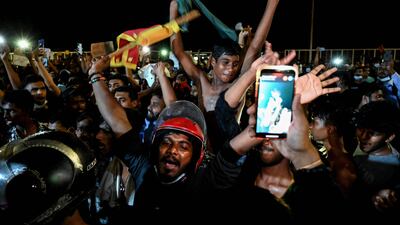
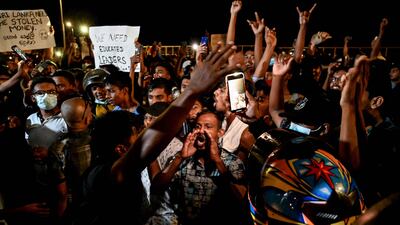
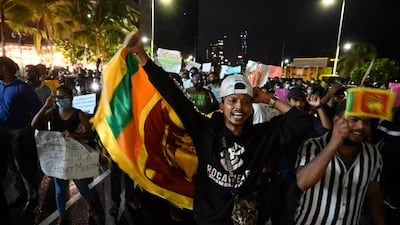
• Violence raged across Sri Lanka late into the night on Monday, with five people dead and some 180 injured. AFP
    Violence raged across Sri Lanka late into the night on Monday, with five people dead and some 180 injured. AFP
  • Sri Lanka's pro-government supporters vandalise camps of anti government protestors outside the president's office in Colombo. AP Photo
    Sri Lanka's pro-government supporters vandalise camps of anti government protestors outside the president's office in Colombo. AP Photo
  • Sri Lankan Prime Minister Mahinda Rajapaksa quit on May 9 after a day of violence saw four people, including an MP, killed. AFP
    Sri Lankan Prime Minister Mahinda Rajapaksa quit on May 9 after a day of violence saw four people, including an MP, killed. AFP
  • Government supporters armed with sticks and clubs attack protestors. AFP
    Government supporters armed with sticks and clubs attack protestors. AFP
  • Demonstrators scuffle with police outside the president's office in Colombo. AFP
    Demonstrators scuffle with police outside the president's office in Colombo. AFP
  • Demonstrators and government supporters clash. AFP
    Demonstrators and government supporters clash. AFP
  • Police personnel stand guard outside the president's office. AFP
    Police personnel stand guard outside the president's office. AFP
  • Destroyed vehicles litter the street after anti-government protesters rioted in Colombo. AFP
    Destroyed vehicles litter the street after anti-government protesters rioted in Colombo. AFP
  • Pro-government supporters hold Prime Minister Mahinda Rajapaksa's portrait while protesting. AFP
    Pro-government supporters hold Prime Minister Mahinda Rajapaksa's portrait while protesting. AFP
  • A bus burns close to Sri Lanka's outgoing Prime Minister Mahinda Rajapaksa's official residence in Colombo. AFP
    A bus burns close to Sri Lanka's outgoing Prime Minister Mahinda Rajapaksa's official residence in Colombo. AFP
  • Anti-government protesters destroy a bus in Colombo. AFP
    Anti-government protesters destroy a bus in Colombo. AFP
  • Army personnel stand guard outside the president's office in Colombo. AFP
    Army personnel stand guard outside the president's office in Colombo. AFP
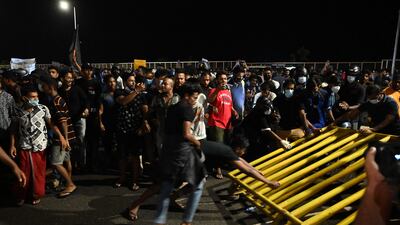
  • Supporters of the Sri Lankan government attempt to block a police water canon truck. AFP
    Supporters of the Sri Lankan government attempt to block a police water canon truck. AFP
  • People gather near a burning bus in Colombo. AFP
    People gather near a burning bus in Colombo. AFP
  • Anti-government demonstrators set fire to the house owned by Cabinet Minister Sanath Nishantha. Reuters
    Anti-government demonstrators set fire to the house owned by Cabinet Minister Sanath Nishantha. Reuters
  • Sri Lankans push a bus, transporting government supporters who attacked anti-government protesters, into a lake in Colombo. AP Photo
    Sri Lankans push a bus, transporting government supporters who attacked anti-government protesters, into a lake in Colombo. AP Photo
  • A policeman fires tear gas during a clash. AFP
    A policeman fires tear gas during a clash. AFP
  • Sri Lankan Prime Minister Mahinda Rajapaksa resigned on Monday over the country’s dire economic state and violence at mass protests outside his home in Colombo, his spokesman Rohan Weliwita said. AP
    Sri Lankan Prime Minister Mahinda Rajapaksa resigned on Monday over the country’s dire economic state and violence at mass protests outside his home in Colombo, his spokesman Rohan Weliwita said. AP
  • Demonstrators and government supporters clash outside the official residence of Mahinda Rajapaksa, 76, who offered his resignation to his younger brother, President Gotabaya Rajapaksa. AFP
    Demonstrators and government supporters clash outside the official residence of Mahinda Rajapaksa, 76, who offered his resignation to his younger brother, President Gotabaya Rajapaksa. AFP
  • A man suffers after being sprayed with tear gas as cars burn on the streets of Colombo, Sri Lanka. AP
    A man suffers after being sprayed with tear gas as cars burn on the streets of Colombo, Sri Lanka. AP
  • Paramilitary police arrive as demonstrators and government supporters clash. AFP
    Paramilitary police arrive as demonstrators and government supporters clash. AFP
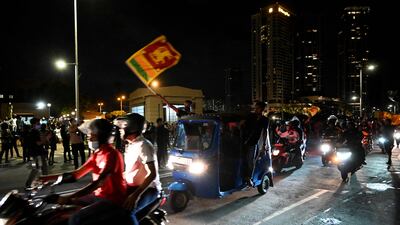
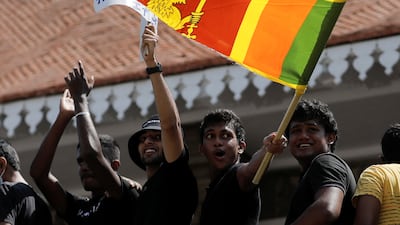
  • Sri Lankan government supporters cheer outside the prime minister's residence in Colombo. AP
    Sri Lankan government supporters cheer outside the prime minister's residence in Colombo. AP
  • Supporters of the ruling party run as riot police fire tear gas during clashes in Colombo, amid the country's economic crisis. Reuters
    Supporters of the ruling party run as riot police fire tear gas during clashes in Colombo, amid the country's economic crisis. Reuters
  • A policeman stands guard in riot gear. AP
    A policeman stands guard in riot gear. AP
  • Water cannon are fired during a confrontation with anti-government demonstrators. Reuters
    Water cannon are fired during a confrontation with anti-government demonstrators. Reuters
  • Supporters of Sri Lanka's ruling party run in Colombo as police fire tear gas during a clash with anti-government demonstrators. Reuters
    Supporters of Sri Lanka's ruling party run in Colombo as police fire tear gas during a clash with anti-government demonstrators. Reuters
  • A Sri Lankan Catholic priest, centre in a white robe, is among anti-government protesters being attacked by supporters of the ruling party outside the prime minister's residence. AP
    A Sri Lankan Catholic priest, centre in a white robe, is among anti-government protesters being attacked by supporters of the ruling party outside the prime minister's residence. AP
  • Tears after anti-government protesters were attacked by supporters of the ruling party in Colombo. AP
    Tears after anti-government protesters were attacked by supporters of the ruling party in Colombo. AP
  • Violence flares between demonstrators and government supporters outside the president's office in Colombo. AFP
    Violence flares between demonstrators and government supporters outside the president's office in Colombo. AFP
  • Activists stage a mock ritual to 'exorcise demons' outside the official residence of Sri Lanka's prime minister. AFP
    Activists stage a mock ritual to 'exorcise demons' outside the official residence of Sri Lanka's prime minister. AFP

Sri Lanka's Prime Minister Mahinda Rajapaksa resigns after latest protest violence


  • English
  • Arabic

Sri Lankan Prime Minister Mahinda Rajapaksa resigned on Monday over the country's worsening economic situation and violence at mass protests to clear the way for a “new unity government”, his spokesman Rohan Weliwita said.

President Gotabaya Rajapaksa, the prime minister's younger brother, accepted the resignation, office representative Sudeva Hettiarachchi said.

The resignation paves the way for the president to appoint opposition members to important government roles, a solution he has proposed to end the crisis. But it’s unclear if the resignation of Mr Rajapaksa, 76, will placate angry citizens, many of whom have called for the president to step down as well.

The move comes as Sri Lanka posted troops on the streets and imposed an indefinite nationwide curfew after government supporters attacked protesters outside President Rajapaksa's office in the capital Colombo.

Ruling party parliamentarian Amarakeerthi Athukorala died after a stand-off with anti-government protesters in the town of Nittambuwa near Colombo, a police source told Reuters without giving details. At least three others were wounded and the atmosphere in the area remained tense with dozens of protesters still on the streets, the source said.

Dozens of demonstrators have been injured elsewhere in Sri Lanka.

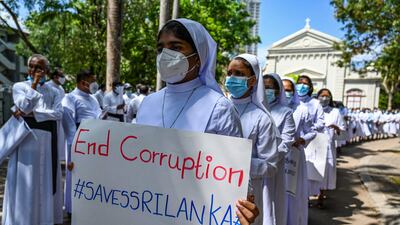
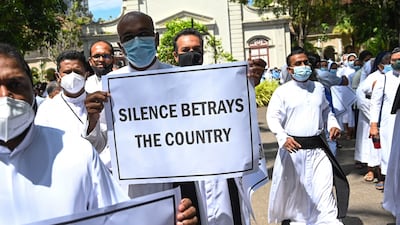
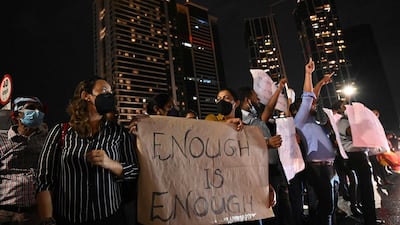
  • Catholic priests and sisters hold placards during a demonstration against the economic crisis in Colombo, the capital of Sri Lanka. All photos: AFP
    Catholic priests and sisters hold placards during a demonstration against the economic crisis in Colombo, the capital of Sri Lanka. All photos: AFP
  • Catholic priests and sisters hold placards during a demonstration against the economic crisis in Colombo.
    Catholic priests and sisters hold placards during a demonstration against the economic crisis in Colombo.
  • Protesters lash out after a surge of prices and a shortage of fuel and other essential commodities outside the president's office in Colombo.
    Protesters lash out after a surge of prices and a shortage of fuel and other essential commodities outside the president's office in Colombo.
  • All 26 Cabinet ministers resigned after thousands defied a national state of emergency and curfew, and joined street protests denouncing the government.
    All 26 Cabinet ministers resigned after thousands defied a national state of emergency and curfew, and joined street protests denouncing the government.
  • The curfew has been lifted but the president and his elder brother Prime Minister Mahinda Rajapaksa continue to hold on to power.
    The curfew has been lifted but the president and his elder brother Prime Minister Mahinda Rajapaksa continue to hold on to power.
  • Sri Lankans have endured long queues to buy fuel, cooking gas, foods and medicine, most of which come from abroad and are paid for in hard currency.
    Sri Lankans have endured long queues to buy fuel, cooking gas, foods and medicine, most of which come from abroad and are paid for in hard currency.
  • The fuel shortage has caused rolling power cuts lasting several hours a day.
    The fuel shortage has caused rolling power cuts lasting several hours a day.
  • The extent of the crisis became clear when Sri Lanka could not pay for imports of basic supplies because of its mounting debts and dwindling foreign reserves.
    The extent of the crisis became clear when Sri Lanka could not pay for imports of basic supplies because of its mounting debts and dwindling foreign reserves.
  • Sri Lanka’s usable foreign reserves reportedly amount to be less than $400 million, yet it is saddled with about $7 billion in foreign debt obligations for this year.
    Sri Lanka’s usable foreign reserves reportedly amount to be less than $400 million, yet it is saddled with about $7 billion in foreign debt obligations for this year.
  • Police used water cannon to disperse angry protesters who marched toward the Rajapaksa family home in southern Sri Lanka, demanding that they quit.
    Police used water cannon to disperse angry protesters who marched toward the Rajapaksa family home in southern Sri Lanka, demanding that they quit.
  • The president had appealed to people to limit their use of power and ‘extend their support to the country’ but the crisis has intensified since the main opposition party rejected his call to form a unity government. Reuters
    The president had appealed to people to limit their use of power and ‘extend their support to the country’ but the crisis has intensified since the main opposition party rejected his call to form a unity government. Reuters

Rajapaksa loyalists armed with sticks and clubs attacked unarmed protesters who have been camping outside the president's office since April 9, AFP reported. Footage shared on social media, purporting to be from Colombo, showed fires burning on the streets.

Officers fired tear gas and water cannon on the government supporters, who breached police lines to smash tents and other structures set up by anti-government protesters. The violence against peaceful protesters was condemned internationally.

"Strongly condemn the violence against peaceful protesters today," British High Commissioner to Sri Lanka Sarah Hulton said on Twitter. "The authorities have a responsibility to safeguard citizens’ rights to protest peacefully and to hold the perpetrators of violence to account."

The Indian Ocean island nation is on the brink of bankruptcy and has suspended payments on its foreign loans. Its economic woes have led to a political crisis, with the government facing widespread protests and a no-confidence motion in the Sri Lankan Parliament.

Supporters of Mr Rajapaksa had earlier rallied inside his office, urging him to ignore the protesters’ demands for him to step down.

After the meeting, they went to the front of the office where people have been demonstrating for several days. Local television channel Sirasa TV showed pro-government supporters attacking protesters with clubs, demolishing and later burning down their tents.

Meanwhile, trade unions on Monday called for protests throughout this week, union activist Saman Rathnapriya said, and more than 1,000 unions representing health, ports, education and other vital service sectors have joined the “Week of Protests” movement.

Protesters made accusations on Sirasa TV that police did not interfere to prevent the attack by pro-government supporters, despite using tear gas and water cannon on protesters as recently as Friday.

At the main hospital in the capital Colombo, 23 wounded people were admitted although none in critical condition, an official said on condition of anonymity, as she was not authorised to speak to the media.

The attack came as protesters marked their 31st day outside the president’s and prime minister’s offices. They have been demanding that the president, his older brother Mahinda Rajapaksa and other powerful Rajapaksa family members quit. Similar protests have spread to other locations, with people setting up camps opposite the prime minister’s residence and in other towns across the country.

Dire economic situation

For several months, Sri Lankans have endured long queues to buy fuel, cooking gas, food and medicine, most of which come from abroad. Shortages of hard currency have also hindered imports of raw materials for manufacturing and worsened inflation, which surged to 18.7 per cent in March.

Protesters have blocked main roads to demand gas and fuel. On Sunday, local TV channel Hiru showed citizens in some areas fighting over fuel.

Demonstrators and government supporters clash outside the president's office in Colombo on Monday. AFP

Sri Lanka was due to pay $7 billion of its foreign debt this year out of the nearly $25bn it must pay by 2026. Its total foreign debt is $51bn.

Sri Lanka’s finance minister announced this week that the country’s usable foreign reserves have plummeted below $50 million.

As oil prices soar during the Russia-Ukraine conflict, Sri Lanka’s fuel stocks are running out. Authorities have announced nationwide cuts that will afford people about four hours of power a day because they cannot supply enough fuel to power generating stations.


Updated: May 11, 2022, 10:03 AM