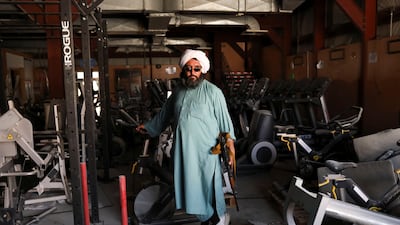
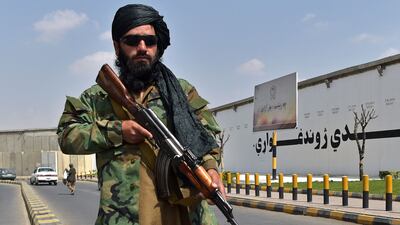
Taliban Prime Minister Mohammed Hassan Akhund has been criticised by Afghans and the international community over comments he made on the country's worsening famine crisis.
In his first speech since the extremist group took control of Afghanistan in August, Mr Akhund addressed the nation on Saturday in a radio broadcast.
During the 30-minute broadcast, the elusive Taliban leader touched upon issues of poverty, inflation, and even the Taliban’s brutal treatment of citizens, among other things.
However, his comments on the famine in Afghanistan earned sharp criticism.
The second khalifa of Islam delivered food to the destitute at night on his own shoulders. His servant offered to assist, but he said that God will ask him about this case, not his servant
Assem Mayar,
expert in the study of droughts and famines
“The Taliban should not be blamed for the country’s problems … we are working overtime to solve the problems of the people,” he said. He added that the famine “is a test from God, after people rebelled against him”.
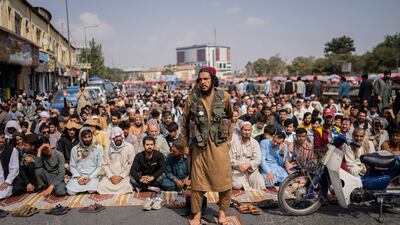
Afghanistan’s economy, which is largely dependent on foreign aid, received a severe blow after the fall of the Afghan government and the Taliban takeover, as many countries and international agencies withdrew their support and aid. This was compounded by increasing drought and displacement which has gone unaddressed, contributing to what has been called “the worst humanitarian crisis on Earth”.
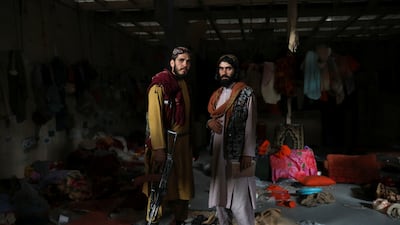
Approximately 22.5 million Afghans are facing acute food insecurity in the coming months, according to a report by the UN’s Food and Agriculture Organisation and the World Food Program. Due to widespread unemployment and an economic crisis, many Afghan families are struggling to make ends meet, and have put up household items and personal belongings for sale to survive.
Afghans face daily struggle
Although Mr Akhund pleaded with humanitarian agencies to continue their aid to the Afghan people, many have criticised the Taliban’s inaction and lack of responsibility for the crisis, particularly those facing starvation.
“How can a leader say something like that to the face of the people who haven’t had anything for days,” said Jawid Samad, a 38-year-old employee of the former government from Kunduz, whose family has been suffering from food insecurity.
Mr Samad, who asked for his name be changed fearing Taliban reprisal, worked in a clerical position in an Afghan ministry and was fired when the insurgent group seized control. “When they announced that government employees could resume work, I went to the office. But I was sent away by the fighters, who told me 'you don’t belong here and your government is gone',” he said.
Mr Samad was then informed that his position had been filled and he was unceremoniously dismissed, plunging his family into a deep financial crisis. “I was a civilian and I never hurt a single Talib and they still snatched my only source of income.”
He said that the only meals his family have had in over a week are stale bread dipped in sweet tea. “There are nights we sleep without eating. We can’t afford milk for the babies,” he said. “Of course, they can’t provide us with food. But if they want to be our leaders, how can they refuse responsibility for the unemployment, famine, and suffering of Afghans?” he said.
Experts also agreed that Mr Akhund’s statements were an attempt to sidestep blame for the growing, interlinked crises.
“It was essentially an attempt to escape from responsibility,” Assem Mayar, an Afghan academic specialising in the study of droughts and famines, told The National. “Current droughts and famine are man-made, caused by climate change, which is the result of human activities, and even preventable if necessary measures are taken.” He advised the Taliban to take concrete measures to mitigate the food shortages.
“Putting all responsibility on God is not appropriate and efforts should be done to tackle the crisis,” he said. Mr Mayer added that there were several examples to seek inspiration from in Islamic history of leaders who’ve responded to food insecurity.
“The second khalifa of Islam delivered food to the destitute at night on his own shoulders. His servant offered to assist, but he said that God will ask him about this case, not his servant,” he said.

Ten tax points to be aware of in 2026
1. Domestic VAT refund amendments: request your refund within five years
If a business does not apply for the refund on time, they lose their credit.
2. E-invoicing in the UAE
Businesses should continue preparing for the implementation of e-invoicing in the UAE, with 2026 a preparation and transition period ahead of phased mandatory adoption.
3. More tax audits
Tax authorities are increasingly using data already available across multiple filings to identify audit risks.
4. More beneficial VAT and excise tax penalty regime
Tax disputes are expected to become more frequent and more structured, with clearer administrative objection and appeal processes. The UAE has adopted a new penalty regime for VAT and excise disputes, which now mirrors the penalty regime for corporate tax.
5. Greater emphasis on statutory audit
There is a greater need for the accuracy of financial statements. The International Financial Reporting Standards standards need to be strictly adhered to and, as a result, the quality of the audits will need to increase.
6. Further transfer pricing enforcement
Transfer pricing enforcement, which refers to the practice of establishing prices for internal transactions between related entities, is expected to broaden in scope. The UAE will shortly open the possibility to negotiate advance pricing agreements, or essentially rulings for transfer pricing purposes.
7. Limited time periods for audits
Recent amendments also introduce a default five-year limitation period for tax audits and assessments, subject to specific statutory exceptions. While the standard audit and assessment period is five years, this may be extended to up to 15 years in cases involving fraud or tax evasion.
8. Pillar 2 implementation
Many multinational groups will begin to feel the practical effect of the Domestic Minimum Top-Up Tax (DMTT), the UAE's implementation of the OECD’s global minimum tax under Pillar 2. While the rules apply for financial years starting on or after January 1, 2025, it is 2026 that marks the transition to an operational phase.
9. Reduced compliance obligations for imported goods and services
Businesses that apply the reverse-charge mechanism for VAT purposes in the UAE may benefit from reduced compliance obligations.
10. Substance and CbC reporting focus
Tax authorities are expected to continue strengthening the enforcement of economic substance and Country-by-Country (CbC) reporting frameworks. In the UAE, these regimes are increasingly being used as risk-assessment tools, providing tax authorities with a comprehensive view of multinational groups’ global footprints and enabling them to assess whether profits are aligned with real economic activity.
Contributed by Thomas Vanhee and Hend Rashwan, Aurifer
The five pillars of Islam
Walls
Louis Tomlinson
3 out of 5 stars
(Syco Music/Arista Records)
In numbers
1,000 tonnes of waste collected daily:
- 800 tonnes converted into alternative fuel
- 150 tonnes to landfill
- 50 tonnes sold as scrap metal
800 tonnes of RDF replaces 500 tonnes of coal
Two conveyor lines treat more than 350,000 tonnes of waste per year
25 staff on site
UK%20record%20temperature
%3Cp%3E38.7C%20(101.7F)%20set%20in%20Cambridge%20in%202019%3C%2Fp%3E%0A
The biog
Name: Dhabia Khalifa AlQubaisi
Age: 23
How she spends spare time: Playing with cats at the clinic and feeding them
Inspiration: My father. He’s a hard working man who has been through a lot to provide us with everything we need
Favourite book: Attitude, emotions and the psychology of cats by Dr Nicholes Dodman
Favourit film: 101 Dalmatians - it remind me of my childhood and began my love of dogs
Word of advice: By being patient, good things will come and by staying positive you’ll have the will to continue to love what you're doing
GIANT REVIEW
Starring: Amir El-Masry, Pierce Brosnan
Director: Athale
Rating: 4/5
'Cheb%20Khaled'
%3Cp%3E%3Cstrong%3EArtist%3A%20%3C%2Fstrong%3EKhaled%3Cbr%3E%3Cstrong%3ELabel%3A%20%3C%2Fstrong%3EBelieve%3Cbr%3E%3Cstrong%3ERating%3A%3C%2Fstrong%3E%204%2F5%3C%2Fp%3E%0A
FIXTURES
December 28
Stan Wawrinka v Pablo Carreno Busta, 5pm
Milos Raonic v Dominic Thiem, no earlier then 7pm
December 29 - semi-finals
Rafael Nadal v Stan Wawrinka / Pablo Carreno Busta, 5pm
Novak Djokovic v Milos Raonic / Dominic Thiem, no earlier then 7pm
December 30
3rd/4th place play-off, 5pm
Final, 7pm
more from Janine di Giovanni
Company profile
Date started: January, 2014
Founders: Mike Dawson, Varuna Singh, and Benita Rowe
Based: Dubai
Sector: Education technology
Size: Five employees
Investment: $100,000 from the ExpoLive Innovation Grant programme in 2018 and an initial $30,000 pre-seed investment from the Turn8 Accelerator in 2014. Most of the projects are government funded.
Partners/incubators: Turn8 Accelerator; In5 Innovation Centre; Expo Live Innovation Impact Grant Programme; Dubai Future Accelerators; FHI 360; VSO and Consult and Coach for a Cause (C3)
Milestones on the road to union
1970
October 26: Bahrain withdraws from a proposal to create a federation of nine with the seven Trucial States and Qatar.
December: Ahmed Al Suwaidi visits New York to discuss potential UN membership.
1971
March 1: Alex Douglas Hume, Conservative foreign secretary confirms that Britain will leave the Gulf and “strongly supports” the creation of a Union of Arab Emirates.
July 12: Historic meeting at which Sheikh Zayed and Sheikh Rashid make a binding agreement to create what will become the UAE.
July 18: It is announced that the UAE will be formed from six emirates, with a proposed constitution signed. RAK is not yet part of the agreement.
August 6: The fifth anniversary of Sheikh Zayed becoming Ruler of Abu Dhabi, with official celebrations deferred until later in the year.
August 15: Bahrain becomes independent.
September 3: Qatar becomes independent.
November 23-25: Meeting with Sheikh Zayed and Sheikh Rashid and senior British officials to fix December 2 as date of creation of the UAE.
November 29: At 5.30pm Iranian forces seize the Greater and Lesser Tunbs by force.
November 30: Despite a power sharing agreement, Tehran takes full control of Abu Musa.
November 31: UK officials visit all six participating Emirates to formally end the Trucial States treaties
December 2: 11am, Dubai. New Supreme Council formally elects Sheikh Zayed as President. Treaty of Friendship signed with the UK. 11.30am. Flag raising ceremony at Union House and Al Manhal Palace in Abu Dhabi witnessed by Sheikh Khalifa, then Crown Prince of Abu Dhabi.
December 6: Arab League formally admits the UAE. The first British Ambassador presents his credentials to Sheikh Zayed.
December 9: UAE joins the United Nations.
COMPANY%20PROFILE%20
%3Cp%3E%3Cstrong%3ECompany%20name%3A%20%3C%2Fstrong%3ENomad%20Homes%3Cbr%3E%3Cstrong%3EStarted%3A%20%3C%2Fstrong%3E2020%3Cbr%3E%3Cstrong%3EFounders%3A%20%3C%2Fstrong%3EHelen%20Chen%2C%20Damien%20Drap%2C%20and%20Dan%20Piehler%3Cbr%3E%3Cstrong%3EBased%3A%3C%2Fstrong%3E%20UAE%20and%20Europe%3Cbr%3E%3Cstrong%3EIndustry%3C%2Fstrong%3E%3A%20PropTech%3Cbr%3E%3Cstrong%3EFunds%20raised%20so%20far%3A%3C%2Fstrong%3E%20%2444m%3Cbr%3E%3Cstrong%3EInvestors%3A%3C%2Fstrong%3E%20Acrew%20Capital%2C%2001%20Advisors%2C%20HighSage%20Ventures%2C%20Abstract%20Ventures%2C%20Partech%2C%20Precursor%20Ventures%2C%20Potluck%20Ventures%2C%20Knollwood%20and%20several%20undisclosed%20hedge%20funds%3C%2Fp%3E%0A
German intelligence warnings
- 2002: "Hezbollah supporters feared becoming a target of security services because of the effects of [9/11] ... discussions on Hezbollah policy moved from mosques into smaller circles in private homes." Supporters in Germany: 800
- 2013: "Financial and logistical support from Germany for Hezbollah in Lebanon supports the armed struggle against Israel ... Hezbollah supporters in Germany hold back from actions that would gain publicity." Supporters in Germany: 950
- 2023: "It must be reckoned with that Hezbollah will continue to plan terrorist actions outside the Middle East against Israel or Israeli interests." Supporters in Germany: 1,250
Source: Federal Office for the Protection of the Constitution
Key facilities
- Olympic-size swimming pool with a split bulkhead for multi-use configurations, including water polo and 50m/25m training lanes
- Premier League-standard football pitch
- 400m Olympic running track
- NBA-spec basketball court with auditorium
- 600-seat auditorium
- Spaces for historical and cultural exploration
- An elevated football field that doubles as a helipad
- Specialist robotics and science laboratories
- AR and VR-enabled learning centres
- Disruption Lab and Research Centre for developing entrepreneurial skills
Recipe: Spirulina Coconut Brothie
Ingredients
1 tbsp Spirulina powder
1 banana
1 cup unsweetened coconut milk (full fat preferable)
1 tbsp fresh turmeric or turmeric powder
½ cup fresh spinach leaves
½ cup vegan broth
2 crushed ice cubes (optional)
Method
Blend all the ingredients together on high in a high-speed blender until smooth and creamy.
The National's picks
4.35pm: Tilal Al Khalediah
5.10pm: Continous
5.45pm: Raging Torrent
6.20pm: West Acre
7pm: Flood Zone
7.40pm: Straight No Chaser
8.15pm: Romantic Warrior
8.50pm: Calandogan
9.30pm: Forever Young
FROM%20THE%20ASHES
%3Cp%3EDirector%3A%20Khalid%20Fahad%3C%2Fp%3E%0A%3Cp%3EStarring%3A%20Shaima%20Al%20Tayeb%2C%20Wafa%20Muhamad%2C%20Hamss%20Bandar%3C%2Fp%3E%0A%3Cp%3ERating%3A%203%2F5%3C%2Fp%3E%0A