



The woman stops nervously when approached by a journalist and looks from beneath her burqa in the direction of a young Taliban fighter watching the scene.
Giving her name as Razia, she says she is pleased with the new stability that has overtaken Kandahar in the four weeks it has been ruled by the Taliban.
“I am very happy with the current situation. The security is better than before,” she says.
-
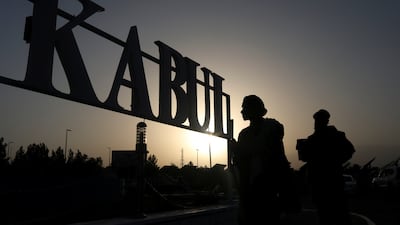
Taliban soldiers stand guard at the international airport in Kabul, Afghanistan. Reuters -
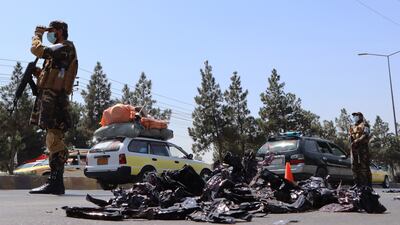
Taliban remove tinted films from vehicle windows at a checkpoint in the Afghan capital. EPA -
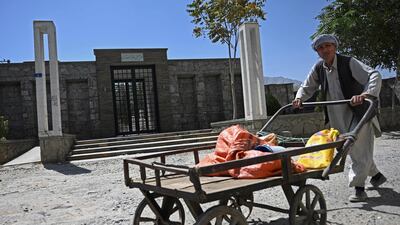
A worker pushes his handcart past the main entrance of the closed National Museum in Kabul. AFP -
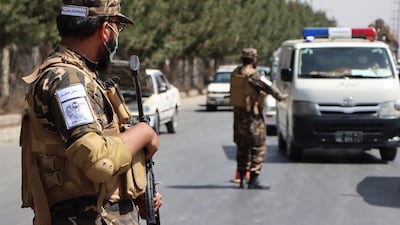
Taliban forces stand guard at a roadside checkpoint. EPA -

Youths play volleyball at Shahr-e Naw Park, Kabul. AFP -
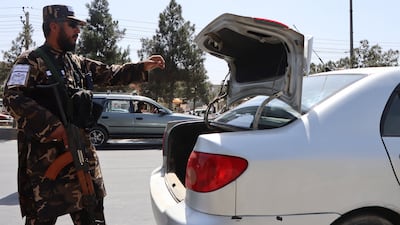
Taliban forces check a car in Kabul. EPA -

Taliban forces monitor traffic flow in the city centre. EPA -

Members of the Taliban guard the entrance to Hamid Karzai International Airport in Kabul. Reuters -

South Korean Prime Minister Kim Boo-kyum, left, greets representatives of a group of 390 Afghans, who were airlifted from Kabul to South Korea as 'persons of merits' late last month. EPA -
Army Staff Sgt Ryan Knauss' funeral procession moves toward the front gate after arriving by charter aircraft from Dover AFB at McGhee Tyson Air Base, in Louisville, Tennessee. AP


The only problem is the economic slump that has deepened in Afghanistan in the past weeks as international aid that once kept the government afloat has been cut off since the Taliban takeover.
“There's a big financial crisis,” she explains. “My husband was working for the government and now he's jobless.” She said she had managed to keep her own job in the health system, and felt safer than in the last years of Ashraf Ghani's government when civilian casualties hit record highs.
“Before we were really scared going to work. We thought that the Taliban would target us, but now they are in charge.”
At one point, a young fighter storms up and demands to know what is happening. A minute later, another takes a swipe at curious children who have gathered to listen.
Razia appears nervous around the militiamen and relieved when the brief exchange next to the city's tiled tomb of Ahmad Shah Durrani is over.
A month after the Taliban took charge of the southern city, which forms the movement's spiritual heartland, it is enjoying some respite from years of violence.
For nearly two decades, the fields around Kandahar have been rocked by fighting, disappearances and air strikes, while a tide of assassinations and bomb blasts have kept the city on edge.
Yet the apparent break from those years of violence has only come with the arrival of hundreds of victorious rural Taliban fighters, who now man checkpoints or cruise around in the back of captured police pickups.
Some are courteous, but others oversee the city with barely disguised menace and the atmosphere is tense.
Away from the scrutiny of such fighters, residents — and in particular women — describe fear and uncertainty beneath the newfound stability.
“Since the Taliban came I haven't been out alone, even though I used to go everywhere for work, even the districts,” says one social activist. “I am frightened the neighbours will tell the Taliban about my work. There is security but our dreams have died.”
Another woman, who declined to give her name, said: “Obviously security will be better when they are the government. Who will injure people, who will destroy the country, obviously it was them doing all the bombings and attacks.”
Life is in limbo for many. The government's extensive payroll is not being paid and secondary schools for both boys and girls have been suspended. It is unclear what will happen to women in the workforce.
Niamatullah Hassan, the newly-appointed Taliban mayor of Kandahar, is adamant the schools will return for both girls and boys.
“We do not have any problem with women's education,” he says in his office. “The only change is that women should do education with Islamic rules and wearing hijab.”
The last time there was a Taliban official in his office there was no schooling for girls, however, and many fear the movement will return to its strictures of the 1990s.
“Previously, the whole of the country was not under our control. Now we are not fighting, so we are facilitating education for women,” he says.
“I am willing to increase the number of women employees in the municipality and we are planning a separate workplace.”
Such promises do not reassure everyone. While women working in health care and education appear to have kept their jobs so far, it is unclear how long that will last and what will happen to other women.
“If I have no job and I'm not allowed out, I don't care about security,” says one.

