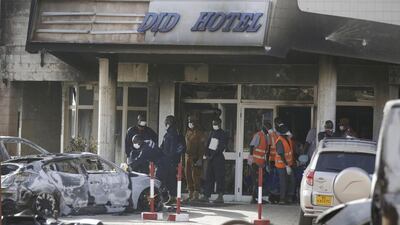
A militant attack that killed 29 people in the Burkina Faso capital in September. AP Photo

Eight terrorists killed in Ivory Coast-Burkina Faso operation


  • English
  • Arabic

Eight suspected terrorists were killed and 38 captured in a joint operation by forces from Burkina Faso and the Ivory Coast near the countries' border.

Twenty-four men caught in Burkina Faso and 14 in Ivory Coast were handed to intelligence services, a source at Ivorian army headquarters said.

A "terrorist base" was destroyed at Alidougou in Burkina Faso, the source said.

The operation also seized arms, ammunition, USB keys and mobile phones, he said.

Operation "Comoe", named after a river that flows through the two countries, was launched in early May, the source said.

He praised the "perfect co-ordination between the two armies".

This joint operation, described on Saturday by the armies' commanders as the first of its kind, took place north-east of the Ivorian town of Ferkessedougou and south of Banfora in Burkina Faso.

On Saturday, a source from Burkina Faso security said the entire operation had been carried out in Ivory Coast.

Locals said the fighting took place around the villages of Tinadalla and Diambeh, in the north-east of Ivory Coast, and that there was a considerable military presence.

A villager from Tindalla said strangers had been in the zone for more than a month, coming and going across the border with Burkina Faso.

The Ivorian army source said on Sunday that "no terrorist base exists on Ivorian territory that may have served as a zone of refuge during previous offensives" by the Burkina Faso army.

A Burkina Faso military source said that one of its soldiers had been wounded and taken to hospital in Korhogo, in northern Ivory Coast.

The presence of militants to the north of Ivory Coast's Comoe national park was detected more than a year ago.

Security sources say they are extremists operating in Burkina Faso and sheltering in the neighbouring country.

Terrorist violence in Burkina Faso has claimed nearly 900 lives since 2015.

The End of Loneliness
Benedict Wells
Translated from the German by Charlotte Collins
Sceptre

Ten tax points to be aware of in 2026

1. Domestic VAT refund amendments: request your refund within five years

If a business does not apply for the refund on time, they lose their credit.

2. E-invoicing in the UAE

Businesses should continue preparing for the implementation of e-invoicing in the UAE, with 2026 a preparation and transition period ahead of phased mandatory adoption. 

3. More tax audits

Tax authorities are increasingly using data already available across multiple filings to identify audit risks. 

4. More beneficial VAT and excise tax penalty regime

Tax disputes are expected to become more frequent and more structured, with clearer administrative objection and appeal processes. The UAE has adopted a new penalty regime for VAT and excise disputes, which now mirrors the penalty regime for corporate tax.

5. Greater emphasis on statutory audit

There is a greater need for the accuracy of financial statements. The International Financial Reporting Standards standards need to be strictly adhered to and, as a result, the quality of the audits will need to increase.

6. Further transfer pricing enforcement

Transfer pricing enforcement, which refers to the practice of establishing prices for internal transactions between related entities, is expected to broaden in scope. The UAE will shortly open the possibility to negotiate advance pricing agreements, or essentially rulings for transfer pricing purposes. 

7. Limited time periods for audits

Recent amendments also introduce a default five-year limitation period for tax audits and assessments, subject to specific statutory exceptions. While the standard audit and assessment period is five years, this may be extended to up to 15 years in cases involving fraud or tax evasion. 

8. Pillar 2 implementation 

Many multinational groups will begin to feel the practical effect of the Domestic Minimum Top-Up Tax (DMTT), the UAE's implementation of the OECD’s global minimum tax under Pillar 2. While the rules apply for financial years starting on or after January 1, 2025, it is 2026 that marks the transition to an operational phase.

9. Reduced compliance obligations for imported goods and services

Businesses that apply the reverse-charge mechanism for VAT purposes in the UAE may benefit from reduced compliance obligations. 

10. Substance and CbC reporting focus

Tax authorities are expected to continue strengthening the enforcement of economic substance and Country-by-Country (CbC) reporting frameworks. In the UAE, these regimes are increasingly being used as risk-assessment tools, providing tax authorities with a comprehensive view of multinational groups’ global footprints and enabling them to assess whether profits are aligned with real economic activity. 

Contributed by Thomas Vanhee and Hend Rashwan, Aurifer
