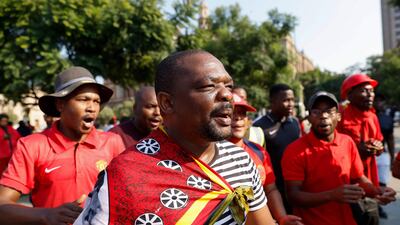
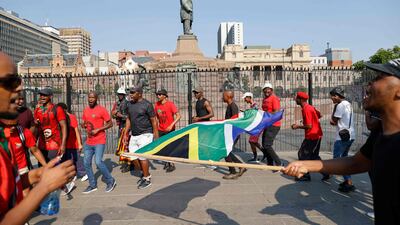
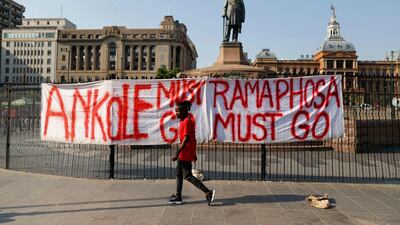
Members of the the Economic Freedom Fighters (EFF) gather at Church Square in Pretoria on March 20, 2023 during a "national shut-down" called by their party to bring the country to a halt. (Photo by PHILL MAGAKOE / AFP)
Members of the the Economic Freedom Fighters (EFF) gather at Church Square in Pretoria on March 20, 2023 during a "national shut-down" called by their party to bring the country to a halt. (Photo by P

Thousands of troops on streets across South Africa as scores are arrested


  • English
  • Arabic

Thousands of troops were on the streets of South Africa and scores of people were arrested on Monday as a demonstrators tried to bring the country to a standstill.

The left-wing Economic Freedom Fighters (EFF) mobilised supporters demanding the resignation of President Cyril Ramaphosa for his handling of the sluggish economy, electricity shortages and high unemployment.

The ruling African National Congress (ANC) promised business would continue as normal, but the protests raised fears of violence similar to 2021, when at least 350 people were killed in days of rioting and looting.

About 3,500 troops joined police, with authorities saying they had arrested 87 people for violence in the hours before the protests were scheduled to start.

Shopkeepers said they were intimidated into shutting their businesses, the government claimed, while thousands of tyres were confiscated after they were stockpiled as roadblocks to be burnt.

  • Members of the Economic Freedom Fighters (EFF) gather at Church Square in Pretoria during a national shutdown called by their party. AFP
    Members of the Economic Freedom Fighters (EFF) gather at Church Square in Pretoria during a national shutdown called by their party. AFP
  • The walkout was called with the intention of bringing South Africa to a halt. AFP
    The walkout was called with the intention of bringing South Africa to a halt. AFP
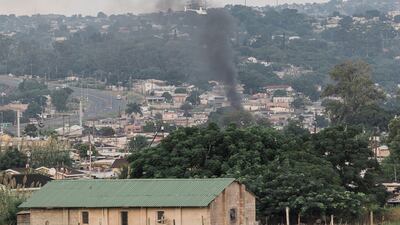
  • A police helicopter hovering over Bhambayi township as smoke rises in Durban. AFP
    A police helicopter hovering over Bhambayi township as smoke rises in Durban. AFP
  • Protesters gather in Johannesburg. The EFF is calling for the removal of Cyril Ramaphosa as South African President. Reuters
    Protesters gather in Johannesburg. The EFF is calling for the removal of Cyril Ramaphosa as South African President. Reuters
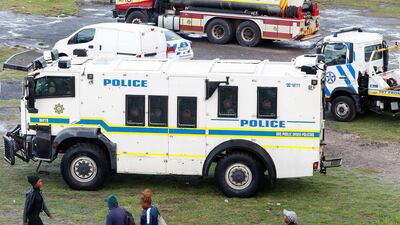
  • Armoured police in Cape Town. Reuters
    Armoured police in Cape Town. Reuters
  • A message for the South African President at Church Square in Pretoria. AFP
    A message for the South African President at Church Square in Pretoria. AFP

“The president has instructed law enforcement agencies to ensure that we do not have to see the repeat of those scenes that we saw back in 2021,” Mr Ramaphosa's spokesman Vincent Magwenya said.

“The state has a responsibility to ensure that citizens can go on about their day … in a normal way and when doing so, that they are safe and that they are not subjected to any anarchy or any form of violence.”

Pretoria and Johannesburg streets were reported to be quiet on Monday morning. Many shops were closed and their shutters were down.

A member of the the Economic Freedom Fighters (EFF) walks past a banner that reads "Ramaphosa must go" at Church Square in Pretoria on March 20, 2023 during a "national shut-down" called by their party. (Photo by PHILL MAGAKOE / AFP)

The EFF, which describes itself as “a radical and militant economic emancipation movement” is South Africa's third largest political party, with support among poor and working class Black South Africans who feel they have not benefited from the end of white minority rule in 1994.

Critics say the party has used anti-white rhetoric, but the EFF denies it is racist.

The shutdown may serve as a barometer for the EFF's support ahead of national elections in 2024.

The ANC, the party of Nelson Mandela, has ruled since 1994, but has gradually lost support as voters have become disillusioned with an anaemic economy, rampant corruption and high levels of crime.

'Just the beginning'

The party is expected to struggle to win an outright majority next year, ushering in an era of coalition politics and potentially putting the EFF, or the main opposition Democratic Alliance, in a position to share power.

As the day got under way, Julius Malema, the EFF's commander in chief, told supporters: “It's just the beginning. Now, let's go out and join the picket lines. They said it was a normal day, but you could see who the deceivers were. You proved to the doomsayers once more that we remain the only disciplined force on the left.”


UAE currency: the story behind the money in your pockets
SEMI-FINAL

Monterrey 1 

Funes Mori (14)

Liverpool 2

Keita (11), Firmino (90 1)

THE SPECS


Engine: 1.5-litre


Transmission: 6-speed automatic


Power: 110 horsepower 


Torque: 147Nm 


Price: From Dh59,700 


On sale: now  


Mercer, the investment consulting arm of US services company Marsh & McLennan, expects its wealth division to at least double its assets under management (AUM) in the Middle East as wealth in the region continues to grow despite economic headwinds, a company official said.

Mercer Wealth, which globally has $160 billion in AUM, plans to boost its AUM in the region to $2-$3bn in the next 2-3 years from the present $1bn, said Yasir AbuShaban, a Dubai-based principal with Mercer Wealth.

Within the next two to three years, we are looking at reaching $2 to $3 billion as a conservative estimate and we do see an opportunity to do so,” said Mr AbuShaban.

Mercer does not directly make investments, but allocates clients’ money they have discretion to, to professional asset managers. They also provide advice to clients.

“We have buying power. We can negotiate on their (client’s) behalf with asset managers to provide them lower fees than they otherwise would have to get on their own,” he added.

Mercer Wealth’s clients include sovereign wealth funds, family offices, and insurance companies among others.

From its office in Dubai, Mercer also looks after Africa, India and Turkey, where they also see opportunity for growth.

Wealth creation in Middle East and Africa (MEA) grew 8.5 per cent to $8.1 trillion last year from $7.5tn in 2015, higher than last year’s global average of 6 per cent and the second-highest growth in a region after Asia-Pacific which grew 9.9 per cent, according to consultancy Boston Consulting Group (BCG). In the region, where wealth grew just 1.9 per cent in 2015 compared with 2014, a pickup in oil prices has helped in wealth generation.

BCG is forecasting MEA wealth will rise to $12tn by 2021, growing at an annual average of 8 per cent.

Drivers of wealth generation in the region will be split evenly between new wealth creation and growth of performance of existing assets, according to BCG.

Another general trend in the region is clients’ looking for a comprehensive approach to investing, according to Mr AbuShaban.

“Institutional investors or some of the families are seeing a slowdown in the available capital they have to invest and in that sense they are looking at optimizing the way they manage their portfolios and making sure they are not investing haphazardly and different parts of their investment are working together,” said Mr AbuShaban.

Some clients also have a higher appetite for risk, given the low interest-rate environment that does not provide enough yield for some institutional investors. These clients are keen to invest in illiquid assets, such as private equity and infrastructure.

“What we have seen is a desire for higher returns in what has been a low-return environment specifically in various fixed income or bonds,” he said.

“In this environment, we have seen a de facto increase in the risk that clients are taking in things like illiquid investments, private equity investments, infrastructure and private debt, those kind of investments were higher illiquidity results in incrementally higher returns.”

The Abu Dhabi Investment Authority, one of the largest sovereign wealth funds, said in its 2016 report that has gradually increased its exposure in direct private equity and private credit transactions, mainly in Asian markets and especially in China and India. The authority’s private equity department focused on structured equities owing to “their defensive characteristics.”

Benefits of first-time home buyers' scheme
  • Priority access to new homes from participating developers
  • Discounts on sales price of off-plan units
  • Flexible payment plans from developers
  • Mortgages with better interest rates, faster approval times and reduced fees
  • DLD registration fee can be paid through banks or credit cards at zero interest rates
DIVINE%20INTERVENTOIN
%3Cp%3EStarring%3A%20Elia%20Suleiman%2C%20Manal%20Khader%2C%20Amer%20Daher%3C%2Fp%3E%0A%3Cp%3EDirector%3A%20Elia%20Suleiman%3C%2Fp%3E%0A%3Cp%3ERating%3A%204.5%2F5%3C%2Fp%3E%0A
Updated: March 20, 2023, 10:31 AM