

UN aid chief Martin Griffiths has urged Ethiopia to allow lorries into northern state Tigray, where a de facto blockade of nearly three months has restricted deliveries to 10 per cent of what is needed.
“This is man-made, this can be remedied by the act of government,” Mr Griffiths told Reuters. “Get those trucks moving.”
War broke out 10 months ago between Ethiopia's federal troops and forces loyal to the Tigray People's Liberation Front, which controls Tigray.
Thousands of people have been killed in the conflict and more than two million have fled their homes.
“We predicted that there were 400,000 people in famine-like conditions, at risk of famine, and the supposition was that if no aid got to them adequately, they would slip into famine,” Mr Griffiths said, referring to a UN assessment in June.
“I have to assume that something like that is happening.”
It is difficult to know the exact situation because of a de facto aid blockade and lack of fuel, cash and lorries.
Ethiopia's UN mission in New York said that “any claim on the existence of blockade is baseless".
It said aid groups “faced shortage in lorries as a result of the non-return of almost all lorries that travelled to Tigray to deliver aid”.
Lorry drivers carrying aid into Tigray have come under fire at least twice and some Tigrayan drivers have been arrested in the neighbouring state of Afar, although they were later released, according to UN reports.
-
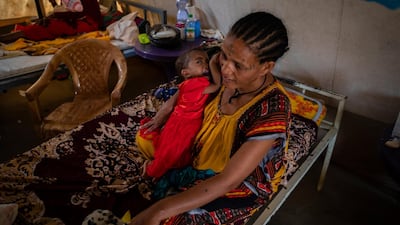
Mother Roman Kidanemariam, 35, holds her malnourished daughter, Merkab Ataklti, 22 months old, in the treatment tent of a medical clinic in the town of Abi Adi, in the Tigray region of northern Ethiopia. AP Photo -
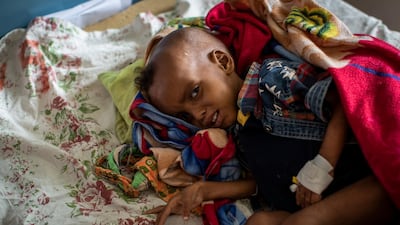
Gebre Kidan Gebrehiwet, 2, is treated for malnutrition after fleeing from the town of Abi Adi with his mother, Abeba Tesfay, at the Ayder Referral Hospital in Mekele, in the Tigray region of northern Ethiopia. AP Photo -
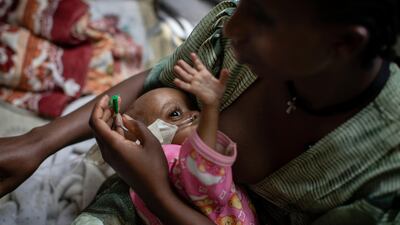
Birhan Etsana, 27, from Dengelat, uses a nasogastric tube to feed her malnourished baby, Mebrhit, who at 17 months old weighs just 5.2 kilograms (11 pounds and 7 ounces), at the Ayder Referral Hospital in Mekele, in the Tigray region of northern Ethiopia. AP Photo -
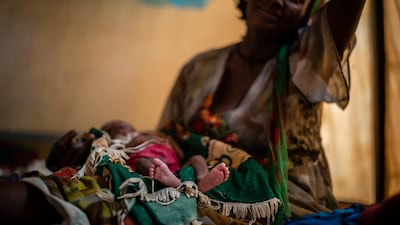
Abeba Gebru, 37, from the village of Getskimilesley, sits with her malnourished daughter, Tigsti Mahderekal, 20 days old, in the treatment tent of a medical clinic in the town of Abi Adi, in the Tigray region of northern Ethiopia. AP Photo -

An Ethiopian woman scoops up portions of yellow split peas to be allocated to waiting families after it was distributed by the Relief Society of Tigray in the town of Agula, in the Tigray region of northern Ethiopia. AP Photo -
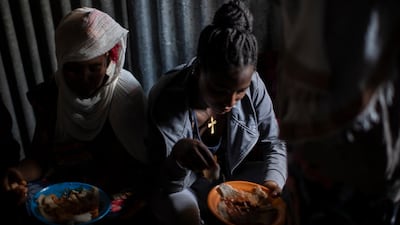
Displaced Tigrayan women sit in a metal shack to eat food donated by local residents at a reception center for the internally displaced in Mekele, in the Tigray region of northern Ethiopia. AP Photo -
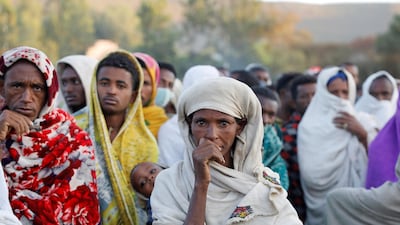
A woman stands in line to receive food donations at the Tsehaye primary school, which was turned into a temporary shelter for people displaced by conflict, in the town of Shire, Tigray region. Reuters -
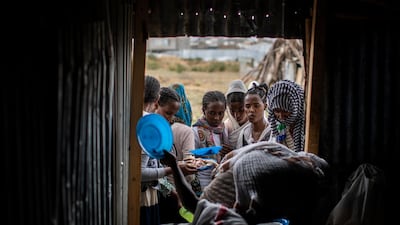
Tigrayans stand in line to receive food donated by local residents at a reception center for the internally displaced in Mekele, in the Tigray region of northern Ethiopia. AP Photo -
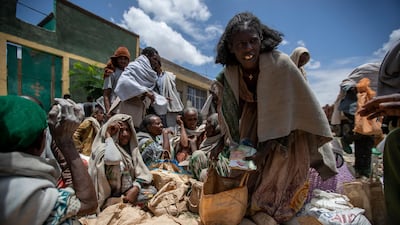
An Ethiopian woman leaves with a portion of yellow split peas after it was distributed by the Relief Society of Tigray in the town of Agula, in the Tigray region of northern Ethiopia. AP Photo -
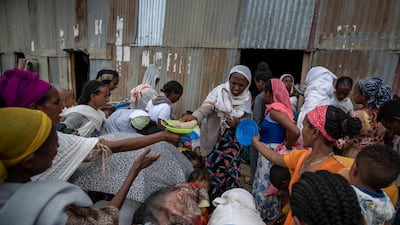
Displaced Tigrayans queue to receive food donated by local residents at a reception center for the internally displaced in Mekele, in the Tigray region of northern Ethiopia. AP Photo


Several lorries have gone into Tigray and not come back, compounding the humanitarian problems, Mr Griffiths said.
“First of all, they probably don't have fuel to come out,” he said. “And secondly, they may not wish to, so the consequences for humanitarian operations – whatever the cause – is problematic.”
In Tigray, 5.2 million people, or 90% of the population, need help, the UN has estimated.
Screening of children under age 5 during the first half of September revealed that 23 per cent are malnourished and more than 70 per cent of some 11,000 pregnant or breastfeeding women are acutely malnourished.
Mr Griffiths said 100 lorries a day of aid are needed to get to Tigray, but only 10% had gained access in the past three months.
“We need the Ethiopian government to do what they promised to do which is to facilitate access,” said Mr Griffiths.
The UN aid chief met Ethiopia's Deputy Prime Minister Demeke Mekonnen last week during the UN General Assembly in New York.
Mr Mekonnen assured him that access is improving.
“It needs to improve a great deal more,” Mr Griffiths said.

