
Iceland faces “a daunting period of upheaval" after homes were destroyed by lava emitted from a long-dormant volcanic system, President Gudni Johannesson said.
Molten lava flows reached the outskirts of Grindavik around noon on Sunday, setting three houses alight, although the town had been evacuated earlier and there was no immediate danger to people.
The volcano, which erupted in south-western Iceland for the second time in less than a month, appeared to be less active early on Monday.
Authorities built barriers of earth and rock in recent weeks to try to prevent lava from reaching the fishing town 40km south-west of the capital Reykjavik.
Mr Johannesson said in a televised address on Sunday night “a daunting period of upheaval has begun on the Reykjanes peninsula” and authorities were battling "tremendous forces of nature".
"We don’t yet know how this eruption will unfold but we must still take those actions that are within our power,” the President said.
“We continue to hope for as good an outcome as possible in the face of these tremendous forces of nature. We will carry on with our responsibilities and we will continue to stand together.”
Volcanic hotspot
It was the second volcanic eruption on the Reykjanes peninsula in south-western Iceland in less than one month and the fifth since 2021.
An eruption started in the Svartsengi volcanic system on December 18 after the complete evacuation of Grindavik's 4,000 residents and the closure of the Blue Lagoon geothermal spa, a popular tourist spot.
No one is known to have been killed in the eruptions but a workman is missing after reportedly falling into a crack opened by the volcano.
More than 100 Grindavik residents have returned in recent weeks before Saturday's renewed evacuation order, local authorities said.
-
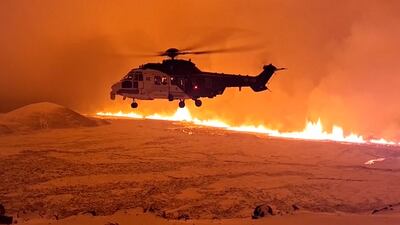
A coastguard helicopter flies close to near magma flowing down a hill on Iceland's Reykjanes Peninsula on Monday night. AP -
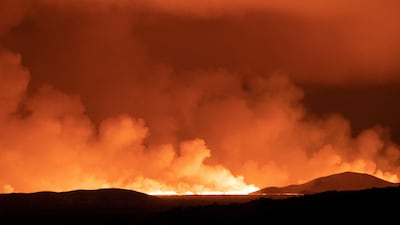
The volcano erupted on Monday night, turning the sky orange and prompting the country’s civil defence to be on high alert. Reuters -

The eruption was about 4km north-east of the town of Grindavik. EPA -

The volcano was hit by more than 1,000 earthquakes in just 24 hours on November 9, igniting fears of an imminent eruption. EPA -
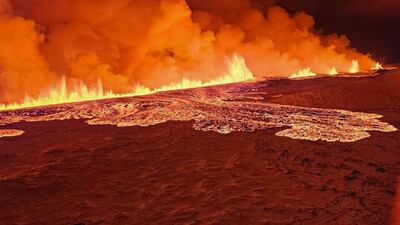
An evacuation order for the population of Grindavik was issued last month following seismic activity and indications of considerable magma movement in the area. EPA -
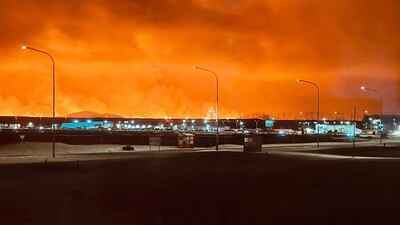
Smoke billows near the town of Keflavik, with the eruption turning the sky orange. AFP -
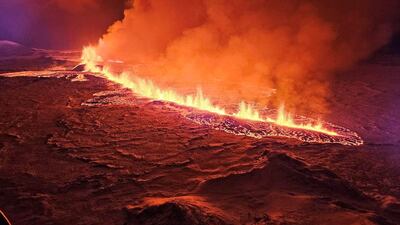
The Norwegian Meteorological Agency estimated that 100 to 200 cubic metres of lava is spewing out each second. Reuters -
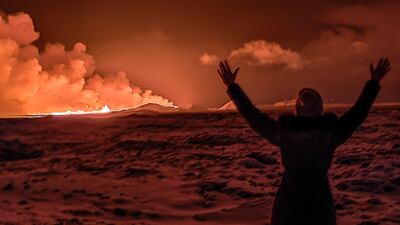
A local resident watches smoke billow as the lava colours the night sky orange on the Reykjanes peninsula. AFP -
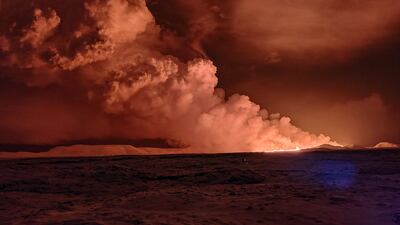
Grindavik, a fishing town of 3,400, sits on the Reykjanes Peninsula, about 50km south-west of the capital, Reykjavik. AFP -
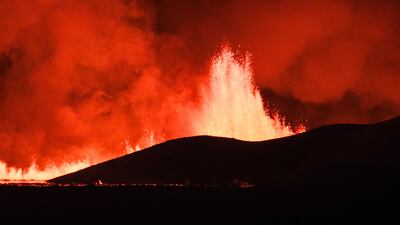
Molten lava is thrown into the air from a fissure on the Reykjanes Peninsula. AFP -
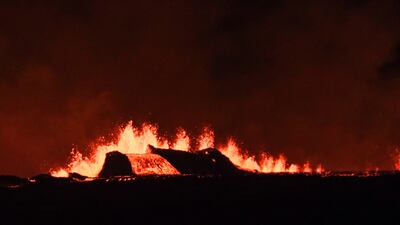
Scientists say the eruption is unlikely to produce a plume of smoke like the Eyjafjallajokull volcano eruption, which grounded flights globally. AFP -

Reykjanes is a volcanic and seismic hotspot south-west of Reykjavik. AFP


Lying between the Eurasian and North American tectonic plates, two of the largest on the planet, Iceland is a seismic and volcanic hotspot. The two plates are moving in opposite directions.
In 2010, ash clouds from eruptions of the Eyafjallajokull volcano in the south of Iceland spread over large parts of Europe, leading to about 100,000 flights being grounded and forcing hundreds of Icelanders from their homes.
Unlike Eyafjallajokull, the Reykjanes systems are not trapped under glaciers, so are not expected to cause similar ash clouds.

