



This month is set to be the hottest on record, with UN chief Antonio Guterres warning the rise in temperatures meant the world was on the brink of an "era of global boiling".
Mr Guterres pleaded for immediate radical action on climate change, on Thursday, warning record-shattering July temperatures prove Earth has passed from a warming phase into an "era of global boiling".
Speaking in New York, the secretary-general said the intense heat across the Northern Hemisphere was "terrifying," adding that "the era of global warming has ended; the era of global boiling has arrived."
July 6 was the hottest day ever and the first three weeks of this month were the hottest such period since records began, analysis by an EU-funded organisation indicates.
Exceptionally high sea surface temperatures have contributed to the record-breaking figures, Copernicus Climate Change Service (C3S) has revealed.
Drastic increase in temperatures
Records were broken as extreme heatwaves have affected many parts of the world, including the US and Mexico, China and Southern Europe. Wildfires have raged amid the sharply rising temperatures.
“Record-breaking temperatures are part of the trend of drastic increases in global temperatures. Anthropogenic emissions are ultimately the main driver of these rising temperatures," Dr Carlo Buontempo, director of C3S, said in a statement.
This month’s temperatures, which averaged about 17 °C globally, according to a graph released by C3S, look set to break the record for the hottest month set in July 2019.
"It is extremely likely that July 2023 will be the hottest July and also the hottest month on record, following on from the hottest June on record," C3S said.
The stark findings were supported by a second report released on Thursday, led by Dr Karsten Haustein, a research scientist at Leipzig University.
The study revealed that this month is the hottest since records began and possibly the hottest for more than 100,000 years.
"It’s quite a lot above the old record," said Dr Haustein.
"We have all the data we need to know it’s the hottest month … We are at least 0.2 °C warmer than the old record, for 2019.
"Even if it turns out to be a bit cooler than my fairly sophisticated forecast, we’re still in record territory. This is the warmest July ever. It’s also the warmest month in absolute terms."
This month is thought likely to have been the warmest since the end, about 115,000 years ago, of an interglacial period called the Eemian interglacial period.
-
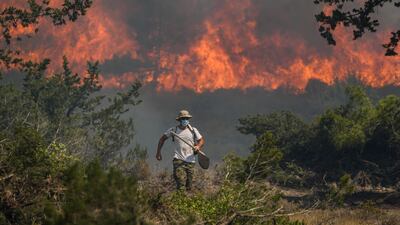
A forest fire burns near Vati village, on the island of Rhodes. AP -
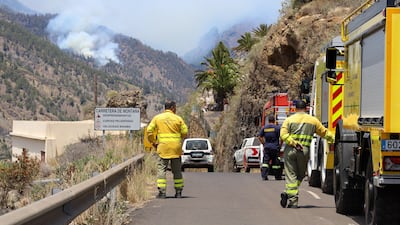
Firefighters watch as a forest fire reignites in Spain's Caldera de Taburiente national park. EPA -

A man lifts a tile from underneath the frame of a burnt bed after a forest fire raced through the Tunisian town of Melloula. AFP -
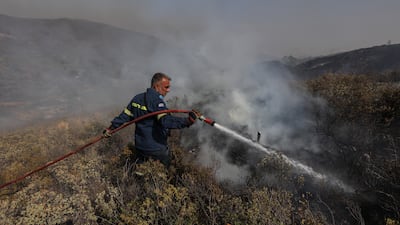
A firefighter tries to extinguish a blaze near the village of Asklipieio, on the Greek island of Rhodes. Reuters -
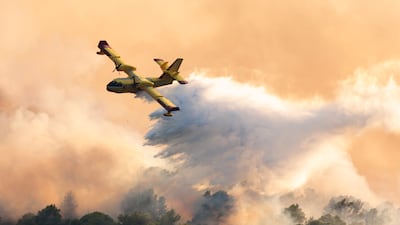
A plane dumps water over a wildfire on Ciovo island, Croatia. AP -
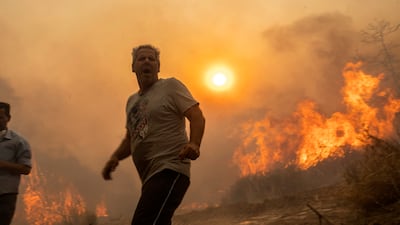
Residents of Gennadi village stand near a forest fire raging on the island of Rhodes. AP -
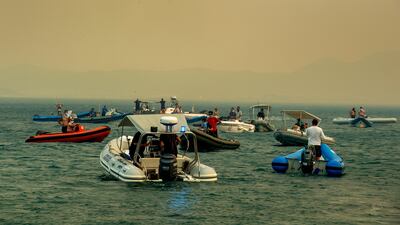
People are evacuated by boat as they flee a fire burning near the Greek town of Nea Anchialos. EPA -
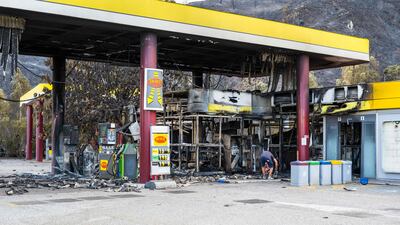
A petrol station destroyed by a forest fire in the Italian town of Oliveri. AFP -

A man watches as a house burns in the Tono district of Messina, Sicily. AFP -
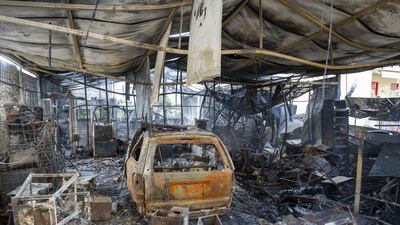
The fire destroyed homes and cars in Oliveri. AFP -
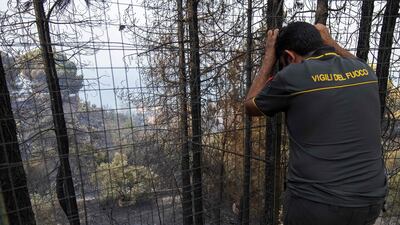
A firefighter is overwhelmed as he looks at the trail of destruction in Messina, Sicily. AFP -
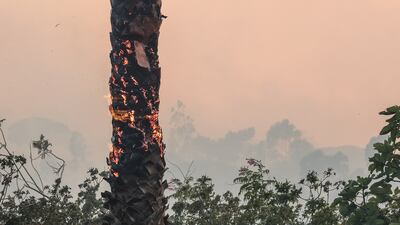
A fire burns a forested area of Alto do Alvide, Portugal. EPA -
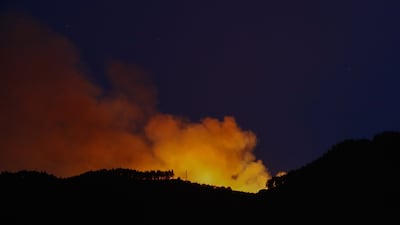
A forest fire burns in Valsequillo, Spain. EPA -
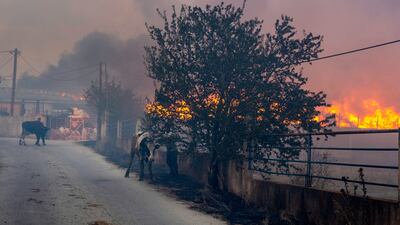
Calves try to escape the fire in Sesklo village, Greece. EPA -

Farmers try to save their animals as the fire approaches Sesklo village. EPA -

A firefighter tackles a blaze outside the village of Vati, Greece. Getty -
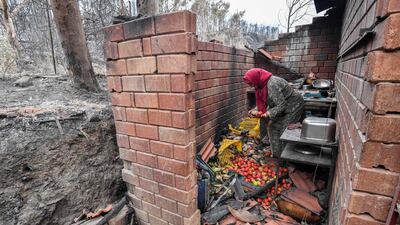
A woman salvages produce from a building gutted by a forest fire near the town of Melloula, Tunisia. AFP -
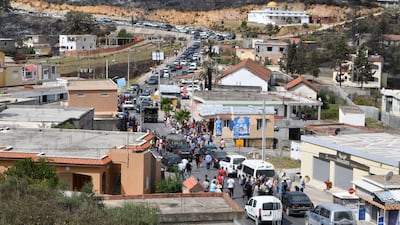
Residents block a street as they demand the restoration water supplies in Melloula, following recent heatwaves and a forest fire in the area. AFP -
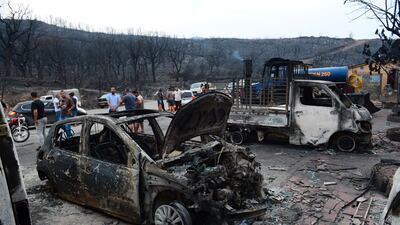
Algerians gather next to vehicles destroyed by wildfires in Bouira, 100km from the capital, Algiers. AP -

A fire engine moves along a road as a forest fire rages near the Tunisian town of Melloula, close to the border with Algeria. AFP -
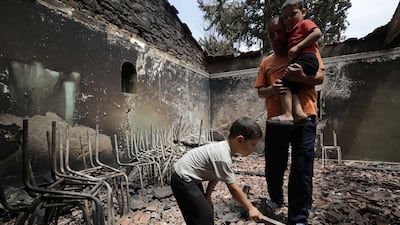
A man and his children inspect the damage to their house after a fire raced through the Algerian village of De Oeud Das. EPA -
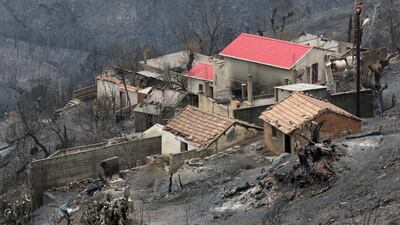
Houses damaged by the forest fires in De Oeud Das village. EPA -
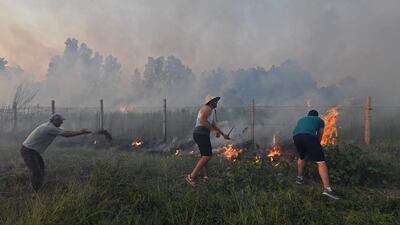
Residents try to extinguish a fire in Tunisia's coastal town of Tabarka amid a blistering heatwave. AFP -
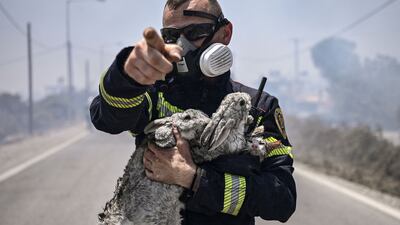
A fireman holds a cat and two rabbits after rescuing them from a fire on the Greek island of Rhodes. AFP -

German tourists and local residents try to extinguish a fire near the seaside resort of Lindos. AP -
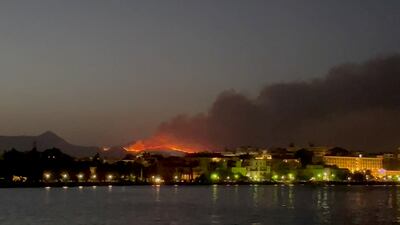
Smoke rises on Corfu following a wildfire. Reuters -

Tourists wait for departing planes at the airport on the island of Rhodes, after being evacuated. Reuters -
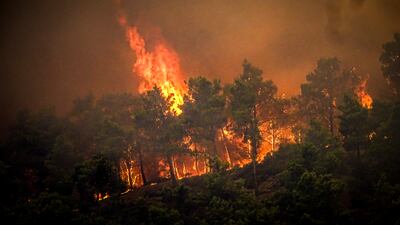
A large forest fire on the Greek island of Rhodes has forced authorities to order an evacuation of four locations. AP -
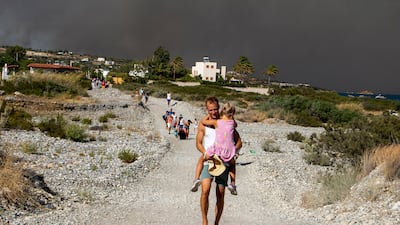
A man carries a child as they leave an area where a forest fire burns. AP -
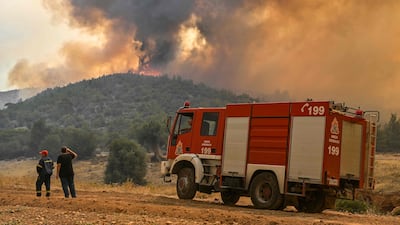
A fire engine is parked in front of a blaze raging in New Peramos, near Athens. AFP -
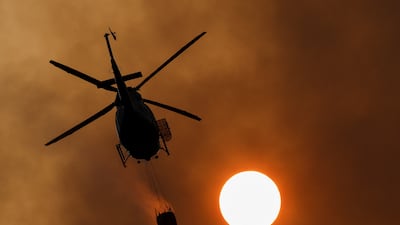
A helicopter works to extinguish a wildfire, in the area of Pico de las Nieves, on the Canary Island of Gran Canaria, Spain. Reuters -
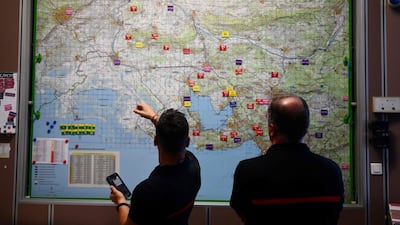
A firefighters' operations room in Marseille, France. AFP -
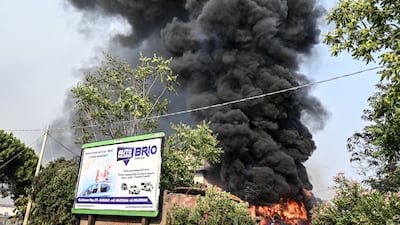
Smoke billows from a house on fire in the Aci Catena area, 20km from Catania. Getty
Dr Haustein based his conclusions on data from land and ocean weather stations, satellites and radiosondes, which are battery-powered devices carried up by balloon.
One factor causing temperatures to be particularly high at the moment is that the world is in an El Niño phase, which is associated with a warmer climate than the opposite La Niña system.
The La Niña system is associated with stronger east-to-west trade winds in the Pacific Ocean, which brings up colder water from the ocean depths and results in cooler temperatures.
On top of the effect of being in an El Niño phase are the effects of climate change, which have made the heatwaves of the kind experienced this month around the world, notably in the United States and Mexico, China and Southern Europe, much more likely.
"We have also seen extremely high rainfall in South Korea, in Brazil, in other parts of the world this July," said Dr Friederike Otto, a senior lecturer in climate science at the Grantham Institute for Climate Change and the Environment, part of Imperial College London, who was also involved in the analysis.
"It’s not by chance this is happening while we’re having this hottest July ever. These heatwaves we’re having are not rare events at all in today’s climate.
"They will be expected every five years or 10 years; not a really extreme event. Without heat-induced climate change, this would’ve been so rare it would’ve been the statistical equivalent of impossible."
Droughts have also been made more likely and more intense and are leading to yet higher temperatures, Dr Otto said.
'Harsh reality' of climate change
Meanwhile, the July 6 record for the hottest day exceeds that of August 2016. C3S said July 5 and July 7 were almost as hot as July 6.
Dr Buontempo said July’s record was "unlikely to remain isolated this year", because forecasts by C3S suggested temperatures over land areas were set to remain "well above average".
During the first and third weeks of this month, global mean temperatures were more than 1.5 °C higher than the average temperature of pre-industrial times, before humans began releasing large quantities of greenhouse gases into the atmosphere.
The key aim of the Paris Agreement of 2015 was to limit average global temperature rises to 1.5 °C above pre-industrial levels.
While the 1.5 °C threshold has been breached this month, it has happened only temporarily and global average temperatures have yet to reach the limit set by the Paris Agreement.
However, given the cuts in global carbon emissions set out in the deal have not been brought in by nations, it is thought highly likely that the threshold will be breached irreversibly.
“The extreme weather which has affected many millions of people in July is unfortunately the harsh reality of climate change and a foretaste of the future,” said Prof Petteri Taalas, secretary general of the World Meteorological Organisation (WMO).
“The need to reduce greenhouse-gas emissions is more urgent than ever before. Climate action is not a luxury but a must.”
Global heatwave - in pictures
-
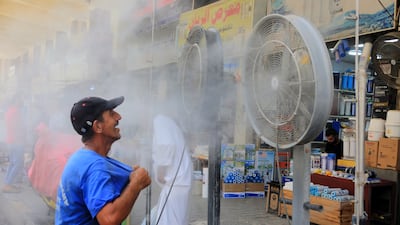
An Iraqi man cool himself off in a spray of water during a sweltering hot day at the Al-Khilani square in central Baghdad, Iraq. EPA -

Children play on water jets at a public square on a very hot afternoon in Madrid, Spain. Getty Images -

A costumed spiderman drinks during a heat wave in New York. Bloomberg -

A pedestrian carries an umbrella during a heat wave in Miami, Florida, US. Bloomberg -

A Palestinian, Mustafa Abdou, repairs fan in his shop amid a heatwave at Shati refugee camp in Gaza City. Reuters -

A man dives into a canal during a hot day in Larkana district of Sind province. AFP -

A man cools himself with a fan while browsing his phone on a sweltering day in Beijing. AP -

People drink coconut water at a market in Dubai to cope with the hot weather. AFP -
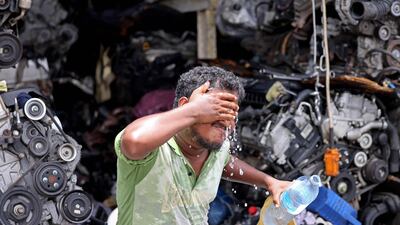
A worker washes his face to cope with the hot weather in Dubai. AFP -

An Egyptian girl cools off in the water amid a heatwave, at a Red Sea resort in Hurghada Egypt. Reuters -

Pedestrians hold umbrellas for protection from the sun during a heat wave in New York, US. Bloomberg -
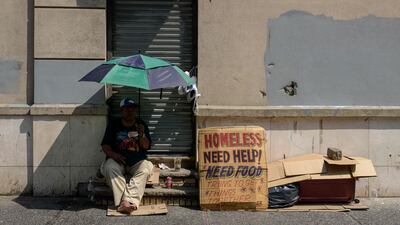
A homeless person holds an umbrella to block out the sun on a hot day in New York City. AFP -

Bottles of water being delivered on a hot summer day in Istanbul. AP -

Diving into the Treska river near Skopje, as temperatures in North Macedonia soared. AFP -

A woman takes a photograph of the Acropolis in Athens in high temperatures. AFP -

A woman shelters from the sun during a heatwave in Rome. Reuters -

Shelia Nunez, 40, cools her dog with ice while sitting under a shaded bus stop in Phoenix, Arizona. AFP -

A lion eats an icy treat containing meat and ostrich eggs to cool down during a regional heatwave at the Safari Zoological Centre in Ramat Gan, Israel. Reuters -

Children play in a water fountain near the walls of Jerusalem's Old City. Reuters -
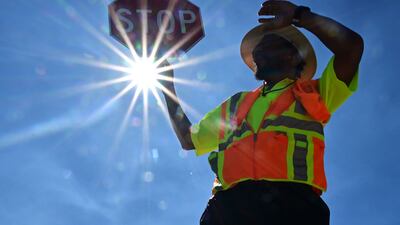
Traffic warden Rai Rogers works on his street corner under the hot sun in Las Vegas. AFP -

A woman uses a fan amid an alert for a heatwave in Shanghai. Reuters -

Andrea Washington pours water on herself in the Hungry Hill neighbourhood of Austin, Texas. Getty -

A busy beach in Rabat, Morocco. EPA -

A person receives medical attention after collapsing in a shop in Phoenix, Arizona, in high heat. AFP -

An Iraqi dives into the Tigris to beat the heat in Baghdad. AP -

Youths play in a fountain at a park in the Syrian capital Damascus, as temperatures exceed 35°C. AFP


According to WMO predictions, there is a 98 per cent chance that one of the next five years will be the warmest on record.
Also, the WMO says there is roughly a two-thirds chance that one of the next five years will have an average temperature more than 1.5 °C above that of the pre-industrial benchmark period of 1850 to 1900.
Statistics from OurWorldinData indicate that six billion tonnes of carbon dioxide, the key greenhouse gas, were emitted globally by fossil-fuel burning and industry in 1990, a figure that had more than quadrupled, to above 25 billion tonnes, by 2000. Two decades later, in 2020, the figure had risen to more than 35 billion tonnes a year.
Global carbon emissions are continuing to increase, although growth has slowed, in part thanks to some governments investing heavily in renewable energy technology, such as solar and wind power.
Some analysis suggests that global carbon emissions could peak as soon as 2025, but to prevent the worst effects of climate change, scientists have said steep reductions must be introduced this decade.
C3S, which released the data about this month’s record-breaking temperatures, is part of the European Centre for Medium-Range Weather Forecasts, which works on behalf of the European Commission.

