
India reported its worst day of the coronavirus pandemic on April 25, with 349,691 new cases and 2,767 deaths in the previous 24 hours – the highest since the start of the pandemic.
The country is battling a deadly resurgence of the virus compounded by a healthcare crisis as hospitals run out of oxygen supplies and beds. At least 22 people died in a hospital after the oxygen supply was disrupted.
As case numbers across the country soar, several countries banned travel to and from India, voicing concerns over the spread of a highly contagious "Indian variant" of Covid-19.
India is at risk of being overwhelmed, despite appearing to have brought the pandemic under control just months ago.
By March 1, daily cases had dropped from a peak of almost 100,000 in mid-September to just 12,000 in a nation of more than 1.3 billion people.
The government lifted various partial restrictions and hoped its vaccination drive would bring a return to normal.
Instead, by mid-April daily infections had climbed to more than 250,000, with more than 1,000 people dying from Covid-19 every day.
“The situation was under control till a few weeks back, and then this second corona wave came like a storm,” India’s Prime Minister Narendra Modi said.
Here is all you need to know about what went wrong – and how India’s crisis risks getting worse.
How bad is the second wave of coronavirus in India?
In short, very bad.
India has surpassed Brazil and has the second-highest number of total infections behind the US.
Thursday's spike was the world's highest daily increase in case numbers yet, and the surge shows no signs of slowing.
Deaths also increased sharply over the past month, rising from about 100 a day in February to more than 2,000.
Which areas of India are worst-hit by Covid-19?
All of India’s regions reported significant coronavirus outbreaks.
The worst-hit region is the central state of Maharashtra – home to more than 110 million people, including 18 million in the Mumbai urban area – which reported more than three million cases in total.
In Maharashtra state 22 Covid-19 patients died on April 21 when a hospital oxygen supply cut out for 30 minutes.
Several other states in southern India are also badly affected – Karnataka, Kerala, and Tamil Nadu all recorded more than a million cases each.
Top 10 Indian states by highest number of coronavirus cases
- Maharashtra
- Kerala
- Karnataka
- Tamil Nadu
- Andhra Pradesh
- Uttar Pradesh
- Delhi
- West Bengal
- Chhattisgarh
- Rajasthan
India’s big cities are all being hit hard by the pandemic.
The capital, New Delhi, recorded more than 900,000 cases, while Pune and Mumbai – both in Maharashtra – reported more than 750,000 and 500,000 cases respectively.
How did India lose control of the pandemic?
The government blamed the resurgence on crowds and a lack of mask-wearing among the population since businesses reopened in February.
Images of large crowds without masks attending weddings and social gatherings circulating online led to suggestions that people had become careless.
But critics accuse the government of putting politics before public health by hosting rallies that are likely to be superspreader events.
In late February, election authorities announced key votes in five states encompassing 186 million people – including the state of West Bengal, where elections would be held in eight phases.
Since then, Mr Modi has campaigned across the states, holding packed rallies at which there is little physical distancing or mask-wearing.
Even as deaths rocketed this week, Mr Modi attended a rally in Asansol, where he hailed the turnout and told crowds “today, in all directions I see huge crowds of people”.
Mr Modi’s ally, Home Minister Amit Shah, hosted huge rallies in crowded spaces across West Bengal as well.
Despite the scale of the health emergency, people were queueing to vote in eastern West Bengal on Thursday.
"It's a festival of democracy and everyone is participating. You can see the queues," said Krishna Kalyan, a candidate from Mr Modi's ruling Bharatiya Janata Party.
The government is also under fire for allowing crowds to attend cricket games between India and England in Gujarat in mid-March, and the Hindu festival of Kumbh Mela in April.
What is the Hindu Kumbh Mela festival and was it a superspreader event?
The Kumbh Mela, one of the most sacred pilgrimages in Hinduism, is a months-long festival held at four pilgrimage sites at rivers in northern India. It takes place approximately every three years.
The festival involves vast numbers of people bathing in holy waters on days significant to Hinduism and is thought to be the world's largest human gathering.
-
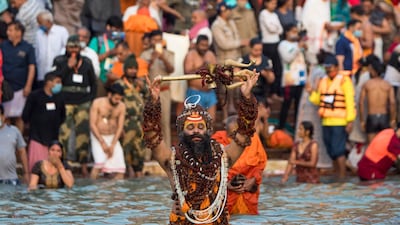
A Sadhu bathes in the Ganges river during the ongoing religious Kumbh Mela festival, in Haridwar. AFP -
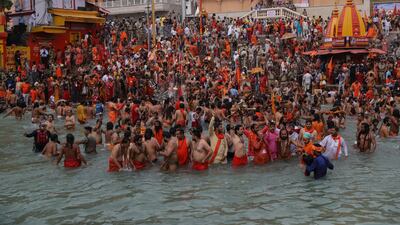
Devotees take holy dips in the Ganges River during Kumbh Mela, or pitcher festival, one of the most sacred pilgrimages in Hinduism, in Haridwar, northern state of Uttarakhand, India. AP -
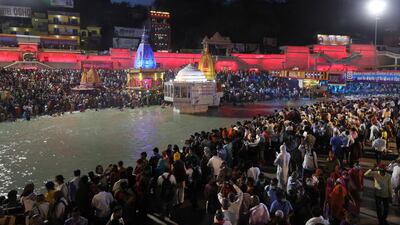
Tens of thousands of Hindu devotees gathered by the Ganges River for special prayers on Monday, many of them flouting social distancing practices as the coronavirus spreads in India with record speed. AP -
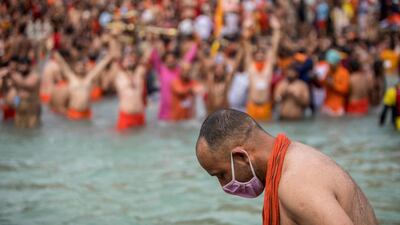
A Sadhu wearing a facemask takes a holy dip in the Ganges river during the ongoing religious Kumbh Mela festival in Haridwar. AFP -
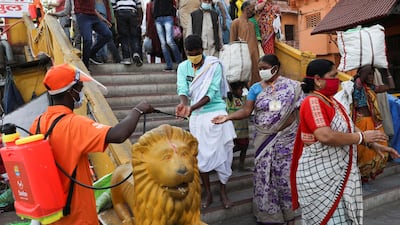
A frontline worker sprays disinfectant on the hands of devotees, on the banks of the Ganges river during Kumbh Mela. Reuters -
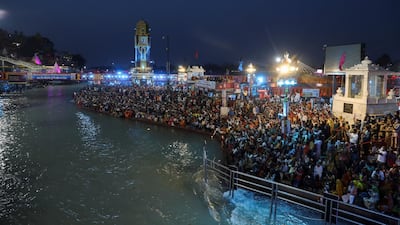
Devotees gather for an evening prayer on the banks of the Ganges river. Reuters -
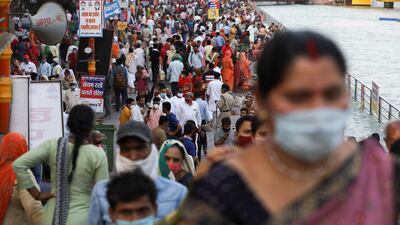
Some on social media criticised the gathering at a time when India registered over 185,000 coronavirus cases in a day. Reuters -
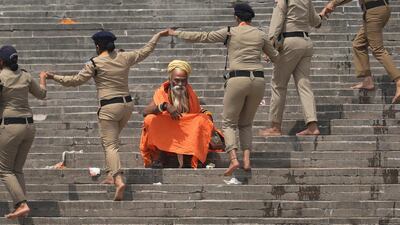
Many flouted social distancing practices as the coronavirus spreads in India with record speed. AP -
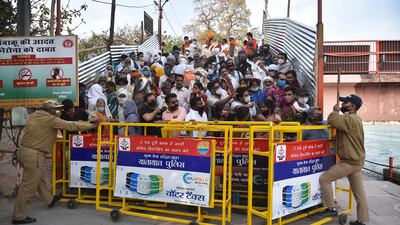
Kumbh Mela is a mass Hindu pilgrimage which occurs after every twelve years and rotates among four locations Prayag (Allahabad) at the confluence of the Ganga and Yamuna and mythical Saraswati river, Haridwar along the Ganga river, Ujjain along the Kshipra river and Nashik along the Godavari river. EPA -
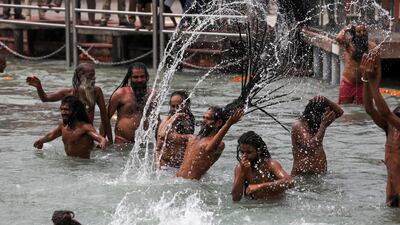
Naga Sadhus, or Hindu holy men, take a dip in the Ganges river during the second Shahi Snan at Kumbh Mela. Reuters -
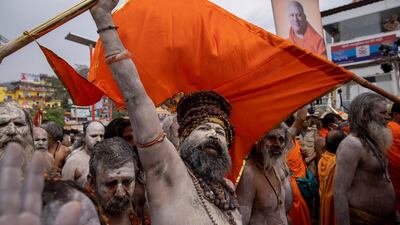
Naga Sadhus, or Hindu holy men, leave after taking a dip in the Ganges river during Shahi Snan at Kumbh Mela. Reuters -

Naga Sadhus, or Hindu holy men, leave after taking a dip in the Ganges river during Shahi Snan at Kumbh Mela. Reuters


This year the festival took place by the River Ganges in the state of Uttarakhand, which allowed millions of people to congregate by the river. An estimated 3.1 million people gathered in vast crowds on April 12, with a similar number attending again two days later.
The sight of enormous crowds without masks or maintaining appropriate physical distancing sparked fears that Kumbh Mela was a superspreader event.
Nearly 1,090 people tested positive for Covid-19 at the festival on April 13, and within days infections in Uttarakhand had jumped. Experts fear the real impact could be far higher, with infected pilgrims taking the virus back to their hometowns.
Despite the risks, the local government – run by Mr Modi’s BJP party – defended the event, with Uttarakhand chief minister Tirath Singh Rawat saying that “faith was stronger than fear”.
What is the Indian “double mutant” B.1.617 coronavirus variant?
While many blamed the large gatherings for the rise in case numbers, a potentially highly infectious "double mutant" variant of Covid-19 could also be driving the surge.
In March, India’s health ministry organised 10 national laboratories to carry out genomic sequencing – a process that maps out the entire genetic code of a virus to reveal mutations – on samples of Covid-19 found in the country.
The government said that the samples from Maharashtra showed a new variant of the virus that carried two mutations: E484Q and L452R. The two mutations were both found in the virus's spike protein – the part of the virus that helps it attach itself to human cells and cause infection.
Together, the double mutation is known as B.1.617 – or the Indian "double mutant" variant – and is feared to be more infectious than other Covid strains, perhaps with the potential to evade antibodies.
Scientists believe the double mutant strain could be behind the rapid rise in case numbets.
Gautam Menon, a professor and researcher on models of infectious diseases, told AFP that this double mutant was driving the surge in cases.
However, not enough samples of the B.1.617 strain have been sequenced to form a conclusive body of evidence, and experts do not yet know whether the strain is more infectious or responsible for the increase in case numbers.
What about the “triple mutant”?
This week, Indian media outlets reported the discovery of a “triple mutant” Covid-19 variant – a variant of B.1.617 with a third additional mutation.
According to media reports, the triple mutation was detected in Maharashtra, West Bengal and Delhi.
Not much is known about the reported triple mutant, which the government has classified as a “variant of interest.”
Which countries have banned travel to and flights from India in 2021?
India's soaring case numbers and fears over the "double mutant" strain led several countries to ban flights to and from India.
UK Prime Minister Boris Johnson cancelled his planned trip to India for the second time, saying it was "only sensible" to postpone.
Britain then added India to its red list of travel ban countries after it detected 103 cases of the Indian Covid-19 variant in the UK.
Japan's Prime Minister Yoshihide Suga also postponed his trip, scheduled for late April, and several other countries banned travel to and from India, most recently Oman.
While the US has not banned all travel to India outright, the Centres for Disease Control and Prevention told citizens to avoid travelling if possible.
“Travellers should avoid all travel to India. Even fully vaccinated travellers may be at risk for getting and spreading variants and should avoid all travel to India. If you must travel to India, get fully vaccinated before travel.”
Germany has also refrained from a complete ban on all travel to and from India, saying that it will shut out all travellers arriving from India apart from its own citizens.
"We're very worried about the new mutation of the virus discovered in India. So as not to endanger our vaccination programme, India travel has to be significantly limited," Health Minister Jens Spahn said.
Italy joined imposed a ban of arrivals from India on April 25. Health Minister Roberto Speranza said on Twitter he had signed an order barring foreigners who had been in India in the past 14 days from entering the country.
Italian residents will be allowed to return from India with a negative test result at their departure and one at their arrival and then have to go into quarantine, the minister said.
France is imposing similar restrictions. Travellers from India will need to pass an antigen test upon arrival, in addition to a pre-boarding PCR test, followed by a mandatory 10-day quarantine with police checks to ensure it is observed.
Australia said it would reduce the number of its citizens able to return from India to contain the risk of the more virulent Covid strains spreading. The restrictions will result in a 3 per cent reduction in direct flights from India to Sydney and chartered flights that land in the Northern Territory.
Countries that have restricted travel to and from India in 2021
- Italy
- Kuwait
- Iran
- Canada
- Hong Kong
- Italy
- New Zealand
- Oman
- Pakistan
- UK
- US
- Singapore
- United Arab Emirates
What happened to India’s vaccination drive, and how is the crisis affecting vaccines across the world?
India’s ambitious vaccination programme got off to a good start in January but has since lost momentum.
The country expanded the campaign to include people above the age of 45 on April 1, having previously restricted inoculations to the over-60s and people with serious health conditions.
As of April 21, more than 109 million people had received one dose, and more than 17 million had been fully vaccinated with two doses.
The government set an ambitious target of fully vaccinating 300 million people by August.
All adults over 18 will be eligible to receive a shot starting from May 1, despite reports that several states have had to slow down or pause their campaigns because of a shortage of vaccines.
The lack of available vaccines comes despite India being the world’s biggest vaccine manufacturer, responsible for exporting millions of vaccines to other countries. Critics say the government prioritises “vaccine diplomacy” over its own people, resulting in shortages at home.
But any change or slowdown in India’s vaccine exports, whether through disruption to production because of the virus or a shift in government policy, could cause major disruption to other vaccination drives around the world.
Dr Sarah Schiffling, a vaccine supply chain expert at Liverpool John Moores University, told The National that vaccine supply issues could have “huge repercussions” and cause a “scramble for some time to come”.
This could have a detrimental effect on the global Covax scheme responsible for distributing shots to developing countries. The organisation has received only 18.2 million doses of the more than 100 million it expected to receive from the Serum Institute of India between February and May.
Why are hospitals in India running short on oxygen?
Several Indian hospitals reported a lack of oxygen supplies, which are crucial to keeping severely ill Covid-19 patients alive.
Indian authorities previously said that several hospitals were at risk of potentially fatal issues over oxygen supplies.
Delhi chief minister Arvind Kejriwal tweeted on Tuesday that some hospitals in the capital "are left with just a few hours of oxygen".
Satyendar Jain, the health minister of the megacity of about 25 million inhabitants, urged the federal government to "restore [the] oxygen supply chain to avert a major crisis".
In Maharashtra and Mumbai, where case numbers rocketed, hospitals were also struggling for supplies, according to media reports.
"Normally we would shift some patients to other hospitals ... none in the city have spare oxygen," NDTV quoted one doctor in the state as saying.
The crisis claimed its first victims on Wednesday, when at least 22 Covid-19 patients died after an oxygen tank leaked at Zakir Hussain Hospital in Nashik.
Hospital beds are almost at full capacity, while a shortage of critical medicines triggered a black market in drugs.
As authorities and hospitals struggle to deal with the mounting crisis, Indians took to social media to plead for help in an increasingly dire situation.
Will the India Premier League schedule continue despite threats of lockdown?
Despite India experiencing its worst public health crisis for decades, the popular Indian Premier League cricket league is still taking place.
The league started on April 9 and features eight teams playing 60 games at six venues, including New Delhi and Mumbai, where infection numbers are high.
Although the games are being played behind closed doors, the eight team squads are allowed a maximum of 25 players each, with several hundred more made up by support staff, caterers, commentators, broadcasters, groundsmen and other roles.
IPL organisers said they are confident they can protect people through bubbles.
“We did it successfully in Dubai last year. We are confident we are going to do it again this time,” BCCI chief Sourav Ganguly told Reuters at the launch of the IPL.
But several prominent cricketers have since tested positive for the virus.
Despite the situation, Mr Modi urged states to avoid lockdowns if possible.
“In the current situation, we have to save the country from another lockdown,” he said on Tuesday. “I urge states only to use lockdowns as the last resort.”

