India reported a global record of more than 314,000 new Covid-19 infections on Thursday as a grim coronavirus surge in the world’s second-most populous country sends more and more sick people into a fragile healthcare system critically short of hospital beds and oxygen.
The 314,835 infections added in the past 24 hours take India’s total past 15.9 million cases since the pandemic began.
It is the second-highest total in the world next to the United States. India has nearly 1.4 billion people.
Fatalities rose by 2,104 in the past 24 hours, raising India’s overall death toll to 184,657, the Health Ministry said.
A large number of hospitals are reporting acute shortages of beds and medicine and are running on dangerously low levels of oxygen.
The New Delhi High Court on Wednesday ordered the government to divert oxygen from industrial use to hospitals to save people’s lives.
-

A pedestrian walks past a wall mural thanking frontline workers following restrictions imposed by the state government amidst rising Covid-19 coronavirus cases, in Mumbai. AFP -
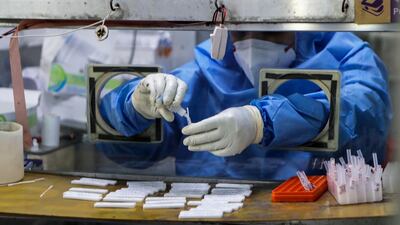
The country of almost 1.4 billion people is seeing a crippling surge of infections that are threatening to overwhelm hospitals in hard-hit cities. AP Photo -
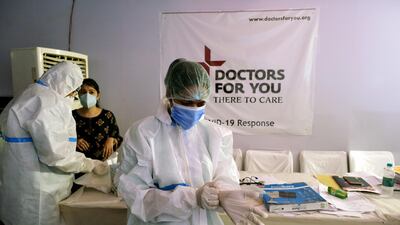
Health workers put on personal protective equipment prior to caring for patients at a makeshift Covid-19 quarantine facility set up in a banquet hall in New Delhi, India. Bloomberg -

A patient with breathing problems is wheeled inside a Covid-19 hospital for treatment in Ahmedabad, India. Reuters -
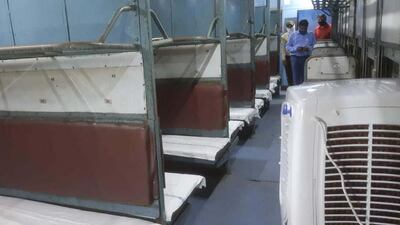
India's makeshift rail carriage hospitals. Courtesy Ministry of Railways -
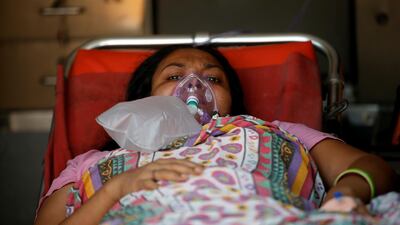
A patient wears an oxygen mask as she lies inside an ambulance waiting in a queue to enter a Covid-19 hospital in Ahmedabad, India. Reuters -
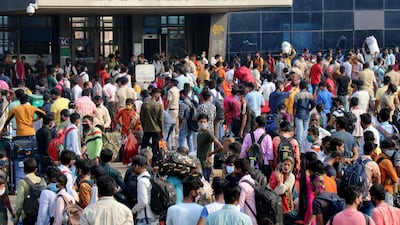
People wearing protective masks wait to enter the Lokmanya Tilak Terminus railway station in Mumbai, India. Reuters -
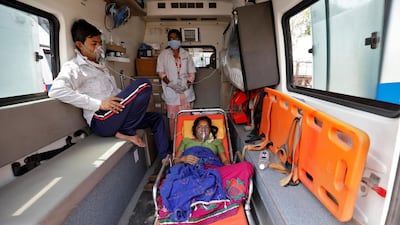
Patients wait inside an ambulance in a queue to enter a Covid-19 hospital amidst the coronavirus disease pandemic, Ahmedabad, India. Reuters -
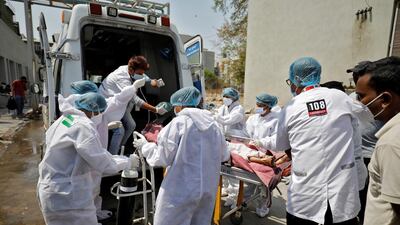
A patient with breathing problems is wheeled inside a Covid-19 hospital for treatment in Ahmedabad, India. Reuters -
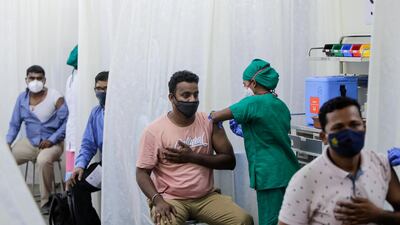
People are administered the Covid-19 vaccine in Mumbai, India. AP Photo -
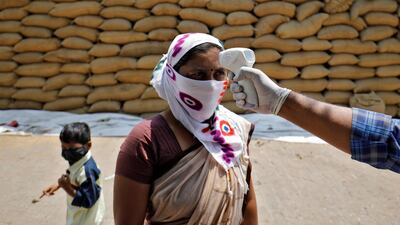
A healthcare worker checks the temperature of a rice mill worker during a coronavirus disease vaccination drive at Bavla village on the outskirts of Ahmedabad, India. Reuters -
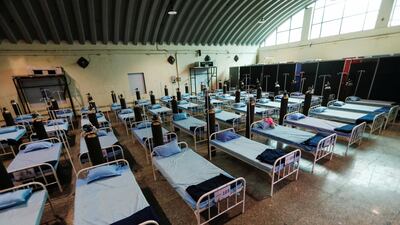
Beds with oxygen support are seen at a recently constructed quarantine facility for patients diagnosed with coronavirus disease in Mumbai, India. Reuters -
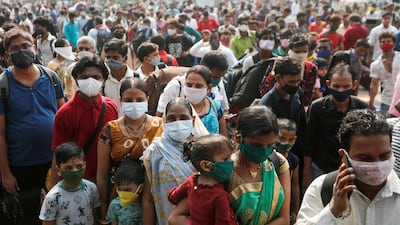
People wearing protective masks stand outside a railway station amidst the spread of the coronavirus disease (COVID-19), in Mumbai, India. Reuters


“You can’t have people die because there is no oxygen. Beg, borrow or steal, it is a national emergency,” the judges said, responding to a petition by a New Delhi hospital seeking a court intervention.
The government is rushing oxygen tankers to replenish supplies to hospitals.
India’s Health Minister Harsh Vardhan said on Thursday that “demand and supply is being monitored round the clock”.
He said in a tweet that to address the exponential surge in demand, the government had increased the quota of oxygen for the worst-hit seven states.
Lockdowns and strict curbs brought pain, fear and agony to many lives in New Delhi and other cities.
In scenes familiar across the country, ambulances were seen rushing from one hospital to another, trying to find an empty bed. Grieving relatives lined up outside crematoriums where the number of dead bodies arriving keeps growing.
arrival of dead bodies has jumped several times.
“I get numerous calls every day from patients desperate for a bed. The demand is far too much than the supply,” said Dr Sanjay Gururaj, a doctor at Bengaluru-based Shanti Hospital and Research Centre.
“I try to find beds for patients every day, and it’s been incredibly frustrating to not be able to help them. In the last week, three patients of mine have died at home because they were unable to get beds. As a doctor, it’s an awful feeling,” Dr Gururaj said.
Yogesh Dixit, a resident of northern Uttar Pradesh state, said earlier this week that he had to buy two oxygen cylinders at 12,000 rupees ($160) each, more than twice the normal cost, for his ailing father because the state-run hospital in Lucknow had run out of supplies.
He bought two “because the doctors can ask for another oxygen cylinder at any time,” he said, adding that he had to sell his wife’s jewellery to meet the cost.
The main cremation ground at Lucknow, the state capital, received nearly 200 bodies on Sunday.
“The bodies were everywhere, they were being cremated on sidewalks meant for walking. I have never such a flow of dead bodies in my life,” said Shekhar Chakraborty, 68.
In Kanpur, another city in Uttar Pradesh state, 35 new temporary platforms have been set up on Bithoor-Sidhnath Ghat stretch along Ganges River to cremate bodies.
The Health Ministry said that of the country’s total production of 7,500 metric tonnes of oxygen per day, 6,600 metric tonnes were being allocated for medical use.
It also said that 75 railroad coaches in the Indian capital have been turned into hospitals providing an additional 1,200 beds for Covid-19 patients.
The US set the previous daily record with 307,581 infections on January 8, the Times of India newspaper said.

