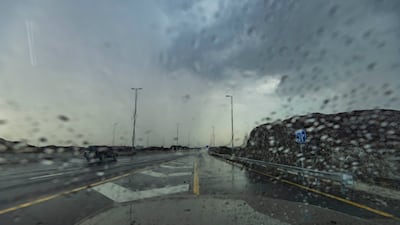

Abu Dhabi issued a weather warning on Monday as the country prepared for several days of heavy rain, hail and high winds.
The public was urged to “exercise caution” during spells of rain expected to persist until at least Friday.
Abu Dhabi Media Office said there could be “small hail in some limited areas” in the advisory, which covered Abu Dhabi, Al Ain and Al Dhafra.

The National Centre of Meteorology has forecast “rainfall of various intensities” in the capital, accompanied by strong winds which could cause dusty conditions.
People are urged to drive carefully, abide by any changes to speed limits and avoid valleys in the event of adverse weather.
The national weather centre called on people to “take all precautions” and to follow official guidance in the event of hail.
Northern and eastern areas of the UAE should expect clouds, rain and decreased visibility until Friday, the centre added.
Rain is expected in parts of Fujairah and Al Ain from Tuesday through the week. Residents and camels alike were seen enjoying the downpour in Ras Al Khaimah on Sunday, in a reprieve from the summer heat.
More rain to come
The forecast for the week predicts clouds over much of the country from Wednesday, with Dubai and Abu Dhabi expected to hit highs of 46°C.
Dust and sand whipped up by winds, which could hit 50kph on Wednesday and Thursday, may reduce visibility, and motorists are encouraged to be cautious on the roads.
Most humid time of year
Ibrahim Al Jarwan, chairman of the Emirates Astronomy Society, said the rise of the star Al Mirzam over the eastern horizon on Wednesday heralded the start of the final phase of the intense summer season.
“Humidity levels with temperatures begin to increase with the star’s appearance, while seasonal winds become more active, helping to form local connective clouds over the Hajar Mountains,” he said.
Humidity in the summer can reach 80 to 90 per cent, especially in coastal areas.
Scorching heat
On Saturday afternoon, temperatures exceeded 50°C in Al Shawamekh on the outskirts of Abu Dhabi, and the weather centre said in its monthly weather summary that August's average temperature would be 35.7°C, slightly above the typical figure for the month.
Due to the high temperatures, the UAE has enacted a midday break that prohibits outdoor work between 12.30pm and 3pm until September 15. This policy is enforced by the Ministry of Human Resources and Emiratisation.
Cloud seeding
The national weather centre recently announced that it had conducted 110 cloud seeding operations this year. Cloud seeding involves planes being sent into the sky equipped with salt flares, which are released into the clouds to cause rain.
It is a valuable tool against severe water scarcity, to recharge underground aquifers and support agriculture in one of the world's driest climates. On average, the UAE gets less than 100mm of natural rainfall per year.

