• A Sadhu bathes in the Ganges river during the ongoing religious Kumbh Mela festival, in Haridwar. AFP
    A Sadhu bathes in the Ganges river during the ongoing religious Kumbh Mela festival, in Haridwar. AFP
  • Devotees take holy dips in the Ganges River during Kumbh Mela, or pitcher festival, one of the most sacred pilgrimages in Hinduism, in Haridwar, northern state of Uttarakhand, India. AP
    Devotees take holy dips in the Ganges River during Kumbh Mela, or pitcher festival, one of the most sacred pilgrimages in Hinduism, in Haridwar, northern state of Uttarakhand, India. AP
  • Tens of thousands of Hindu devotees gathered by the Ganges River for special prayers on Monday, many of them flouting social distancing practices as the coronavirus spreads in India with record speed. AP
    Tens of thousands of Hindu devotees gathered by the Ganges River for special prayers on Monday, many of them flouting social distancing practices as the coronavirus spreads in India with record speed. AP
  • A Sadhu wearing a facemask takes a holy dip in the Ganges river during the ongoing religious Kumbh Mela festival in Haridwar. AFP
    A Sadhu wearing a facemask takes a holy dip in the Ganges river during the ongoing religious Kumbh Mela festival in Haridwar. AFP
  • A frontline worker sprays disinfectant on the hands of devotees, on the banks of the Ganges river during Kumbh Mela. Reuters
    A frontline worker sprays disinfectant on the hands of devotees, on the banks of the Ganges river during Kumbh Mela. Reuters
  • Devotees gather for an evening prayer on the banks of the Ganges river. Reuters
    Devotees gather for an evening prayer on the banks of the Ganges river. Reuters
  • Some on social media criticised the gathering at a time when India registered over 185,000 coronavirus cases in a day. Reuters
    Some on social media criticised the gathering at a time when India registered over 185,000 coronavirus cases in a day. Reuters
  • Many flouted social distancing practices as the coronavirus spreads in India with record speed. AP
    Many flouted social distancing practices as the coronavirus spreads in India with record speed. AP
  • Kumbh Mela is a mass Hindu pilgrimage which occurs after every twelve years and rotates among four locations Prayag (Allahabad) at the confluence of the Ganga and Yamuna and mythical Saraswati river, Haridwar along the Ganga river, Ujjain along the Kshipra river and Nashik along the Godavari river. EPA
    Kumbh Mela is a mass Hindu pilgrimage which occurs after every twelve years and rotates among four locations Prayag (Allahabad) at the confluence of the Ganga and Yamuna and mythical Saraswati river, Haridwar along the Ganga river, Ujjain along the Kshipra river and Nashik along the Godavari river. EPA
  • Naga Sadhus, or Hindu holy men, take a dip in the Ganges river during the second Shahi Snan at Kumbh Mela. Reuters
    Naga Sadhus, or Hindu holy men, take a dip in the Ganges river during the second Shahi Snan at Kumbh Mela. Reuters
  • Naga Sadhus, or Hindu holy men, leave after taking a dip in the Ganges river during Shahi Snan at Kumbh Mela. Reuters
    Naga Sadhus, or Hindu holy men, leave after taking a dip in the Ganges river during Shahi Snan at Kumbh Mela. Reuters
  • Naga Sadhus, or Hindu holy men, leave after taking a dip in the Ganges river during Shahi Snan at Kumbh Mela. Reuters
    Naga Sadhus, or Hindu holy men, leave after taking a dip in the Ganges river during Shahi Snan at Kumbh Mela. Reuters

Outrage as millions descend on Ganges despite pandemic


  • English
  • Arabic

Millions of pilgrims  plunged into the Ganges on Wednesday, sparking outrage at the government for allowing the massive Kumbh festival to go ahead while India is being hit by a second wave of coronavirus.

The world's largest religious gathering attracts millions of pilgrims from across the country who throng the northern city of Haridwar.

About 1.4 million pilgrims jostled for space on the banks of the river in a repeat of scenes witnessed on Monday, when 3.1 million devotees gathered to perform a bathing ritual in the city considered holy by Hindus.

Most pilgrims did not wear masks or observe social distancing measures introduced during the year-long fight against Covid-19.

The sight of thousands of naked and dreadlocked Hindu ascetics splashing in the fast-flowing water sparked fears among experts and ordinary citizens, who are accusing the government of glossing over an event that could fuel infection rates.

India has been hit hard by the pandemic and recently overtook Brazil for having the second-highest number of confirmed cases.

Social media users lashed out at Prime Minister Narendra Modi’s government, which also rules Uttarakhand state where the festival took place, for allowing the mammoth gathering despite warnings by federal officials that it could potentially become a “super-spreader” event.

"It is utterly nonsense and criminal to allow such a huge gathering during a pandemic. Who is responsible for the fallout?,” one Twitter user wrote.

Uttarakhand has already reported a sharp rise in new infections, with the state reporting a record 2,000 cases on Wednesday. More than 500 cases were detected in Haridwar city.

Nearly 1,090 people tested positive for Covid-19 at the festival on April 13.

Experts say the event could have a nationwide impact as pilgrims who converged in the city could take the virus back to small towns and villages across the country.

The Health Ministry on Wednesday said nearly 185,000 infections were recorded in the country, taking the total number of cases reported in India to 13.8 million.

More than 170,000 people have died, over 1,000 of them on Tuesday.

Several Indian states have imposed complete lockdowns, night curfews and other restrictions to curb transmission of Covid-19.

Many hospitals have reached breaking point and some crematoriums and morgues have run out of space.

But the local government defended the event, publishing full-page newspaper advertisements inviting the faithful to take part in the spiritual experience.

Uttarakhand Chief Minister Tirath Singh Rawat, who recovered from coronavirus last month, brushed aside the criticism and claimed that “faith was stronger than fear”.

“Nobody will be stopped in the name of Covid-19 as we are sure that faith in God will overcome the fear of the virus,” Mr Rawat said.

The state government made negative Covid-19 test certificates mandatory for the pilgrimage, but local media reported that most of the pilgrims broke the requirement.

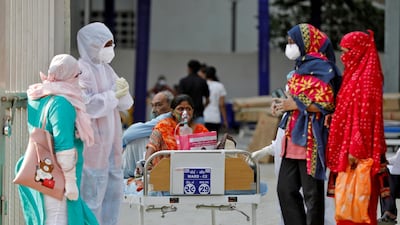
  • Patients sit on bed waiting to be moved to a hospital, amid the spread of the coronavirus disease in Ahmedabad, India. Reuters
    Patients sit on bed waiting to be moved to a hospital, amid the spread of the coronavirus disease in Ahmedabad, India. Reuters
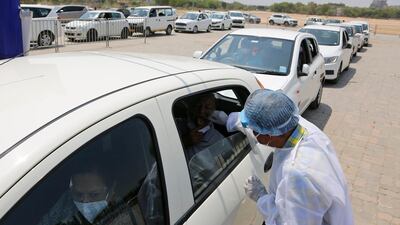
  • A health worker takes a swab sample to test for Covid-19 at a drive-through testing facility at GMDC ground in Ahmedabad, India. AP Photo
    A health worker takes a swab sample to test for Covid-19 at a drive-through testing facility at GMDC ground in Ahmedabad, India. AP Photo
  • People pray while attending a funeral service for a Covid-19 fatality at a burial ground in New Delhi, India. Bloomberg
    People pray while attending a funeral service for a Covid-19 fatality at a burial ground in New Delhi, India. Bloomberg
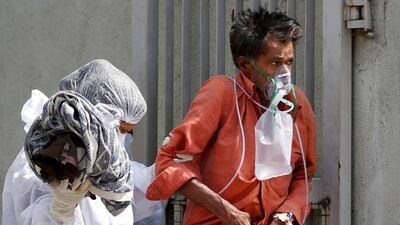
  • A patient with breathing problem is helped to walk towards an ambulance as he is being shifted to a hospital in Ahmedabad, India. Reuters
    A patient with breathing problem is helped to walk towards an ambulance as he is being shifted to a hospital in Ahmedabad, India. Reuters
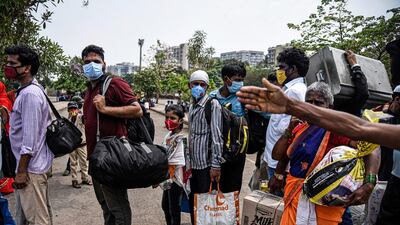
  • Migrant workers queue up to enter a railway station to leave the city ahead of a lockdown to slow the spread of Covid-19 in Mumbai, India. Getty Images
    Migrant workers queue up to enter a railway station to leave the city ahead of a lockdown to slow the spread of Covid-19 in Mumbai, India. Getty Images
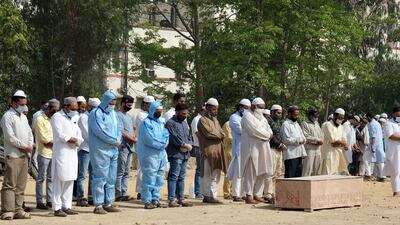
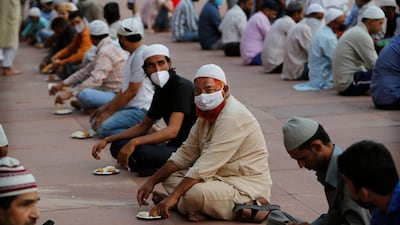
  • Muslims wearing masks as a precaution against the coronavirus wait to break fast on the first day of the holy month of Ramadan at the Jama Mosque, in New Delhi, India. AP Photo
    Muslims wearing masks as a precaution against the coronavirus wait to break fast on the first day of the holy month of Ramadan at the Jama Mosque, in New Delhi, India. AP Photo

Health officials said more than 300 out of 20,000 people were found to be infected during random testing of pilgrims in the area.

"We agree it is difficult to maintain social distancing here but we are following all the standard procedures and encouraging devotees to wear masks," Harbeer Singh, a member of the Kumbh organising committee told The National.

The event occurs every 12 years for about four months.

Hindus believe taking a dip in the Ganges during the festival cleanses them of their sins and brings an end to the cycle of life and death.

This year the government cut short the event to 30 days because of the pandemic, but jubilant crowds converged in the city.

India's railways even organised 25 special trains linking the city to various locations to enable the pilgrimage, while thousands of buses and private cars take the pilgrims to a 600-hectare festival area that is guarded by about 20,000 policemen.

People discussing the festival on social media drew parallels between the government’s facilitation of the Hindu festival and the incrimination of hundreds of Muslims after they were stranded at a complex in New Delhi last March.

Several high-ranking members of Mr Modi’s party falsely claimed that the Tablighi Jamaat missionaries were attempting to spread the virus as part of a conspiracy to harm the country.

Some in the right-wing Hindu leadership described the stranded Muslims as “human bombs”.

The government has been accused of treating Hindu and Muslim religious gatherings differently.

“There is a kind of duplicity with regards to Tablighi Jamaat,” said Dr Shah Alam, a professor of orthopaedics in New Delhi and a commentator on Muslim affairs.

“Kumbh is a poor public health policy decision and it will affect the population at large as the second wave is tenacious and brutal,” Dr Alam said.


What can victims do?

Always use only regulated platforms

Stop all transactions and communication on suspicion

Save all evidence (screenshots, chat logs, transaction IDs)

Report to local authorities

Warn others to prevent further harm

Courtesy: Crystal Intelligence

Monster Hunter: World

Capcom

PlayStation 4, Xbox One

COMPANY%20PROFILE
%3Cp%3E%3Cstrong%3ECompany%20name%3A%3C%2Fstrong%3E%20Revibe%20%0D%3Cbr%3E%3Cstrong%3EStarted%3A%3C%2Fstrong%3E%202022%0D%3Cbr%3E%3Cstrong%3EFounders%3A%3C%2Fstrong%3E%20Hamza%20Iraqui%20and%20Abdessamad%20Ben%20Zakour%20%0D%3Cbr%3E%3Cstrong%3EBased%3A%3C%2Fstrong%3E%20UAE%20%0D%3Cbr%3E%3Cstrong%3EIndustry%3A%3C%2Fstrong%3E%20Refurbished%20electronics%20%0D%3Cbr%3E%3Cstrong%3EFunds%20raised%20so%20far%3A%3C%2Fstrong%3E%20%2410m%20%0D%3Cbr%3E%3Cstrong%3EInvestors%3A%20%3C%2Fstrong%3EFlat6Labs%2C%20Resonance%20and%20various%20others%0D%3C%2Fp%3E%0A
The biog

Name: Ayisha Abdulrahman Gareb

Age: 57

From: Kalba

Occupation: Mukrema, though she washes bodies without charge

Favourite things to do: Visiting patients at the hospital and give them the support they need.
Role model: Sheikha Fatima bint Mubarak, Chairwoman of the General Women's Union, Supreme Chairwoman of the Family Development Foundation and President of the Supreme Council for Motherhood and Childhood.


ATP RANKINGS (NOVEMBER 4)

1. Rafael Nadal (ESP) 9,585 pts ( 1)
2. Novak Djokovic (SRB) 8,945 (-1)
3. Roger Federer (SUI) 6,190
4. Daniil Medvedev (RUS) 5,705
5. Dominic Thiem (AUT) 5,025
6. Stefanos Tsitsipas (GRE) 4,000 ( 1)
7. Alexander Zverev (GER) 2,945 (-1)
8. Matteo Berrettini (ITA) 2,670 ( 1)
9. Roberto Bautista (ESP) 2,540 ( 1)
10. Gaël Monfils (FRA) 2,530 ( 3)
11. David Goffin (BEL) 2,335 ( 3)
12. Fabio Fognini (ITA) 2,290
13. Kei Nishikori (JPN) 2,180 (-2)
14. Diego Schwartzman (ARG) 2,125 ( 1)
15. Denis Shapovalov (CAN) 2,050 ( 13)
16. Stan Wawrinka (SUI) 2,000
17. Karen Khachanov (RUS) 1,840 (-9)
18. Alex De Minaur (AUS) 1,775
19. John Isner (USA) 1,770 (-2)
20. Grigor Dimitrov (BUL) 1,747 ( 7)

How to apply for a drone permit
  • Individuals must register on UAE Drone app or website using their UAE Pass
  • Add all their personal details, including name, nationality, passport number, Emiratis ID, email and phone number
  • Upload the training certificate from a centre accredited by the GCAA
  • Submit their request
What are the regulations?
  • Fly it within visual line of sight
  • Never over populated areas
  • Ensure maximum flying height of 400 feet (122 metres) above ground level is not crossed
  • Users must avoid flying over restricted areas listed on the UAE Drone app
  • Only fly the drone during the day, and never at night
  • Should have a live feed of the drone flight
  • Drones must weigh 5 kg or less
Analysis

Members of Syria's Alawite minority community face threat in their heartland after one of the deadliest days in country’s recent history. Read more