



Swarms of drones able to pick out high-value targets and overwhelm enemy ground forces, unmanned stealth jets able to search out and engage enemy aircraft, all powered and directed by artificial intelligence — this isn't the stuff of sci-fi films but the next generation of weapons under development in a new race to dominate future battlefields.
But all of these high-tech systems, including many of the sophisticated weapons already in the arsenal of global powers, depend on tiny microchips.
Increasingly powerful, small and difficult to manufacture, the steady and secure supply of “leading-edge” microchips will determine which militaries dominate in the coming decades.
Falling behind the competition in microchip development or losing access to advanced chips entirely could spell disaster.
Georgetown University
This isn't only an issue for the future ― sanctions on Russia since the start of the invasion of Ukraine in February have drastically affected Moscow's ability to secure supplies of microchips.
The Russian military has started pulling apart civilian goods to cannibalise components such as microchips to build precision-guided missiles and drones, the Royal United Services Institute (Rusi), a UK-based defence think tank, said in an August report on the impact of sanctions.
But taking parts from items such as games consoles to source “dual use” chips for weapons, Rusi said, makes them far less reliable.
Meanwhile, Nato countries have maintained a steady supply of advanced weapons systems to the Ukrainian military.
Superpower competition for the best chips
For now, the US appears to have the edge in the high-tech race for microchips, but it has this primacy through alliances rather than domestic expertise.
Currently, the Dutch company ASML builds the most advanced machines for making leading-edge chips while the Taiwan Semiconductor Manufacturing Company (TSMC) is the biggest chip maker in the world. While both the Netherlands and Taiwan are US allies, neither are American firms.
TSMC can make tiny chips capable of running advanced artificial intelligence systems, powering super-advanced quantum computers or even controlling the next generation of weapons, including hypersonic aircraft that can fly over five times the speed of sound.
The US successfully pressured Taiwan into cutting supplies of these kinds of chips to both Russia and Chinese tech firms such as Huawei and research institutions including the China Aerodynamics Research and Development Centre.
But Russia and China are far from being out of the game.
That’s because most existing high-tech weapons do not yet need the most sophisticated chips necessary for top-spec AI applications. This gives countries and militaries time to invest in their own supplies.
-
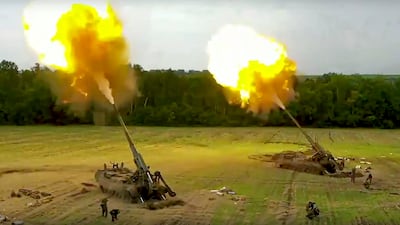
Russian Malka artillery systems are fired from an undisclosed location in Ukraine. AP -

German Chancellor Olaf Scholz visits a training ground for Ukrainian soldiers in Putlos near Oldenburg, Germany. AFP -
Ukrainian President Volodymyr Zelensky (R) hands The Order of Liberty medal to Boris Johnson in Kyiv. The UK Prime Minister visited on Ukraine’s Independence Day. AFP -

Destruction in Chaplyne, Dnipropetrovsk region. Reuters -

The UN Security Council votes on whether to allow Ukrainian President Volodymyr Zelenskyy to address the meeting via video link on threats to international peace and security. AP -

A pro-Ukrainian statue in Prague, Czech Republic. AP -

Krystyna Kopaczewska takes part in a Ukrainian Independence Day rally outside Downing Street in London. Reuters -

Firefighters work to extinguish flames at a shopping centre Galaktika after Russian shelling in Donetsk. Reuters -

Ukrainian servicemen fire at Russian positions in Kharkiv region. AP -

Destroyed Russian tanks and military equipment on Khreshchatyk, a street in central Kyiv, have been turned into an outdoor military museum. AFP


The best microchips in the world are the size of a thumbnail and made up of as many as 15 billion transistors ― tiny devices that send signals in a circuit. Each one is between 5 and 10-nanometres wide. By comparison, a single human hair is 100,000 nanometres wide.
The more transistors packed in a chip, the more powerful the processor. A chip with 15 billion transistors, for example, is able to carry out 15 trillion operations a second.
Apple’s A15 chip represents the peak of computer science and engineering, using the 5-nanometre process.
However, IBM said it has made experimental transistors with 2-nanometre transistors, thinner than a strand of DNA.
While these are the fastest and most complex, they’re not yet necessary for the majority of weapons systems.
“Most of the militaries operate on legacy chips, between 14 and 30-nanometre processes or even higher,” Charles Wessner, a research professor at Georgetown University who specialises in emerging technology, told The National.
“There’s a paradox where the chips in the leading weapons are not always leading chips.”
In 2018, TSMC began mass-producing 7-nanometre transistor chips and is already working on 3-nanometre chips for Apple, with products to feature them as soon as next year.
China has recently created a 7-nanometre chip with what analysts say is a basic prototype using last-generation “deep ultraviolet” lithography technology. However, it is unlikely Beijing can mass produce such densely packed chips.
This “deep ultraviolet” lithography process, which uses ultraviolet light to etch microchip patterns on to silicon, has been surpassed by a process known as extreme ultraviolet (EUV) lithography.
This EUV process is so difficult, many companies gave up until ASML made the breakthrough by using what the manufacturer called “the most precise mirrors in the world”. They currently hold a monopoly on the technique.
Today, TSMC uses EUV machines to supply Apple’s 5-nanometre transistor M1 chips for their latest MacBook laptops, iPad Pros and other top-of-the-range devices.
While the US has pressured TSMC and ASML not to sell their chips and machines to China and Russia, Washington has a critical dependence on the firms, which has left it scrambling to catch up.

In 1990, the US manufactured almost 40 per cent of the global supply of microchips. Today, it makes only 12 per cent.
However, US companies still design half the world’s chips — itself a highly complex process that requires powerful computer software — but manufacturing is often outsourced to the likes of TSMC.
This is, in part, because of their dominance but also that a new chip foundry can cost upwards of $10 billion to $15bn to build.
American firm Intel is one exception that has invested in domestic supply and hopes to start producing 7-nanometre chips next year.
South Korea’s Samsung, too, has long invested in development and is another leading-edge chip manufacturer. Both Samsung and TSMC are in the middle of a $100bn investment plan to secure their leading place in the industry.
Now, the US, European Union and China are trying to catch up.
In July 2022, the US Congress passed the Chips Act to provide a $50bn boost to home-grown microchip production in a bid to match the massive subsidies some of its foreign competitors offer their chip industries.
The EU is spending almost as much as the US to boost home-grown production.
The Chinese National Integrated Circuit Industry Investment Fund has pumped $100bn in subsidies into chip production and development. Currently, only 17 per cent of China’s chip demand is met domestically and only half of that production is carried out by Chinese-run firms.
But experts say there’s not going to be a clear “winner” from the spending bonanza anytime soon. This is because chip production depends on a global ecosystem of highly specialised expertise and supply chains rather than having a small number of firms able to dominate the entire process.
“The broad risk of the Chips Act is the complexity of the industry and just trying to bring these tremendously complicated supply chains back to the US,” Mr Wessner said.
“The device manufacturers are one part of that, but it's by no means the whole part.”
Taking tech by investment, force or subterfuge
Last month, the Special Competitive Studies Project, an organisation led by ex-Google chief executive Eric Schmidt, said that China could eventually turn the tables on the US and dominate the industry.
While it is investing heavily in the industry, some experts have also said that Beijing could blockade the industry’s key hub.
As Taiwan makes about 60 per cent of the world’s chips, a military crisis in the area such as a long-feared invasion or blockade could prove catastrophic for the global economy.
But, ultimately, experts said that the complex process of manufacturing and the global supply chain involved make it very hard to simply buy or steal dominance. Chips cannot simply be reverse engineered from stolen plans.
The Soviet Union learnt this the hard way. In the early 1980s, the CIA estimated that Moscow had obtained 2,500 machines needed for “the full spectrum” of microelectronic manufacturing.
But even with the equipment, it was unable to build competitive computers that at the time had only 5,000 transistors in the chips compared with the billions packed into today’s equivalents.
They still fell decades behind the West.
“If you steal a concept, if you steal a piece of intellectual property, it’s just a piece of the puzzle,” said Taipei-based industry analyst Jonathan, who goes only by his first name.
“In terms of a semiconductor manufacturing process and all the trade secrets behind it, it's just as important that you're able to have the whole process and have access to the best material and equipment.”
Jonathan’s father designed microchips in the 1960s and 70s, and he now documents the evolution of the microchip industry in his Asianometry podcast.
One aspect that’s hard to force is the human dynamic: Jonathan said that companies have formed close relationships over decades which is hard to manufacture quickly.
“In addition to a lot of tacit knowledge, there is the ability of TSMC or Intel or Samsung to work extremely closely with the best supplier in that particular field,” he said.
“They won't take calls from anyone, except the people they've intimately worked with because they already know those people are the experts in that particular field. So, you have these relationships that are very intimate and not exactly easy to break in.”
For example, ASML makes the most advanced machines for building microchips. German firm Carl Zeiss supplies the curved mirrors with atomic precision that project the extreme ultraviolet light. They are the only company able to make such precision mirrors.
ASML also needs the US firm Cymer and Germany’s Trumpf for specialised lasers.
Tech company IBM said the entire process of making their chips requires more than 1,000 steps.
This illustrates how simply knowing how ASML or TSMC makes their machines and chips doesn’t mean they can be copied.
Co-operation to create an ecosystem
Although ASML is TSMC’s main supplier, they also rely on co-operation with scientific institutes and universities in the US and Europe. TSMC also gets crucial materials and software from Japan and the US.
The industry is highly interconnected.
“There's certainly a movement with Japan, Korea, Taiwan, the US and Europe to collaborate more,” Mr Wessner said.
“Samsung and TSMC are both building major facilities in the US, but not at their most cutting-edge level of production. And that may be in part because of some of the talent challenges.
“They work really hard but that’s not describing the whole culture of Taiwan. I'm talking about TSMC’s culture, you know, that's really quite driven.”
Both Mr Wessner and Jonathan believe that while US companies such as Intel face massive hurdles bringing supply chains home, it could yet have the edge, in the long run — provided it remains open to close co-operation with international friends.
“I was asking the assistant of a German research minister what would they think if we managed to find a company that would refurbish a fab [chip foundry] in Ireland, build a test and assembly facility in Italy and build a research facility in France and build a huge fab in Germany. Well, that's what Intel is doing. So, it's just a whole breath of fresh air into the semiconductor ecosystem.”
So, where does that leave the US in seeking resilience and avoiding a scenario such as that of Russia, which has lost access to chips at a crucial time?
“I don't necessarily see a situation in the United States where they suddenly lose access,” Jonathan said.
But domestically, competing with Taiwan is still a tall order.
“For us to bring this back to America, I wouldn't say it's impossible,” he said.
“The question is whether it is commercially competitive in a situation where TSMC is building five fabs a year over the next four years. I don't see that as commercially competitive in the US.”
But China faces the same hurdles.
“Chinese hardware in semiconductor manufacturing isn't quite there yet either. Especially when it comes to AI chips and GPUs — very few companies are capable of making those.”

