• Uranus is surrounded by 13 rings and 27 small moons as it rotates at a nearly 90-degree angle from the plane of its orbit. Photo: Nasa
    Uranus is surrounded by 13 rings and 27 small moons as it rotates at a nearly 90-degree angle from the plane of its orbit. Photo: Nasa
  • Complex organic molecules similar to smoke or smog in a galaxy more than 12 billion light-years from Earth. Photo: Nasa
    Complex organic molecules similar to smoke or smog in a galaxy more than 12 billion light-years from Earth. Photo: Nasa
  • A delicate image of dust structures and bright star clusters taken by the James Webb Space Telescope. Photo: Nasa
    A delicate image of dust structures and bright star clusters taken by the James Webb Space Telescope. Photo: Nasa
  • Saturn has seven rings with several gaps and divisions between them, as well as 53 known moons. Photo: Nasa
    Saturn has seven rings with several gaps and divisions between them, as well as 53 known moons. Photo: Nasa
  • Star cluster NGC 346, spiral galaxies NGC 1672 and Messier 74, and the Pillars of Creation, towering tendrils of cosmic dust and gas at the heart of the Eagle Nebula. Photo: Nasa
    Star cluster NGC 346, spiral galaxies NGC 1672 and Messier 74, and the Pillars of Creation, towering tendrils of cosmic dust and gas at the heart of the Eagle Nebula. Photo: Nasa
  • An infrared image of Neptune, the only planet in our solar system not visible to the naked eye. Photo: Nasa
    An infrared image of Neptune, the only planet in our solar system not visible to the naked eye. Photo: Nasa
  • Every eight years, the two stars in this image are brought together by their orbits – creating colliding streams of gas that, under the right conditions, form a new ring of dust. Photo: Nasa
    Every eight years, the two stars in this image are brought together by their orbits – creating colliding streams of gas that, under the right conditions, form a new ring of dust. Photo: Nasa
  • A part of the Orion Nebula known as the Orion Bar. Photo: Nasa
    A part of the Orion Nebula known as the Orion Bar. Photo: Nasa
  • A crowded field of galaxies, along with stars crowned with the James Webb Space Telescope's signature six-pointed diffraction spikes. Photo: Nasa
    A crowded field of galaxies, along with stars crowned with the James Webb Space Telescope's signature six-pointed diffraction spikes. Photo: Nasa
  • The NGC 3256 spiral galaxy was formed after a collision of two massive galaxies about 500 million years ago. Photo: Nasa
    The NGC 3256 spiral galaxy was formed after a collision of two massive galaxies about 500 million years ago. Photo: Nasa
  • The Wolf-Rayet 124 star, featured in an image combining near-infrared and mid-infrared wavelengths of light. Photo: Nasa
    The Wolf-Rayet 124 star, featured in an image combining near-infrared and mid-infrared wavelengths of light. Photo: Nasa
  • An hourglass-shaped cloud of dust and gas is illuminated by light from a protostar. Photo: Nasa
    An hourglass-shaped cloud of dust and gas is illuminated by light from a protostar. Photo: Nasa
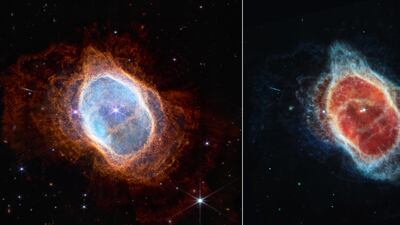
  • Two views of the Southern Ring Nebula, which show the planetary nebula as a misshapen oval. Photo: Nasa
    Two views of the Southern Ring Nebula, which show the planetary nebula as a misshapen oval. Photo: Nasa
  • A composite image of the Cartwheel Galaxy captured by the James Webb Space Telescope in August 2022. AFP
    A composite image of the Cartwheel Galaxy captured by the James Webb Space Telescope in August 2022. AFP
  • A cluster of stars in the Small Magellanic Cloud, near the Milky Way. Photo: JWST
    A cluster of stars in the Small Magellanic Cloud, near the Milky Way. Photo: JWST
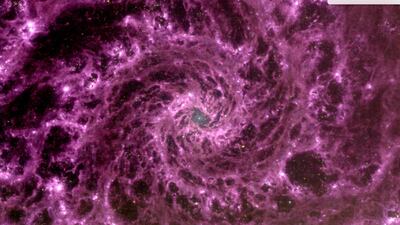
  • A colour composite image of the Messier 74 galaxy. Photo: JWST
    A colour composite image of the Messier 74 galaxy. Photo: JWST
  • The gravity of galaxy cluster MACS0647 bends and magnifies light from the more distant MACS0647-JD. Photo: Nasa
    The gravity of galaxy cluster MACS0647 bends and magnifies light from the more distant MACS0647-JD. Photo: Nasa
  • The 'Pillars of Creation' — clouds of hydrogen gas and dust 6,500 light years from Earth — captured by the Hubble Space Telescope, left, and James Webb Space Telescope. AP
    The 'Pillars of Creation' — clouds of hydrogen gas and dust 6,500 light years from Earth — captured by the Hubble Space Telescope, left, and James Webb Space Telescope. AP
  • Dust rings resembling a fingerprint created by a rare type of star and its companion. PA
    Dust rings resembling a fingerprint created by a rare type of star and its companion. PA
  • Images of the asteroid Dimorphos hours after Nasa crashed a spacecraft into it in September 2022. EPA
    Images of the asteroid Dimorphos hours after Nasa crashed a spacecraft into it in September 2022. EPA
  • Neptune and seven of its 14 known moons. AFP
    Neptune and seven of its 14 known moons. AFP
  • Thousands of young stars in a stellar nursery called the Tarantula Nebula. Photo: Nasa
    Thousands of young stars in a stellar nursery called the Tarantula Nebula. Photo: Nasa
  • A image of an exoplanet — a gas giant with no rocky surface. Photo: Nasa, ESA and CSA
    A image of an exoplanet — a gas giant with no rocky surface. Photo: Nasa, ESA and CSA
  • Glass-z13, the oldest galaxy to be detected, was formed about 300 million years after the Big Bang. Photo: JWST
    Glass-z13, the oldest galaxy to be detected, was formed about 300 million years after the Big Bang. Photo: JWST
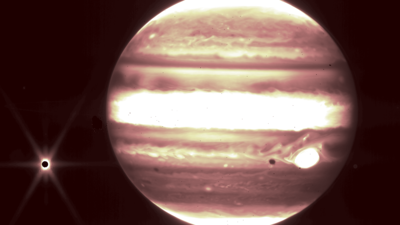
  • Jupiter and its moon Europa. Photo: Nasa
    Jupiter and its moon Europa. Photo: Nasa
  • Jupiter and its moons Europa, Thebe and Metis. Photo: Nasa
    Jupiter and its moons Europa, Thebe and Metis. Photo: Nasa
  • Another image of Jupiter and some of its 79 moons. Photo: Nasa
    Another image of Jupiter and some of its 79 moons. Photo: Nasa
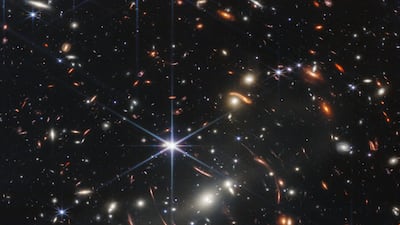
  • An image of galaxy cluster Smacs 0723 taken by the James Webb telescope. Photo: Nasa
    An image of galaxy cluster Smacs 0723 taken by the James Webb telescope. Photo: Nasa
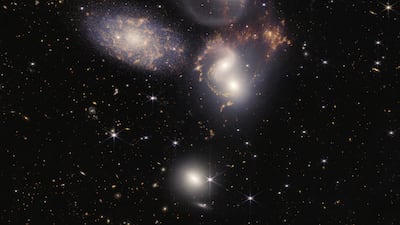
  • Stephan’s Quintet is an area in space that has five galaxies. Photo: JWST
    Stephan’s Quintet is an area in space that has five galaxies. Photo: JWST
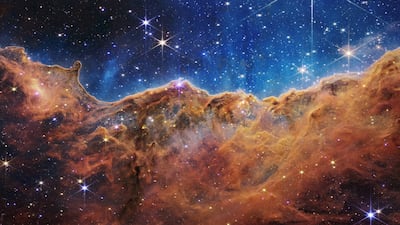
  • The 'Cosmic Cliffs' of the Carina Nebula. Photo: JWST
    The 'Cosmic Cliffs' of the Carina Nebula. Photo: JWST
  • An anniversary image shows the birth of a star in the Rho Ophiuchi cloud complex, the closest star-forming region to Earth. Photo: Nasa
    An anniversary image shows the birth of a star in the Rho Ophiuchi cloud complex, the closest star-forming region to Earth. Photo: Nasa

Huge 'space tarantula’ caught by James Webb Space Telescope


Sarwat Nasir
  • English
  • Arabic

The James Webb Space Telescope continues to capture weird and wonderful objects in space and its latest observation is no less fascinating ― a star-forming region that is shaped like a tarantula.

Thousands of never-before-seen young stars have been spotted in the stellar nursery called 30 Doradus.

The nursery has been nicknamed the Tarantula Nebula because of its appearance.

A nebula is an enormous cloud of dust and gas occupying the space between stars and acting as a nursery for new stars.

Nasa released the image on Tuesday and said that the nebula is a favourite for astronomers who study star formation.

“At only 161,000 light years away in the Large Magellanic Cloud galaxy [a satellite galaxy of the Milky Way], the Tarantula Nebula is the largest and brightest star-forming region in the local group, the galaxies nearest our Milky Way,” the US space agency said.

“It is home to the hottest, most massive stars known.

“In addition to young stars, Webb reveals distant background galaxies, as well as the detailed structure and composition of the nebula’s gas and dust.”

  • A colour composite image of the Messier 74 galaxy. Photo: Gabriel Brammer (Cosmic Dawn Center, Niels Bohr Institute, University of Copenhagen) / James Webb Space Telescope
    A colour composite image of the Messier 74 galaxy. Photo: Gabriel Brammer (Cosmic Dawn Center, Niels Bohr Institute, University of Copenhagen) / James Webb Space Telescope
  • Jupiter and its moon Europa, left, are seen through the James Webb Space Telescope. Photo: Nasa
    Jupiter and its moon Europa, left, are seen through the James Webb Space Telescope. Photo: Nasa
  • Captured in infrared light by Nasa's new James Webb Space Telescope, this image reveals areas of star birth in Carina Nebula. All photos: James Webb Space Telescope
    Captured in infrared light by Nasa's new James Webb Space Telescope, this image reveals areas of star birth in Carina Nebula. All photos: James Webb Space Telescope
  • Known as Webb's First Deep Field, the picture showcases a galaxy cluster called SMACS 0723 as it appeared 4.6 billion years ago. The image was revealed by US President Joe Biden on July 11 during an event at the White House.
    Known as Webb's First Deep Field, the picture showcases a galaxy cluster called SMACS 0723 as it appeared 4.6 billion years ago. The image was revealed by US President Joe Biden on July 11 during an event at the White House.
  • An image of Stephan's Quintet, an area in space with a group of five galaxies.
    An image of Stephan's Quintet, an area in space with a group of five galaxies.
  • Side-by-side comparison shows observations of the Southern Ring Nebula in near-infrared light (left) and mid-infrared light.
    Side-by-side comparison shows observations of the Southern Ring Nebula in near-infrared light (left) and mid-infrared light.
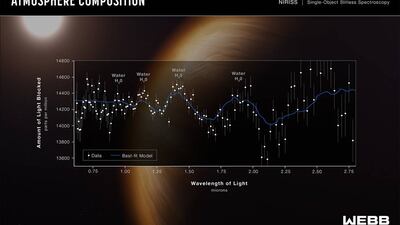
  • The telescope has captured the distinct signature of water, along with evidence for clouds and haze, in the atmosphere surrounding a hot, puffy gas giant planet orbiting a distant Sun-like star, called WASP-96 b. Photo: James Webb Space Telescope
    The telescope has captured the distinct signature of water, along with evidence for clouds and haze, in the atmosphere surrounding a hot, puffy gas giant planet orbiting a distant Sun-like star, called WASP-96 b. Photo: James Webb Space Telescope

The pale blue area sparkling in the image is a cluster of massive young stars.

These stars were difficult to spot before because they were hidden behind cosmic dust. But with the Webb telescope's infrared camera, an instrument that captures radiant energy invisible to the human eye, the stars were spotted for the first time.

Nasa said one of the reasons this nebula is interesting to astronomers is because it has a similar type of chemical composition as the enormous star-forming regions observed at the universe’s "cosmic noon" ― when the cosmos was only a few billion years old and star formation was at its peak.

“Star-forming regions in our Milky Way galaxy are not producing stars at the same furious rate as the Tarantula Nebula, and have a different chemical composition,” Nasa said.

“This makes the Tarantula the closest example of what was happening in the universe as it reached its brilliant high noon.

“Webb will provide astronomers the opportunity to compare and contrast observations of star formation in the Tarantula Nebula with the telescope’s deep observations of distant galaxies from the actual era of cosmic noon.”

The $10 billion space telescope was launched on Christmas Day, 2021, to observe distant worlds, capture the first galaxies after the Big Bang and study the atmosphere of planets outside our solar system.

It is the world's most powerful telescope and is helping reveal the mysteries of the universe.

Updated: September 07, 2022, 8:51 AM