A military team leader practises firing a Stinger missile, but for how much longer will they be supplied to Ukraine? Photo: US Army

Stinger missiles: US seeks to upgrade supply of lethal weapons for Ukraine


  • English
  • Arabic

A supply of deadly shoulder-launched Stinger missiles for Ukraine may be in doubt after Raytheon, the company that produces the weapon, limited production to purchased exports, the Pentagon has said.

The move has put the number of Stingers available for donation to Ukraine in question.

A limited number of Stingers — which can seek enemy helicopters, drones and even missiles at three times the speed of sound, are being kept in service to protect US forces overseas.

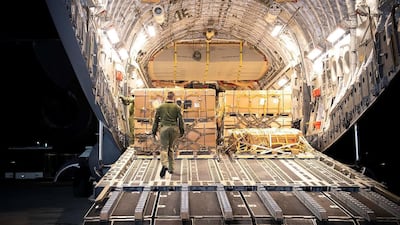
  • Workers unloading a Royal Canadian Air Force military transport plane to assist Ukraine at Lviv airport. AFP
    Workers unloading a Royal Canadian Air Force military transport plane to assist Ukraine at Lviv airport. AFP
  • A new member of the Territorial Defence Forces trains to operate an AT4 anti-tank launcher in Kyiv. Reuters
    A new member of the Territorial Defence Forces trains to operate an AT4 anti-tank launcher in Kyiv. Reuters
  • A plane loaded with military equipment for Ukrainian forces takes off from Albacete, Spain. EPA
    A plane loaded with military equipment for Ukrainian forces takes off from Albacete, Spain. EPA
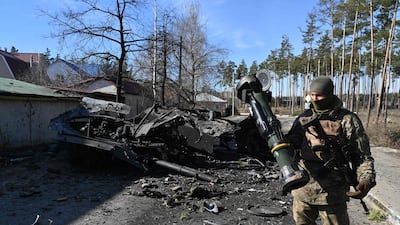
  • A Ukrainian soldier holds a Next Generation Light Anti-tank Weapon used to destroy a Russian armoured personal carrier in Irpin, north of Kyiv. AFP
    A Ukrainian soldier holds a Next Generation Light Anti-tank Weapon used to destroy a Russian armoured personal carrier in Irpin, north of Kyiv. AFP
  • A Ukrainian serviceman with a Javelin missile system on the front line near Kyiv. Reuters
    A Ukrainian serviceman with a Javelin missile system on the front line near Kyiv. Reuters
  • A soldier holds a Panzerfaust 3 anti-tank rocket launcher at the Munster military training area in Germany in 2016. Getty Images
    A soldier holds a Panzerfaust 3 anti-tank rocket launcher at the Munster military training area in Germany in 2016. Getty Images
  • A US Marine Corps staff sergeant aims a M72 Light Anti-tank Weapon. Photo: US National Archives
    A US Marine Corps staff sergeant aims a M72 Light Anti-tank Weapon. Photo: US National Archives
  • The Switchblade is a camera-equipped, remote-controlled flying bomb with a reputation for pinpoint delivery. AP Photo
    The Switchblade is a camera-equipped, remote-controlled flying bomb with a reputation for pinpoint delivery. AP Photo
  • A coalition forces member fires a Carl Gustav recoilless rifle system during weapons practice on a range in Helmand province, Afghanistan, in 2013. US Army Photo
    A coalition forces member fires a Carl Gustav recoilless rifle system during weapons practice on a range in Helmand province, Afghanistan, in 2013. US Army Photo
  • A Starstreak surface-to-air missile system. PA
    A Starstreak surface-to-air missile system. PA

The main problem with supply is that the missile was on the verge of being phased out by the US as the Ukraine crisis unfolded.

Stingers, of which the US has supplied 1,400 to Ukraine, rose to prominence in 1986 when they were supplied to Afghan resistance fighters, who used them against invading Soviet forces to great effect, forcing Russian aircraft to fly at high altitude, reducing the accuracy of their attacks.

Russian air losses — especially of helicopters — suggest the weapon is being used to deadly effect in Ukraine.

But while improvements have been made to the portable missile, the US military had decided before the Ukraine war to phase it out.

There is a reluctance among US defence officials to shift limited manufacturing resources to a weapon that could soon be obsolete in favour of a more advanced replacement, Reuters has learnt.

The US also needs to keep some stock to defend its own forces until a replacement system is in use — Stingers can be quickly deployed to counter threats for what the US military classes as short-range engagements — to take out low-flying helicopters and drones as they appear over the horizon.

In war zones such as Iraq, where drones have become an increasing threat, some of these stocks could be needed.

Replacing Stingers

"Right before Ukraine hit, we were going to divest ourselves of Stingers," a congressional source said. Still, US defence authorities are concerned about a "dwindling" surplus, according to one Pentagon official and the congressional source.

Ukrainian troops have shot down at least six targets during the conflict using Lithuanian-provided Stingers, according to a Facebook post April 6 by Arvydas Anusauskas, Lithuania's Defence Minister, including helicopters, planes, drones and a cruise missile. The claim has not yet been verified.

The Stinger production line was closed in December 2020, said Pentagon representative Jessica Maxwell. Raytheon Technologies won a contract in July 2021 to manufacture more Stingers but mainly for international governments, the US Army said. The sole Stinger plant, in Arizona, produces at a low rate.

The Pentagon has not ordered new Stingers for many years but has called for parts or made other efforts to increase its supply.

For example, the army is in the midst of a "service life extension plan" for some of its Stingers that were to become obsolete in 2023 and is extending what the military calls their "useful life" until 2030.

The Pentagon, which has thrown together weekly meetings to discuss surging weapons demand from Eastern Europe, met a group of eight defence contractor chiefs in mid-April to discuss the supply to Ukraine, including the Stinger.

Two sources familiar with the meeting said Raytheon chief executive Greg Hayes noted that it can require six to 12 months to restart a munitions production line.

Raytheon declined to comment.

At the meeting, industry executives voiced reservations about increasing weapons production. One chief executive said that when the Ukraine war winds down, they do not want to be stuck with warehouses full of unsaleable inventory without a guaranteed buyer, three sources familiar with the discussion said.

Congress also wants more Stingers, or at least a similar weapons that perform the same job.

The chairman of the House of Representatives Armed Services Committee, Representative Adam Smith, wrote to Secretary of Defence Lloyd Austin last week and pointed out an "apparent absence of a Department of Defence plan to meet short-range air defence replenishment requirements for not only our US stocks of Stinger systems, but those of other contributing allies and partners".

Doug Bush, a Pentagon official who oversees weapons acquisitions for the army, told Congress on March 31 that the Defence Department was putting together a plan to increase Stinger production and intended to inform Congress imminently.

But as of late last week, a second congressional source who spoke on condition of anonymity said there has been no information about the plan to date.

Senator Richard Blumenthal, a member of the Senate's Committee on Armed Services, this month asked Gen Austin at a Senate budget hearing about using the Defence Production Act to restore depleted supplies of Stingers and Javelins.

But using the DPA, which forces the industry to put resources into an immediate effort to make a product needed for national security purposes, is premature, the Ms Maxwell said.

Longer term, the US Army is looking for a replacement for the Stinger that will go into production in 2027.


Top 10 most polluted cities
  1. Bhiwadi, India
  2. Ghaziabad, India
  3. Hotan, China
  4. Delhi, India
  5. Jaunpur, India
  6. Faisalabad, Pakistan
  7. Noida, India
  8. Bahawalpur, Pakistan
  9. Peshawar, Pakistan
  10. Bagpat, India
Company%20profile
%3Cp%3E%3Cstrong%3ECompany%3A%20%3C%2Fstrong%3EPOPC%3Cbr%3E%3Cstrong%3EStarted%3A%20%3C%2Fstrong%3E2022%3Cbr%3E%3Cstrong%3EFounders%3A%20%3C%2Fstrong%3EAmna%20Aijaz%2C%20Haroon%20Tahir%20and%20Arafat%20Ali%20Khan%3Cbr%3E%3Cstrong%3EBased%3A%3C%2Fstrong%3E%20Dubai%2C%20UAE%3Cbr%3E%3Cstrong%3EIndustry%3A%20%3C%2Fstrong%3Eart%20and%20e-commerce%3Cbr%3E%3Cstrong%3EFunds%20raised%3A%20u%3C%2Fstrong%3Endisclosed%20amount%20raised%20through%20Waverider%20Entertainment%3C%2Fp%3E%0A
FA%20Cup%20semi-final%20draw
%3Cp%3ECoventry%20City%20v%20Manchester%20United%C2%A0%3C%2Fp%3E%0A%3Cp%3EManchester%20City%20v%20Chelsea%3C%2Fp%3E%0A%3Cp%3E-%20Games%20to%20be%20played%20at%20Wembley%20Stadium%20on%20weekend%20of%20April%2020%2F21.%C2%A0%3C%2Fp%3E%0A
Some of Darwish's last words

"They see their tomorrows slipping out of their reach. And though it seems to them that everything outside this reality is heaven, yet they do not want to go to that heaven. They stay, because they are afflicted with hope." - Mahmoud Darwish, to attendees of the Palestine Festival of Literature, 2008

His life in brief: Born in a village near Galilee, he lived in exile for most of his life and started writing poetry after high school. He was arrested several times by Israel for what were deemed to be inciteful poems. Most of his work focused on the love and yearning for his homeland, and he was regarded the Palestinian poet of resistance. Over the course of his life, he published more than 30 poetry collections and books of prose, with his work translated into more than 20 languages. Many of his poems were set to music by Arab composers, most significantly Marcel Khalife. Darwish died on August 9, 2008 after undergoing heart surgery in the United States. He was later buried in Ramallah where a shrine was erected in his honour.

The%20team
%3Cp%3E%0DFashion%20director%3A%20Sarah%20Maisey%0D%3Cbr%3EPhotographer%3A%20Greg%20Adamski%0D%3Cbr%3EHair%20and%20make-up%3A%20Ania%20Poniatowska%0D%3Cbr%3EModels%3A%20Nyajouk%20and%20Kristine%20at%20MMG%2C%20and%20Mitchell%0D%3Cbr%3EStylist%E2%80%99s%20assistants%3A%20Nihala%20Naval%20and%20Sneha%20Maria%20Siby%0D%3Cbr%3EVideographer%3A%20Nilanjana%20Gupta%3C%2Fp%3E%0A
Company%20Profile
%3Cp%3E%3Cstrong%3EName%3A%3C%2Fstrong%3E%20Neo%20Mobility%3Cbr%3E%3Cstrong%3EStarted%3A%3C%2Fstrong%3E%20February%202023%3Cbr%3E%3Cstrong%3ECo-founders%3A%3C%2Fstrong%3E%20Abhishek%20Shah%20and%20Anish%20Garg%3Cbr%3E%3Cstrong%3EBased%3A%3C%2Fstrong%3E%20Dubai%3Cbr%3E%3Cstrong%3EIndustry%3A%3C%2Fstrong%3E%20Logistics%3Cbr%3E%3Cstrong%3EFunding%3A%3C%2Fstrong%3E%20%2410%20million%3Cbr%3E%3Cstrong%3EInvestors%3A%3C%2Fstrong%3E%20Delta%20Corp%2C%20Pyse%20Sustainability%20Fund%2C%20angel%20investors%3C%2Fp%3E%0A
The specs

Engine: 1.5-litre turbo

Power: 181hp

Torque: 230Nm

Transmission: 6-speed automatic

Starting price: Dh79,000

On sale: Now

EA Sports FC 26

Publisher: EA Sports

Consoles: PC, PlayStation 4/5, Xbox Series X/S

Rating: 3/5

Mercer, the investment consulting arm of US services company Marsh & McLennan, expects its wealth division to at least double its assets under management (AUM) in the Middle East as wealth in the region continues to grow despite economic headwinds, a company official said.

Mercer Wealth, which globally has $160 billion in AUM, plans to boost its AUM in the region to $2-$3bn in the next 2-3 years from the present $1bn, said Yasir AbuShaban, a Dubai-based principal with Mercer Wealth.

Within the next two to three years, we are looking at reaching $2 to $3 billion as a conservative estimate and we do see an opportunity to do so,” said Mr AbuShaban.

Mercer does not directly make investments, but allocates clients’ money they have discretion to, to professional asset managers. They also provide advice to clients.

“We have buying power. We can negotiate on their (client’s) behalf with asset managers to provide them lower fees than they otherwise would have to get on their own,” he added.

Mercer Wealth’s clients include sovereign wealth funds, family offices, and insurance companies among others.

From its office in Dubai, Mercer also looks after Africa, India and Turkey, where they also see opportunity for growth.

Wealth creation in Middle East and Africa (MEA) grew 8.5 per cent to $8.1 trillion last year from $7.5tn in 2015, higher than last year’s global average of 6 per cent and the second-highest growth in a region after Asia-Pacific which grew 9.9 per cent, according to consultancy Boston Consulting Group (BCG). In the region, where wealth grew just 1.9 per cent in 2015 compared with 2014, a pickup in oil prices has helped in wealth generation.

BCG is forecasting MEA wealth will rise to $12tn by 2021, growing at an annual average of 8 per cent.

Drivers of wealth generation in the region will be split evenly between new wealth creation and growth of performance of existing assets, according to BCG.

Another general trend in the region is clients’ looking for a comprehensive approach to investing, according to Mr AbuShaban.

“Institutional investors or some of the families are seeing a slowdown in the available capital they have to invest and in that sense they are looking at optimizing the way they manage their portfolios and making sure they are not investing haphazardly and different parts of their investment are working together,” said Mr AbuShaban.

Some clients also have a higher appetite for risk, given the low interest-rate environment that does not provide enough yield for some institutional investors. These clients are keen to invest in illiquid assets, such as private equity and infrastructure.

“What we have seen is a desire for higher returns in what has been a low-return environment specifically in various fixed income or bonds,” he said.

“In this environment, we have seen a de facto increase in the risk that clients are taking in things like illiquid investments, private equity investments, infrastructure and private debt, those kind of investments were higher illiquidity results in incrementally higher returns.”

The Abu Dhabi Investment Authority, one of the largest sovereign wealth funds, said in its 2016 report that has gradually increased its exposure in direct private equity and private credit transactions, mainly in Asian markets and especially in China and India. The authority’s private equity department focused on structured equities owing to “their defensive characteristics.”

Updated: April 26, 2022, 11:45 AM