


Russia is sending an unspecified number of troops from the country’s far east to Belarus for major war games, officials said on Tuesday, a deployment that will further beef up Russian military presence near Ukraine amid western fears of a planned invasion.
With tensions soaring, the White House said Russia could attack its neighbour at “any point,” while the UK delivered a batch of anti-tank weapons to Ukraine.
Alexander Fomin, Russia’s deputy defence minister, said the joint drills with Belarus would involve practising a joint response to external threats.
Ukrainian officials said Russia could launch an attack on Ukraine from several directions, including from its ally Belarus.
The US again stressed its concern on Tuesday, with White House press secretary Jen Psaki describing the Russian forces’ move into Belarus as part of an “extremely dangerous situation”.
“We’re now at a stage where Russia could at any point launch an attack in Ukraine,” Ms Psaki said.
US Secretary of State Antony Blinken will meet his Russian counterpart Sergey Lavrov in Geneva on Friday in another attempt to defuse the crisis.
Ukraine’s Defence Ministry said on Tuesday it has received a shipment of anti-tank weapons from the UK, noting they will help “strengthen our defence capability”.
Mr Fomin said it would take until February 9 to fully deploy weapons and personnel for the Allied Resolve 2022 drills, which are expected to take place from February 10 to 20.
Mr Fomin didn’t say how many troops will be involved, but mentioned Russia will deploy a dozen Su-35 fighter jets and several air defence units to Belarus.
The deployment would bolster an estimated 100,000 Russian troops, who are already amassed near Ukraine, with tanks and other heavy weapons.
Russia denied it intends to attack its neighbour but demanded guarantees from the West that Nato will not expand to Ukraine or other former Soviet nations or place its troops and weapons there.
Washington and its allies firmly rejected Moscow’s demands during Russia-US negotiations in Geneva and a related Nato-Russia meeting in Brussels last week.
Mr Fomin said the drills in Belarus, which involve an unspecified number of troops from Russia’s Eastern Military District, reflect the need to concentrate the country’s entire military potential in the West.
“A situation may arise when forces and means of the regional group of forces will be insufficient to ensure reliable security of the union state, and we must be ready to strengthen it,” Mr Fomin said at a meeting with foreign military attaches.
“We have reached an understanding with Belarus that it’s necessary to engage the entire military potential for joint defence.”
Belarusian President Alexander Lukashenko said the joint manoeuvres will be conducted on Belarus’s western border and in the country’s south, where it borders Ukraine.
Mr Lukashenko, who has edged increasingly close to Russia amid western sanctions over his government’s crackdown on domestic protests, has recently offered to host Russian nuclear weapons.
-
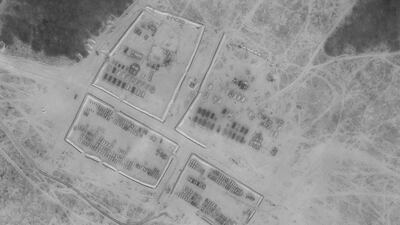
A satellite image shows a Russian battle group deployment in the Kursk Training Area, Russia, on December 21, 2021. Reuters -
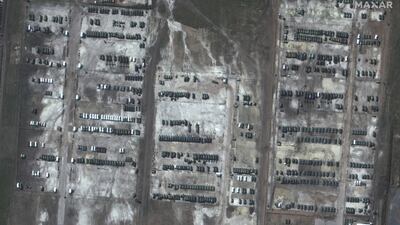
Russian forces in Soloti, Russia, on September 7, 2021. Reuters -
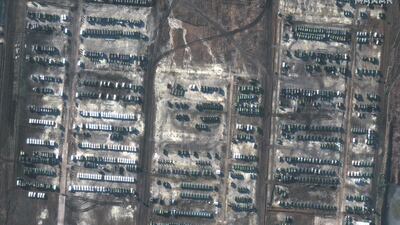
A satellite image shows Russian forces in Soloti, Russia, on December 5, 2021. Reuters -
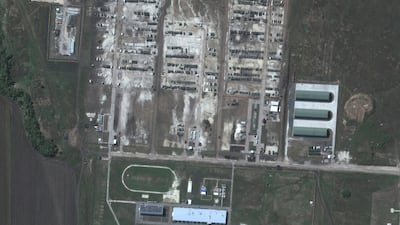
Russian forces in Soloti, Russia, on September 7, 2021. Reuters -

A satellite image released by Maxar Technologies shows Russian armoured units training in the Pogonovo Training Area near Voronezh, Russia, on November 26, 2021. Reuters -
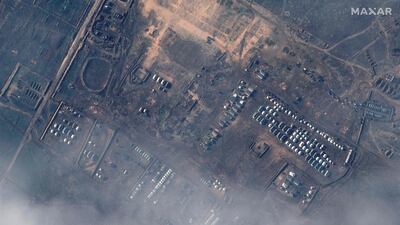
A satellite image released by Maxar Technologies reportedly shows Russian ground forces deployed at the Opuk Training Area on December 22, 2021. AFP -
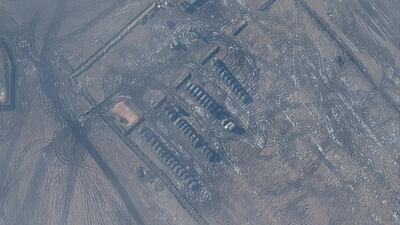
Russian ground forces deployed at the Opuk Training Area on December 22, 2021. AFP -
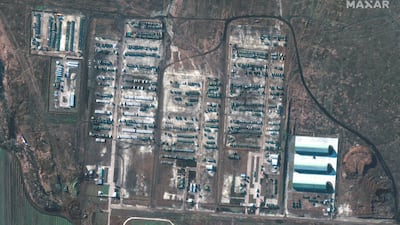
A satellite image of a Russian troop location in Soloti, Russia, provided by Maxar Technologies and taken on December 5, 2021. AP -

A Russian troop location in Bakhchysarai, Russia. AP


A senior Biden administration official said the Russian troop deployment to Belarus raises concerns that Moscow may be planning to stage troops there to stretch Ukraine’s defences with an attack from the north.
The official, who spoke on condition of anonymity to discuss sensitive issues, noted the movement may also indicate Belarus’ willingness “to allow both Russian conventional and nuclear forces to be stationed on its territory”.
Amid the tensions, Ukraine’s Defence Ministry said it was speeding up efforts to form reserve battalions that would allow for the rapid deployment of 130,000 recruits to expand the country’s 246,000-strong military.
The US and its allies have urged Russia to de-escalate the situation by calling back the troops amassed near Ukraine.
“In recent weeks, more than 100,000 Russian troops with tanks and guns have gathered near Ukraine without an understandable reason, and it’s hard not to understand that as a threat,” German Foreign Minister Annalena Baerbock told reporters on Tuesday after talks in Moscow with Mr Lavrov.
Mr Lavrov responded by restating Moscow’s argument that it’s free to deploy its forces wherever it considers it necessary on its territory.
“We can’t accept demands about our armed forces on our own territory,” Mr Lavrov said.
“We aren’t threatening anyone, but we are hearing threats to us.”
Ms Baerbock emphasised that the West was ready “for a serious dialogue on mutual agreements and steps to bring everyone in Europe more security”.
Nato Secretary General Jens Stoltenberg met with German Chancellor Olaf Scholz in Berlin on Tuesday.
He said “the main task now is to make progress on the political way forward” to prevent a military attack against Ukraine.
“Nato allies are ready to meet with Russia again, and today I have invited Russia and all the Nato allies to attend a series of meetings in the Nato-Russia Council in the near future to address our concerns but also listen to Russia’s concerns,” Mr Stoltenberg said.
He added that Nato “in the near future” will deliver its written proposals in response to Russian demands and “hopefully we can begin meeting after that”.
“We need to see what Russia says, and that will be a kind of pivotal moment,” the Nato chief said.
Mr Lavrov, meanwhile, reaffirmed that Russia wants a quick western answer to its demand for security guarantees that would preclude Nato’s expansion to Ukraine and limit its presence in Eastern Europe.
He repeated that in a phone conversation with Mr Blinken, who will visit Ukraine on Wednesday.
Speaking on a visit Tuesday to Ukraine, Canadian Foreign Minister Mélanie Joly denounced the Russian troop buildup as unacceptable.
She noted Canada’s efforts to help train Ukraine’s military, adding that it’s currently considering Ukraine’s demand to provide it with military equipment and will make “a decision in a timely manner”.
Russia annexed the Crimean Peninsula from Ukraine in 2014 after the ouster of Ukraine’s Moscow-friendly leader and also threw its weight behind a separatist insurgency that took over large sections in eastern Ukraine.
More than 14,000 people have been killed in nearly eight years of fighting there.

