


Healthcare systems across Europe are in danger of buckling under the increasing strain of Omicron, while Britain’s National Health Service has ordered staff to discharge patients where possible to free up beds.
Tens of thousands of people rushed to get booster vaccines on Monday, forming long queues outside hospitals, after Prime Minister Boris Johnson set an ambitious target to offer every adult in England a third dose by the end of the year.
Routine appointments are set to be cancelled to free up staff to get shots into arms and doctors have been told to discharge patients from hospitals to care homes, hospices, their own homes or hotels in the run-up to Christmas to make room for Omicron patients.
NHS bosses wrote to hospitals setting out the crisis plan after Mr Johnson confirmed the UK’s first Omicron death on Monday. It is understood to be the world's first recorded death from the variant but South Africa has blamed a rise in excess deaths on Omicron.
In a letter, NHS England’s chief executive, Amanda Pritchard, and medical director, Prof Stephen Powis, said the health service was facing a level-4 “national incident”.
They said patients arriving in ambulances into A&E should be moved faster so paramedics can get back on the road to attend to more emergency calls.
Nurses are being flown in from overseas to help the NHS prepare for an expected rise in hospital admissions over winter.

As many patients as possible will be diverted to private hospitals for surgery.
Mr Johnson is set to come up against a rebellion from MPs in his own party on Tuesday when the House of Commons holds a vote on his Plan B measures. Up to 80 politicians are reportedly planning to vote against the package, which includes mandatory face masks in most public indoor settings, vaccine passports for nightclubs and mass events and an order to work from home.
Dominic Raab, Justice Secretary and Deputy Prime Minister, said further restrictions were not needed to bring the infection rate down.
He said ministers believe Plan B should be sufficient over the Christmas period but did not rule out more measures being imposed.
He acknowledged that the NHS had been given a “demanding target” to offer every adult in England a booster shot in the coming weeks but said the programme was necessary to ensure the best chance of tackling Omicron.
“These issues are always discussed but we have got Plan B, that’s what we think is required over the Christmas period,” he told Times Radio.
Pressed if Christmas will be safe, Mr Raab said: “Yes, I think it is. I want to give that reassurance. I think people can look forward to spending Christmas with loved ones in a way that we couldn’t last year.”
He said 41 per cent of people in England have now had a booster shot.
Meanwhile, Norway has imposed tighter social restrictions as Prime Minister Jonas Gahr Store spoke of a "serious" situation in which the Delta variant combined with Omicron could create "a total saturation of the health system".
The country on Monday declared 958 Omicron cases, more than half of which were in the capital Oslo. The Norwegian national health authority said between 90,000 and 300,000 Covid-19 infections and up to 200 hospital admissions could become the daily reality within three weeks if measures were not imposed.
-
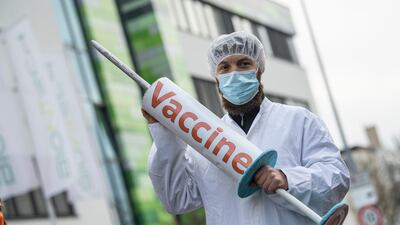
Activists demonstrate in front of the BioNTech headquarters in Mainz, Germany. AP Photo -
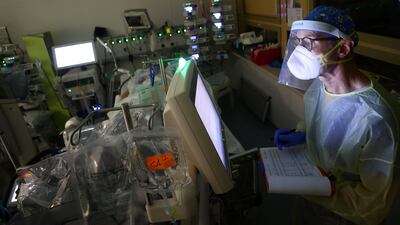
Head nurse Gunnar Goelzenleuchter hard at work at the coronavirus ICU at a clinic in Darmstadt, Germany. Reuters -

Opponents of coronavirus measures march during a demonstration near the church square in Koenigs Wusterhausen, Germany. AP Photo -
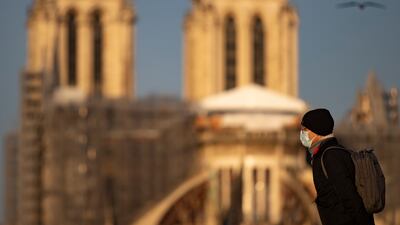
A pedestrian wearing a protective face mask walks near Notre-Dame Cathedral, in Paris. Nearly 57,000 new Covid-19 infections are being reported in France every 24 hours. EPA -

Schoolchildren wearing protective face masks play in the courtyard at a private school in Saint-Sebastien-sur-Loire near Nantes, France. Reuters -

People pay attention to health advice by wearing face masks in Paris. AP Photo -
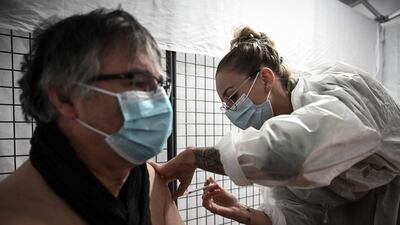
A patient receives an injection of the Moderna Covid-19 vaccine in Merignac on the outskirts of Bordeaux, south-western France. AFP -

Nurses prepare and check vaccine syringes at FieraMesse, the Bolzano trade fair centre, during a vaccination 'marathon' in Italy. Getty Images -
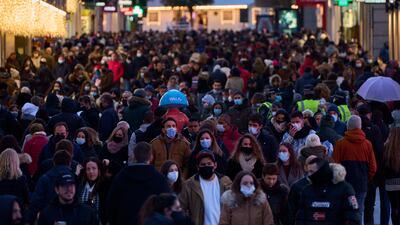
People wearing face masks in central Madrid. Spain's prime minister is urging people to 'remain prudent' over the holidays. AP Photo -
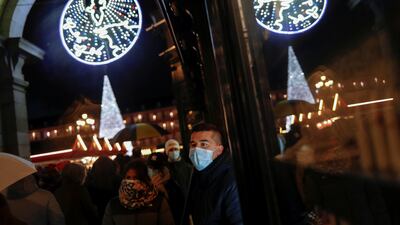
People visit a Christmas market at Plaza Mayor in the Spanish capital. Reuters -
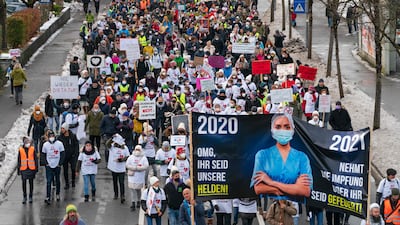
Protesters take part in a demonstration against the government's measures taken in order to limit the spread of the coronavirus, in Bregenz, Austria. AFP -
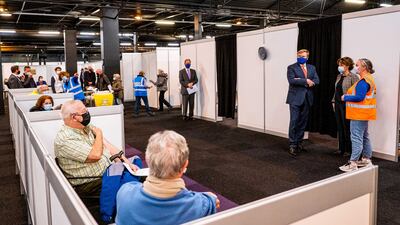
Dutch King Willem-Alexander visits a vaccination centre in Rijswijk, the Netherlands. EPA


“The situation is serious. The spread of infection is too high and we have to take action to limit this development,” Mr Store told news agency NTB.
Authorities in Denmark fear that Omicron could become the dominant Covid strain within days as the country detected 3,437 new cases on Monday.
Soren Riis Paludan, professor of biomedicine at Aarhus University, said the situation would soon be replicated in other European countries. “Denmark is a frontrunner here. We were one of the first countries to have initial spreading domestically, but other countries in Europe will see the same,” he said.
The UK has confirmed the highest number of Omicron cases in the world, followed by Denmark.
Meanwhile, France is bracing for a sixth Covid-19 wave in January due to the spread of Omicron, a leading French hospital executive has said.
Martin Hirsch, head of Paris's AP-HP hospital group, Europe's largest hospital system, said a surge of infections was around the corner, despite France having declared only 59 Omicron cases so far.
"We haven't said a word on the sixth wave, which is Omicron, which will come later in January," he told RTL radio.

