Former CIA director retired Gen David Petraeus says the US decision to withdraw from Afghanistan is ignominious. AP

Afghanistan’s ‘endless war’ will continue after US pullout, former CIA director says


Ahmed Maher
  • English
  • Arabic

The Biden administration’s decision to withdraw US troops from Afghanistan is ignominious, as it lets down the Afghans in their daily fight against their former oppressors, retired US military commander and former CIA director David Petraeus said.

“What is not clear is whether there is recognition in Washington that endless wars do not end with a withdrawal or drawdown of American involvement," Gen Petraeus said. "In the case of Afghanistan, for example, it appears that the endless war will continue and [is] quite likely [to] get worse, as already seems to be the case."

Gen Petraeus was speaking to an online seminar hosted by the Washington-based Middle East Institute to mark the launch of a book by French philosopher and rights activist Bernard-Henri Levy on Afghanistan. In the July 26 seminar, he said that the US withdrawal may result in the return of a “brutal medieval regime in which extremists once again find safe haven”.

Gen Petraeus was the commander of the International Security Assistance Force and commander of US Forces – Afghanistan from July 4, 2010, to July 18, 2011. He also headed the US Central Command. He wrote the foreword of the book, Past as Prologue: Revisiting Bernard-Henri Levy’s 2002 Report on Afghanistan.

The book is the first English translation of the report Mr Levy wrote in 2002 following his visit to Afghanistan at the request of the then French president, Jacques Chirac. He was sent to assess the conditions on the ground and determine how France could contribute to Afghanistan’s rebirth as a nation following the US-led war that was started a year earlier.

“Needless to say, return of Taliban rule would at best undermine, or at worst reverse much of the progress achieved during that time," Gen Petraeus said. "As that prospect looms, perhaps it is time to revisit what once was hoped and envisioned by revisiting Mr Levy’s report of nearly two decades ago.”

In his subsequent report, Mr Levy pressed for France to take on a key role in areas ranging from strengthening the rule of law and women’s rights to helping to restore the country’s cultural heritage.

‘Betrayal’

The pullout decision by US President Joe Biden was a "betrayal" to the people of Afghanistan, Mr Levy said at the seminar.

“It’s all the more depressing for me as an old friend of Afghanistan to see the situation, which we Afghans and westerners are facing together, I mean this withdrawal, this betrayal by America and by the West in general," said Mr Lévy, who is the author of 30 books. "It’s so sad because the progress was considerable. We were on the good road and we decided to cut it.”

A file photo of French philosopher Bernard-Henri Levy takes part in a demonstration at the Human Rights plaza in Paris on October 12, 2019. AFP

Mr Biden has strongly defended his decision to pull US military forces out of Afghanistan by the end of next month, saying the Afghan people must decide their future, rather than sacrificing another generation of Americans in an unwinnable war.

Mr Biden’s rationale centres on the argument that the US has defeated Al Qaeda and prevented another major attack on the US like the one launched on September 11, 2001.

The mastermind of that attack, Osama bin Laden, was killed in a US special operation on May 2, 2011 in Pakistan.

Dangerous Dependencies

Javid Ahmad, the Afghan ambassador to the UAE, criticised the war management in Afghanistan, saying many challenges lying ahead.

“My impression is that by looking at the positive side of the West engagement, ordinary Afghans see Afghanistan largely as a glass half full, because in the end, that's what mattered to them, Mr Ahmad said at the seminar.

"They are survivalists. But then again, Afghans are also clear-eyed about the challenges facing the country, especially right now. And so, for the vast majority of the Afghan people who believe right now that the glass is half full, it would actually matter if we're going to end up throwing the glass away altogether.”

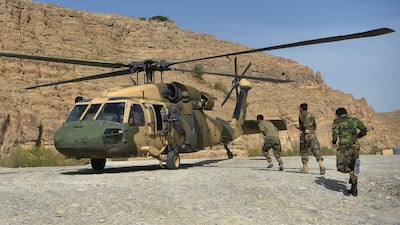
  • Afghan soldiers unload supplies from an Afghan Air Force Black Hawk helicopter at the Kajaki Dam in Kajaki, Helmand Province. Afghan legislators have voiced concerns about the ability of the military to withstand a Taliban offensive.
    Afghan soldiers unload supplies from an Afghan Air Force Black Hawk helicopter at the Kajaki Dam in Kajaki, Helmand Province. Afghan legislators have voiced concerns about the ability of the military to withstand a Taliban offensive.
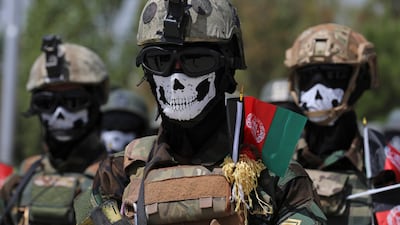
  • Afghan Army special forces personnel graduate after a three-month training programme at the Kabul Military Training Centre. The Afghan military is under increased pressure as US forces are withdrawing after almost 20 years.
    Afghan Army special forces personnel graduate after a three-month training programme at the Kabul Military Training Centre. The Afghan military is under increased pressure as US forces are withdrawing after almost 20 years.
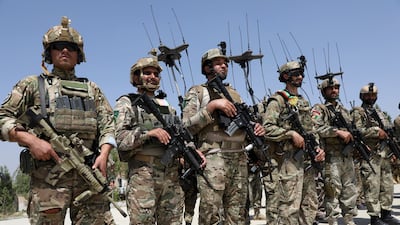
  • A graduation ceremony for Afghan Army special forces commandos at the Kabul Military Training Centre. The Afghan military is consolidating forces around cities, border crossings and vital infrastructure.
    A graduation ceremony for Afghan Army special forces commandos at the Kabul Military Training Centre. The Afghan military is consolidating forces around cities, border crossings and vital infrastructure.
  • This strategy reflects an attempt to hold provincial capitals in the face of a resurgent Taliban.
    This strategy reflects an attempt to hold provincial capitals in the face of a resurgent Taliban.
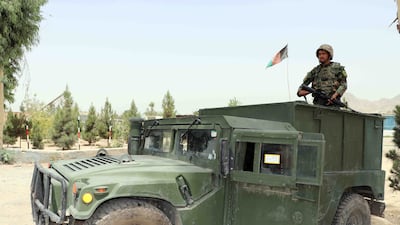
  • A member of Afghan security forces at a checkpoint in Kandahar. All US forces are due to have left Afghanistan by August 31.
    A member of Afghan security forces at a checkpoint in Kandahar. All US forces are due to have left Afghanistan by August 31.

Mr Ahmad said his country has not managed so far to overcome “dangerous dependencies” and said that warlords have become a central part in Afghanistan’s power dynamic.

“Now, I say that the word 'warlord' is a very loaded term under which, in today's context, much of the criminal activities take place, from organised crime to drug trafficking, to terrorism financing, to engaging in mafia-type politics,” he said.

Another factor the ambassador singled out as one of the obstacles to Afghanistan’s prosperity is its dependence on Pakistan.

“I would mention the very similar, very dangerous and toxic dependence on Pakistan. Now, this dependence and reliance and oftentimes over-reliance from the start of the campaign proved more dangerous than anything else, perhaps. And this is my argument, and this is perhaps the key reason for our collective failure in Afghanistan,” he said.

“Pakistan today has an organised large-scale militant force that's operating in Afghanistan. And by today, I mean how this formation has changed since President Biden has announced the withdrawal, the Afghan Taliban are just one part of that elaborate militant force,” he said.

The Taliban militants in Afghanistan have in recent weeks made advances and raised fears that the country will slide into civil war again.

Since it was announced that almost all foreign troops led by the US would withdraw from Afghanistan, Taliban have captured territories from government forces in key cities like Herat and Kandahar.

US and Nato forces toppled the Taliban from power in November 2001.

.
.
TO%20CATCH%20A%20KILLER
%3Cp%3E%3Cstrong%3EDirector%3A%20%3C%2Fstrong%3EDamian%20Szifron%3C%2Fp%3E%0A%3Cp%3E%3Cstrong%3EStars%3A%3C%2Fstrong%3E%20Shailene%20Woodley%2C%20Ben%20Mendelsohn%2C%20Ralph%20Ineson%3C%2Fp%3E%0A%3Cp%3E%3Cstrong%3ERating%3A%3C%2Fstrong%3E%202%2F5%3C%2Fp%3E%0A
MATCH INFO

Southampton 0
Manchester City 1
(Sterling 16')

Man of the match: Kevin de Bruyne (Manchester City)

Analysis

Members of Syria's Alawite minority community face threat in their heartland after one of the deadliest days in country’s recent history. Read more

In numbers: China in Dubai

The number of Chinese people living in Dubai: An estimated 200,000

Number of Chinese people in International City: Almost 50,000

Daily visitors to Dragon Mart in 2018/19: 120,000

Daily visitors to Dragon Mart in 2010: 20,000

Percentage increase in visitors in eight years: 500 per cent

Mercer, the investment consulting arm of US services company Marsh & McLennan, expects its wealth division to at least double its assets under management (AUM) in the Middle East as wealth in the region continues to grow despite economic headwinds, a company official said.

Mercer Wealth, which globally has $160 billion in AUM, plans to boost its AUM in the region to $2-$3bn in the next 2-3 years from the present $1bn, said Yasir AbuShaban, a Dubai-based principal with Mercer Wealth.

Within the next two to three years, we are looking at reaching $2 to $3 billion as a conservative estimate and we do see an opportunity to do so,” said Mr AbuShaban.

Mercer does not directly make investments, but allocates clients’ money they have discretion to, to professional asset managers. They also provide advice to clients.

“We have buying power. We can negotiate on their (client’s) behalf with asset managers to provide them lower fees than they otherwise would have to get on their own,” he added.

Mercer Wealth’s clients include sovereign wealth funds, family offices, and insurance companies among others.

From its office in Dubai, Mercer also looks after Africa, India and Turkey, where they also see opportunity for growth.

Wealth creation in Middle East and Africa (MEA) grew 8.5 per cent to $8.1 trillion last year from $7.5tn in 2015, higher than last year’s global average of 6 per cent and the second-highest growth in a region after Asia-Pacific which grew 9.9 per cent, according to consultancy Boston Consulting Group (BCG). In the region, where wealth grew just 1.9 per cent in 2015 compared with 2014, a pickup in oil prices has helped in wealth generation.

BCG is forecasting MEA wealth will rise to $12tn by 2021, growing at an annual average of 8 per cent.

Drivers of wealth generation in the region will be split evenly between new wealth creation and growth of performance of existing assets, according to BCG.

Another general trend in the region is clients’ looking for a comprehensive approach to investing, according to Mr AbuShaban.

“Institutional investors or some of the families are seeing a slowdown in the available capital they have to invest and in that sense they are looking at optimizing the way they manage their portfolios and making sure they are not investing haphazardly and different parts of their investment are working together,” said Mr AbuShaban.

Some clients also have a higher appetite for risk, given the low interest-rate environment that does not provide enough yield for some institutional investors. These clients are keen to invest in illiquid assets, such as private equity and infrastructure.

“What we have seen is a desire for higher returns in what has been a low-return environment specifically in various fixed income or bonds,” he said.

“In this environment, we have seen a de facto increase in the risk that clients are taking in things like illiquid investments, private equity investments, infrastructure and private debt, those kind of investments were higher illiquidity results in incrementally higher returns.”

The Abu Dhabi Investment Authority, one of the largest sovereign wealth funds, said in its 2016 report that has gradually increased its exposure in direct private equity and private credit transactions, mainly in Asian markets and especially in China and India. The authority’s private equity department focused on structured equities owing to “their defensive characteristics.”

Five films to watch

Castle in the Sky (1986)

Grave of the Fireflies (1988)

Only Yesterday (1991)

Pom Poki (1994)

The Tale of Princess Kaguya (2013)

Who's who in Yemen conflict

Houthis: Iran-backed rebels who occupy Sanaa and run unrecognised government

Yemeni government: Exiled government in Aden led by eight-member Presidential Leadership Council

Southern Transitional Council: Faction in Yemeni government that seeks autonomy for the south

Habrish 'rebels': Tribal-backed forces feuding with STC over control of oil in government territory

Timeline

2012-2015

The company offers payments/bribes to win key contracts in the Middle East

May 2017

The UK SFO officially opens investigation into Petrofac’s use of agents, corruption, and potential bribery to secure contracts

September 2021

Petrofac pleads guilty to seven counts of failing to prevent bribery under the UK Bribery Act

October 2021

Court fines Petrofac £77 million for bribery. Former executive receives a two-year suspended sentence 

December 2024

Petrofac enters into comprehensive restructuring to strengthen the financial position of the group

May 2025

The High Court of England and Wales approves the company’s restructuring plan

July 2025

The Court of Appeal issues a judgment challenging parts of the restructuring plan

August 2025

Petrofac issues a business update to execute the restructuring and confirms it will appeal the Court of Appeal decision

October 2025

Petrofac loses a major TenneT offshore wind contract worth €13 billion. Holding company files for administration in the UK. Petrofac delisted from the London Stock Exchange

November 2025

180 Petrofac employees laid off in the UAE

The burning issue

The internal combustion engine is facing a watershed moment – major manufacturer Volvo is to stop producing petroleum-powered vehicles by 2021 and countries in Europe, including the UK, have vowed to ban their sale before 2040. The National takes a look at the story of one of the most successful technologies of the last 100 years and how it has impacted life in the UAE. 

Read part four: an affection for classic cars lives on

Read part three: the age of the electric vehicle begins

Read part two: how climate change drove the race for an alternative 

The biog

Marital status: Separated with two young daughters

Education: Master's degree from American Univeristy of Cairo

Favourite book: That Is How They Defeat Despair by Salwa Aladian

Favourite Motto: Their happiness is your happiness

Goal: For Nefsy to become his legacy long after he is gon

Secret Nation: The Hidden Armenians of Turkey
Avedis Hadjian, (IB Tauris)
 

Tonight's Chat on The National

Tonight's Chat is a series of online conversations on The National. The series features a diverse range of celebrities, politicians and business leaders from around the Arab world.

Tonight’s Chat host Ricardo Karam is a renowned author and broadcaster who has previously interviewed Bill Gates, Carlos Ghosn, Andre Agassi and the late Zaha Hadid, among others.

Intellectually curious and thought-provoking, Tonight’s Chat moves the conversation forward.

Facebook | Our website | Instagram


The biog

Name: Salvador Toriano Jr

Age: 59

From: Laguna, The Philippines

Favourite dish: Seabass or Fish and Chips

Hobbies: When he’s not in the restaurant, he still likes to cook, along with walking and meeting up with friends.

Updated: August 02, 2021, 7:39 AM